

Car Accident Lawyer · Jonesboro, GA
Hurt in a Left Turn Crash in Jonesboro? Let's Look at Who Is at Fault.
T. Madden & Associates, P.C. has represented people hurt in Georgia crashes since 1999. Call for a free, confidential consultation with no obligation to continue.
Serving Clayton County and Georgia since 1999
1999
In practice since
5
Georgia offices: Jonesboro, Atlanta, Decatur, Macon, Augusta
By Terance Madden · Published October 17, 2026
A left turn accident can leave you asking one question first: who is at fault? But the facts of each crash decide who is responsible. Georgia also cuts your recovery by your share of fault. This page explains how that works in plain words.
What Left-Turn and Intersection Crashes Are
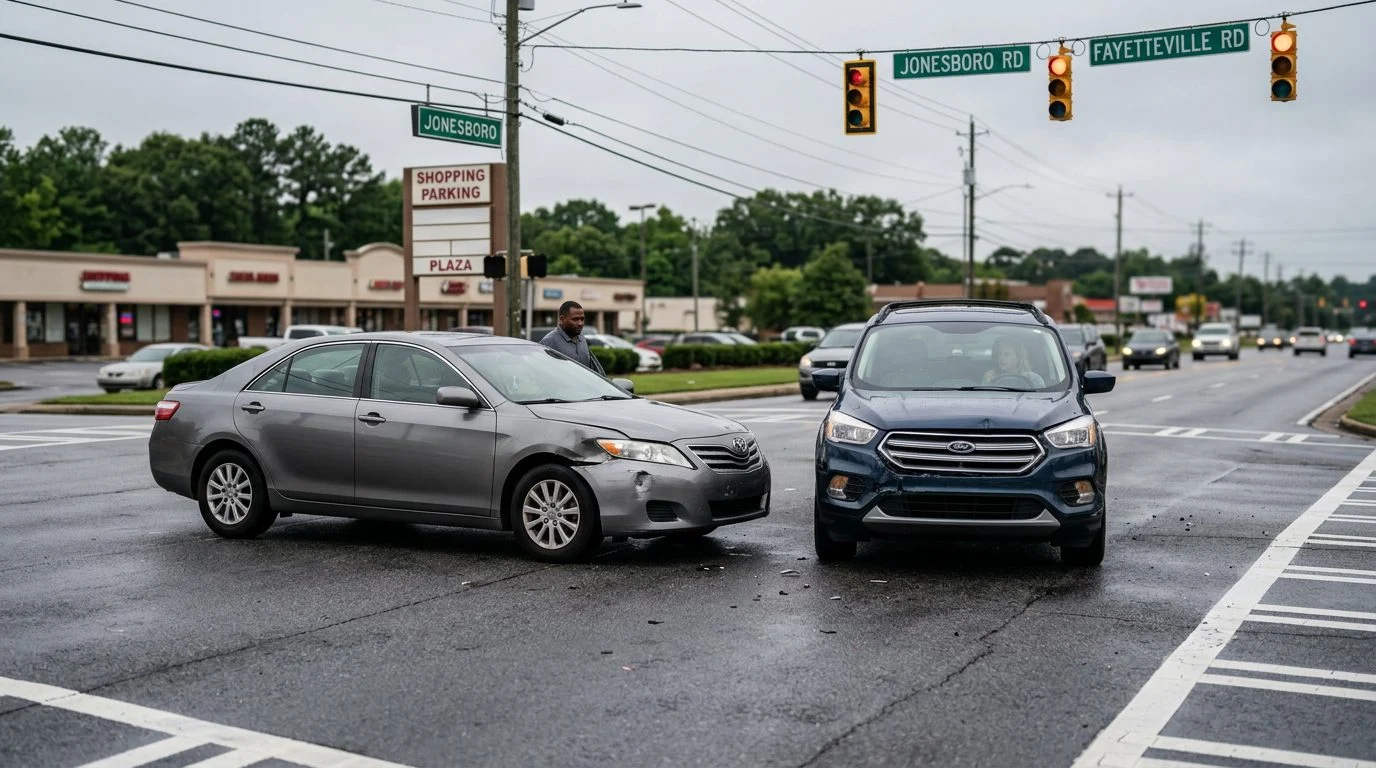
A left-turn crash happens when a driver turning left across traffic collides with a vehicle going straight through the intersection. Many of these crashes are T-bone (side-impact) collisions, where the front of one vehicle hits the side of another.
Side impacts can cause serious injuries. There is little space between the outside door and the person sitting inside. Passengers on the struck side often take the force directly.
This page is for injured drivers, passengers, and family members trying to understand fault after a crash in Jonesboro, Clayton County, or elsewhere in Georgia. You may be dealing with injuries, a damaged car, and a version of events that doesn’t match yours.
T. Madden & Associates, P.C. handles car and truck accident claims, and those claims can include intersection and left-turn collisions. Our car accident claims guide covers the wider picture.
If a left turn crash has left you hurt and unsure who will pay, our team is here to talk, free and confidentially, whenever you call. Talk it through with our team — the first consultation is free, confidential, and carries no obligation.
Who Is at Fault When a Driver Turns Left in Georgia
That duty doesn’t end the analysis. Other facts can shift blame to the oncoming driver, such as:
- Speeding toward the intersection
- Running a red light or an expired yellow
- Changing lanes without a signal
Pedestrians matter too.
A police report is a starting point. It records what the officer saw and heard. It doesn’t end the question of who is responsible.
Traffic Signals, Right-of-Way, and Following Too Closely
The color of the traffic signal is one of the first facts to check after a crash. Whether a turn had its own arrow or shared a green light with oncoming traffic is among the facts that may matter after a crash.
Following too closely can also matter, especially in a rear-end impact right at an intersection.
Write down the signal color you saw and the time of the crash while your memory is fresh.
How Georgia Divides Fault When Both Drivers Share Blame
Georgia reduces your recovery by your percentage of fault, and you recover nothing at 50 percent or more (O.C.G.A. § 51-12-33; Quynn v. Hulsey, 310 Ga. 473 (2020)). Under O.C.G.A. § 51-12-33, the judge reduces the damages in proportion to your fault. A plaintiff who is 50 percent or more responsible is not entitled to receive any damages (O.C.G.A. § 51-12-33; Quynn v. Hulsey, 310 Ga. 473 (2020)).
The rule is applied in Quynn v. Hulsey. Under O.C.G.A. § 51-12-33 (Quynn v. Hulsey, 310 Ga. 473 (2020)), when an injured person is partly responsible for the injury, the trier of fact determines that person’s percentage of fault, and the judge reduces the damages otherwise awarded in proportion to it.
Here is a simple example. Say total damages are $100,000 and the decision-maker finds you 20 percent at fault. Your award drops by $20,000, to $80,000.
Georgia’s apportionment rules under O.C.G.A. § 51-12-33 generally assign each at-fault party its own share of fault, but the statute has limits and exceptions, such as vicarious liability and parties acting in concert. Insurers often argue for a higher percentage against the injured driver. That is why fault is negotiated and sometimes decided in court.
What a Claim Covers and How the Process Works
A claim may seek medical bills, lost income, property damage, and pain and suffering. The amount depends on your injuries and the facts.
A typical claim follows these steps:
- Free consultation. You describe the crash, your injuries, and your questions.
- Records. You gather bills, the police report, photos, and repair estimates.
- Fault investigation. Signals, statements, and video are reviewed.
- Demand to the insurer. The claim is presented with supporting proof.
- Negotiation. Fault and damages are discussed with the insurer.
- Suit, if needed. A lawsuit is filed when settlement talks don’t resolve the claim.
Timing matters. Most personal injury claims in Georgia must be brought within two years after the right of action accrues, under O.C.G.A. § 9-3-33 (Cameron v. JMP Pizza, Inc. (2026)).
Terance Madden has practiced law since 1999, with offices in Jonesboro (Clayton County), Atlanta, Decatur, Macon, and Augusta. Our team includes office staff who help with records and scheduling.
The firm offers a free first consultation, which is confidential and carries no obligation to continue. It works on a no-fee-unless-we-win basis, but you may still be responsible for court costs and case expenses.
Insurance Adjusters, Statements, and Evidence That Shows Fault
Evidence that shows fault includes the police report, photos of vehicle positions and damage, video, witness contact details, and signal timing records. Damage patterns can show which vehicle was moving through the intersection.
An adjuster may ask you for a recorded statement early. Stick to facts you know. Don’t guess about speed, signal colors, or who had the right of way. A guess can be used against you later.
An adjuster’s view of fault is the insurer’s position. It is not a court ruling, and it does not decide your claim.
Before you sign any release, make sure your injuries are known. Keep medical records, repair estimates, and a written log of symptoms and missed work.
Not sure what your next step is?
Talk it through with our team — the first consultation is free, confidential, and carries no obligation.

Common Questions About Left-Turn and Intersection Crashes
Can you pull into the intersection when turning left in Georgia?
Only when it is safe.
What should you not say to insurance after an accident?
Avoid guessing about fault, speed, or injuries. Don’t sign a release before your injuries are known.
Who is at fault when both drivers share blame?
Georgia reduces your recovery by your share of fault. You recover nothing if you are 50 percent or more responsible (O.C.G.A. § 51-12-33; Quynn v. Hulsey, 310 Ga. 473 (2020)).
How long do you have to file a claim?
Most Georgia personal injury claims must be brought within two years, under state law.
If a left turn crash has left you hurt and unsure who will pay, call us anytime, available 24/7, or start a free case evaluation.
Terance Madden is the responsible lawyer for T. Madden & Associates, P.C. Contact the firm at https://www.tmaddenlaw.com/contact/. This page explains Georgia law in general terms and promises no particular result.
Common Factors in Left Turn Crashes
The Turning Driver
Questions often focus on the timing of the turn, the gap in oncoming traffic, and whether the driver checked for vehicles, motorcycles, or bicycles before proceeding.
Oncoming Traffic
Speed, distance, signal timing, and whether a driver had a fair chance to react can all shape how a crash is viewed after the fact.
Shared Blame
Drivers often point at each other. When both sides dispute fault, the details of the scene, the vehicles, and the witnesses matter.
Evidence to Preserve
Photos, the police report, dashcam footage, and the names of witnesses can help our team reconstruct what happened at the intersection.
How Our Team Can Help
Focused on Injury Claims
T. Madden & Associates, P.C. handles car and truck wrecks, motorcycle and e-bike crashes, and other injury cases, with Terance Madden leading each matter.
Review of the Facts
We look at the crash report, insurance communications, and medical records so you understand where your claim stands.
No Fee Unless There Is a Recovery
You pay no attorney fee unless there is a recovery. You may still be responsible for court costs and case expenses, which we will explain before you decide.
Free First Consultation
Your first consultation is free, confidential, and comes with no obligation to continue.
Be Careful What You Say After a Crash
Avoid guessing about fault, speed, or injuries when speaking with insurance adjusters or the other driver. Do not sign a release before your injuries are known.
Talk With Terance Madden About Your Left Turn Crash
Related practice areas
- Catastrophic Injury Car Accident Clayton County Lawyer