

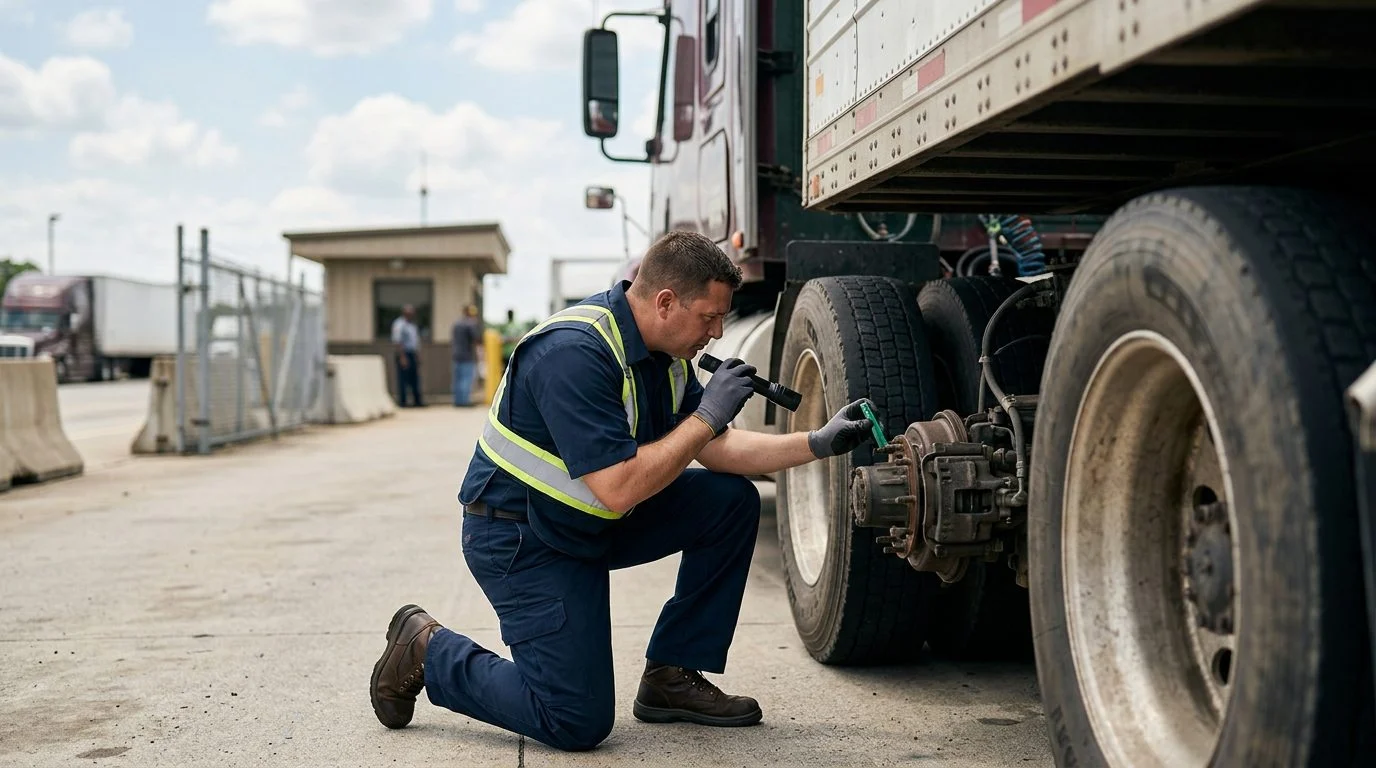
Truck crashes in Clayton County
Hurt in a Truck Crash? We Start With the Evidence That Can Disappear.
A commercial driver's test results, logs and vehicle data can decide how a claim is built. Here is how we approach them for injured people and their families.
Who we are
1999
Representing injured Georgians since 1999
5
Offices in Jonesboro, Atlanta, Decatur, Macon and Augusta
Free
First consultation, confidential and with no obligation to continue
By Terance Madden · Published November 6, 2026
After a serious truck crash, federal rules generally require the trucking employer to test the surviving commercial driver for alcohol and drugs. The rules set strict time limits, and a refusal carries its own consequences. This guide explains the truck driver drug test rules after an accident in Clayton County and metro Atlanta, in plain language, for injured people and the family members helping them.
What a Post-Accident Drug and Alcohol Test Is and Who It Applies To
A post-accident test is a breath test for alcohol and a urine test for drugs, given to a driver after a qualifying crash. The rule appears in 49 CFR 382.303 and covers commercial motor vehicles operating on public roads in commerce.
The duty falls on the employer. Each employer must test each of its surviving drivers after a covered crash. The driver does not arrange the test. The company does.
Commercial drivers hold a commercial driver’s license (CDL). The testing rules apply to the people who drive these vehicles. Under 49 CFR § 382.401, each employer shall maintain records of its alcohol misuse and controlled substances use prevention programs, and those records shall be kept in a secure location with controlled access.
This page is for people hurt by a commercial truck in Clayton County, including Jonesboro and the roads around it. It is also for family members acting for an injured person. If you are asking whether the driver was tested, you are in the right place.
If a truck crash left you or a family member hurt and the driver's testing is still unclear, our team is ready to talk, and the first consultation is free. Talk it through with our team — the first consultation is free, confidential, and carries no obligation.

When a Clayton County Truck Crash Triggers Testing
Under federal rules (49 CFR 382.303), an employer must test a surviving driver of a commercial motor vehicle for alcohol after a crash on a public road when the crash involved bodily injury to a person who immediately receives medical treatment away from the scene, and the driver receives a citation within 8 hours of the crash for a moving traffic violation arising from it. Federal law also requires a trucking employer to test a surviving driver for alcohol as soon as practicable after a crash involving a commercial motor vehicle on a public road in commerce. This applies when the driver receives a citation under State or local law within 8 hours for a moving traffic violation arising from the crash, and one or more vehicles had disabling damage that required a tow truck or other motor vehicle to take them away from the scene (49 CFR 382.303). These triggers come from 49 CFR 382.303.
The clocks start at the crash. For alcohol, the test should happen as soon as practicable. If it is not given within two hours, the employer must record why. If it is not given within eight hours, the employer must stop trying.
For drugs, the urine test has a 32-hour limit. If it is not given within 32 hours, the employer must stop trying. The employer must keep a record of the reasons.
The driver must stay readily available for testing. The rule also says nothing in it requires delaying necessary medical care for an injured person. An injured driver can get treatment first.
What the Tests Check For and What the Results Mean
An alcohol result of 0.04 or higher is a violation. A driver with that concentration cannot report for duty or stay on duty in safety-sensitive work. See 49 CFR 382.201.
A positive drug result works the same way. A driver who tests positive for controlled substances, or who adulterates or substitutes a specimen, cannot perform safety-sensitive work. See 49 CFR 382.215.
The employer cannot let that driver keep performing safety-sensitive functions once it knows the driver tested positive or adulterated or substituted a test specimen. Once the employer knows of the result, it must not permit the driver to continue.
The paper trail matters too. It must also keep documents made in decisions about post-accident tests when those records are required to be prepared. See 49 CFR 382.401. See 49 CFR 382.401.
Refusing or Failing a Test: What Happens to the Driver’s CDL
A driver who refuses a required post-accident test cannot keep doing safety-sensitive work. The employer cannot let that driver keep working either. The rule is in 49 CFR 382.211.
A driver who is not readily available for testing may be treated by the employer as having refused. That point comes from 49 CFR 382.303.
A driver who has engaged in conduct prohibited by subpart B of this part cannot drive a commercial motor vehicle until the driver meets the requirements of 49 CFR part 40, subpart O. See 49 CFR 382.503.
Getting back to work runs through that same subpart. Return-to-duty testing and follow-up testing must follow part 40, subpart O. See 49 CFR 382.309 and 49 CFR 382.311.
See 49 CFR 382.503.
How Test Records and Timing Can Matter to an Injury Claim
Test records can matter in an injury claim. Georgia’s filing deadlines keep running while you gather them. Start by writing down what you know about the crash.
- The crash report number and the date and place of the crash
- Photos of the vehicles, the scene, and any injuries
- Names and phone numbers of witnesses
- The truck company’s name and the DOT number on the truck
- Any citation details
Under 49 CFR 382.405, a driver may request copies of his or her own alcohol and drug test records in writing. The employer must promptly provide them. Release to someone else generally requires the driver’s specific written consent.
Records can also reach investigators. See 49 CFR 382.401.
Georgia’s two-year limit for actions for injuries to the person, running from when the right of action accrues, is in O.C.G.A. § 9-3-33, except as otherwise provided in this article; injuries to reputation have a one-year limit and loss of consortium actions have a four-year limit. Under O.C.G.A. § 51-12-33, a plaintiff who is 50 percent or more responsible for the injury or damages claimed may not recover any damages.
Common mistakes can hurt a claim. People wait weeks to act. They give a recorded statement to a trucking company’s insurer without advice. They post about the crash online.
Frequently Asked Questions
Does federal law require drug testing after a crash?
Under 49 CFR § 382.303, employers must test surviving drivers for controlled substances as soon as practicable after certain occurrences involving a commercial motor vehicle operating on a public road in commerce. The regulation’s post-accident table states when a test is required, and attempts to conduct a controlled substances test stop if it is not given within 32 hours. The same regulation also covers alcohol: the employer must test surviving drivers for alcohol as soon as practicable after the occurrences that its post-accident table identifies, as set out in 49 CFR § 382.303.
What drugs do they test truck drivers for?
The federal drug test covers controlled substances. The alcohol test checks breath alcohol concentration.
Does a test result decide the case by itself?
No. A result is one piece of evidence, and fault depends on the full record of the crash.
Not sure what your next step is?
Talk it through with our team — the first consultation is free, confidential, and carries no obligation.
Talk With T. Madden & Associates About Your Clayton County Crash
T. Madden & Associates, P.C. is a Georgia personal injury firm in practice since 1999. The firm represents people hurt in car and truck wrecks. It has offices in Jonesboro, Atlanta, Decatur, Macon, and Augusta. Terance Madden and Shenia Madden are the firm’s lawyers, and our team supports them.
The first consultation is free, confidential, and carries no obligation to continue. You may still be responsible for court costs and case expenses.
If a truck crash left you or someone you love hurt, and you still don’t know whether the driver was tested, you don’t have to sort it out alone. Request a free case evaluation at tmaddenlaw.com/contact, or call us, available 24/7.
This page is general information, not legal advice. Terance Madden is the responsible lawyer for this page at T. Madden & Associates, P.C. Contact the firm at tmaddenlaw.com/contact.