

Macon Lithium Battery Fire Lawyer
Hurt by a lithium battery fire in Macon? Get answers from people who look at the evidence.
Burns, smoke damage and lost belongings are hard enough. Terance Madden and the firm's Macon office help families find out what failed, and who should answer for it.
T. Madden & Associates, P.C.
1999
Year the firm began practice
5
Offices, including Macon
24/7
Call us any time
By Terance Madden · Published November 13, 2026
A battery fire can change a family’s life in seconds. If a defective lithium battery caused your injury, you may have a claim against more than one company, and Georgia sets a time limit for filing it.
The short answer: the company that made the battery or device can be held responsible when a defect causes harm, and Georgia law limits when a seller can be held liable as a manufacturer. Get medical care first. Then talk with a lithium battery fire lawyer in Macon soon, while the evidence still exists.
Lithium Battery Fires in Macon: What Injured People Face First
Lithium-ion batteries power phones, laptops, power tools, scooters, e-bikes and many vehicles. When one overheats, it can catch fire or explode, and it can happen fast.
Burns, smoke injuries and blast injuries can each mean long treatment. The bills and paperwork often arrive long before the recovery is done.
If you are the spouse, mother or adult daughter managing this, you already know the list. Appointments. Prescriptions. Bills in the mail. The phone or scooter still sitting in the house. Then comes the first call from an insurance company. You do not have to sort it all out alone.
Early steps matter. Medical records, photos and the device itself are the first proof of what happened.
T. Madden & Associates, P.C. has an office in Macon. The firm also has offices in Jonesboro, Atlanta, Decatur and Augusta, and Terance Madden has been in practice since 1999.
For the sequence of events after a battery fire, read what happens when a lithium battery catches fire.
If a burned phone, scooter or battery is still in your home, you may have a claim against the company that made it. Call or start a free case evaluation today, and the firm will review it with you. Talk it through with our team — the first consultation is free, confidential, and carries no obligation.
Who Can Be Responsible When a Battery Fails
More than one company can be responsible when a defective battery causes harm. That is the core of a product liability claim, which is a legal claim that a product was defective and caused the injury.
Under Georgia law, a manufacturer of a product sold as new can be liable to a person it injures, even without a direct contract with that person. The product must not have been reasonably suited to its intended use when sold, and that condition must be the proximate cause (the direct cause) of the injury. See O.C.G.A. § 51-1-11. Under the same statute, a claim based on a manufacturer’s liability for a defective product, or on its negligence, generally cannot be brought for an injury more than ten years after the product’s first sale; this limit does not apply to an action for negligence in manufacturing products that cause a disease or birth defect, or for conduct showing willful, reckless, or wanton disregard for life or property.
Possible parties include the battery cell maker, the device or e-bike maker, an importer, a distributor, a seller, and the maker of a charger or battery management circuit.
Georgia treats a seller differently from a manufacturer in strict liability cases. Under O.C.G.A. § 51-1-11.1, a product seller is not treated as the manufacturer in that kind of claim. So every link in the chain gets checked.
Most claims turn on one of three problems: a design flaw, a manufacturing flaw, or a warning or instruction that was missing or wrong.
Off-brand, counterfeit or repackaged cells and chargers deserve a close look. A cheaper part can change who made it, who imported it, and who put it on the market.
For the first steps after a phone or device fire, see what to do if a phone battery explodes.
What the Engineering Evidence Shows After a Battery Fire
The physical evidence shows where a fire started and whether the battery itself failed. That answer often decides who is responsible.
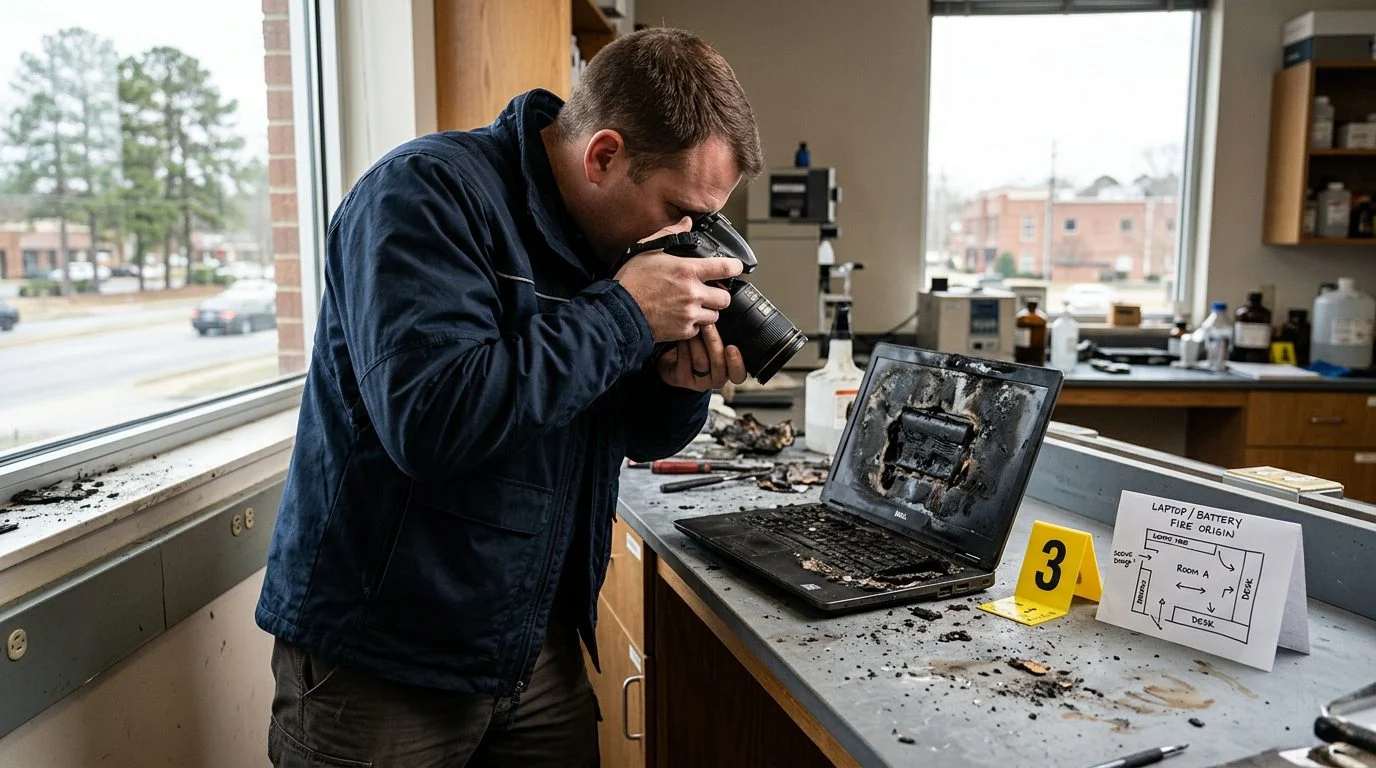
Before law school, Terance Madden trained as an electrical engineer. Terance Madden trained as an electrical engineer before he became a lawyer, so he looks closely at the evidence in each case and asks what it shows about how the crash happened. In a battery fire case, he starts by asking what the evidence shows and how the fire began.
An origin-and-cause investigation (a review of where and how a fire started) looks at burn patterns, damage to the cells, signs of an internal short (a short circuit inside the battery), the charger and its circuit, and the labels, certification marks and packaging.
Keep the device or battery. Do not charge it or try to repair it. Store it away from heat and anything that can burn. Tell the firm before anyone throws it out.
Write down what you saw and when. Save photos and medical records. Ask that the device be documented before anyone examines it.
An engineer’s review can also point to a parts maker or vendor whose cell or circuit failed. Each one may carry its own insurance, and that can add coverage to your claim.
Big Insurance Moves Fast. Your Claim Should Move Smarter.
Big Insurance is not on your side. A first offer is rarely what your claim is worth.
Expect a quick offer, often before anyone knows the full cost of the injury. Expect a request for a recorded statement, taken before you understand the harm. Expect slow payments and slow investigations. Expect disputes over whether treatment was needed. Expect arguments that the battery was misused or the damage was minor.
A claimant should not rush to accept an offer, and may negotiate for a fair settlement. See Georgia insurance claim tips.
The response is to pursue every coverage layer. That can include the liability coverage of the maker or seller, a homeowner’s or renter’s policy where it applies, umbrella and excess coverage, and uninsured or underinsured motorist coverage if a vehicle was involved.
The law separates general damages, which it presumes flow from a wrong, from special damages, which must be proved. See O.C.G.A. § 51-12-2. Medical expenses are limited to the reasonable value of medically necessary care under O.C.G.A. § 51-12-1.1.
For a lasting burn injury, a claim can include future medical care and lost earning ability. The trier of fact, the person or group deciding the case, may reduce future losses to present value under O.C.G.A. § 51-12-13.
Georgia Deadlines, Costs, and the Free First Consultation
Most Georgia injury claims must be filed within two years. Under O.C.G.A. § 9-3-33, actions for injuries to the person must generally be brought within two years after the right of action accrues, meaning when the claim arose; actions for injuries to the person involving loss of consortium must be brought within four years. See O.C.G.A. § 9-3-33.
Exceptions exist, and the deadline depends on the facts of your case.
Georgia also reduces damages by the injured person’s share of fault. Under O.C.G.A. § 51-12-33, a person who is 50 percent or more responsible for the injury cannot recover any damages.
The firm works on a no-fee-unless-we-win basis, but you may still be responsible for court costs and case expenses.
Your first consultation is free and confidential, with no obligation to continue.
Waiting costs evidence. A device can be thrown away, a scene can be cleaned up, and records can be lost.
Battery Fire Claims in Macon
If the burned phone or scooter is still in your house and the bills are stacking up, this is the time to act. Call the firm or start a free case evaluation at the firm’s contact page. The firm is available 24/7, and our team can walk you through the device, your medical care and the calls from Big Insurance.
Our Macon office can set up that first consultation.
For other battery fire injuries and product claims, see the lithium battery fire lawyer guide for Georgia.
Not sure what your next step is?
Talk it through with our team — the first consultation is free, confidential, and carries no obligation.

Frequently Asked Questions
What should I do first after a lithium battery fire at home?
Get everyone to safety, call 911, and get medical care, even if the injuries seem minor. Keep the damaged device, its charger, and the packaging, and do not repair, throw away, or plug in the battery again.
Who can be held responsible when a lithium-ion battery catches fire?
Who is responsible for a defective product depends on the facts of each case, and the firm looks at every party in the product’s chain of sale and manufacture. Under Georgia product liability law, a company can be responsible when a defective or poorly made product causes harm, and the firm can investigate who made, sold, and labeled the battery.
Can a family file a claim if a loved one died in a battery fire?
Families who have lost someone to another person’s wrongful conduct may have questions about who can bring a claim. Time limits apply, so families should contact T. Madden & Associates early.
How much does it cost to talk to the firm about a battery fire?
The first consultation is free, confidential, and comes with no obligation to continue. Call T. Madden & Associates, P.C. any time, 24/7, to start a free case evaluation.