

Motorcycle Accident Lawyer | Georgia
Hurt in a Motorcycle Crash Someone Else Caused? Know Your Insurance Options.
T. Madden & Associates, P.C. has represented people injured in Georgia since 1999. We help riders understand not-at-fault insurance claims and what steps to take after a crash.
Serving Riders Across Georgia
1999
Practicing since
5
Offices: Jonesboro, Atlanta, Decatur, Macon, Augusta
Free
First consultation, confidential and with no obligation
By Terance Madden · Published November 1, 2026
This page answers a common question: how does insurance handle a motorcycle accident that wasn’t my fault? In Georgia, the claim usually goes first to the other driver’s insurance company. Your own policy may also cover some costs.
Not being at fault doesn’t make the process simple. Several insurers can be involved at once, and each one follows its own steps. This guide walks through those steps in the order they usually happen. It gives general information for Georgia riders, and the facts of your crash shape how each step plays out.
Why a Not-at-Fault Motorcycle Crash Still Involves Insurance Companies
Several insurance companies can touch your claim, even when you did nothing wrong. Fault decides who pays, but it doesn’t remove the paperwork.
After a crash, you may be hurt and your motorcycle may be damaged. Calls from adjusters can start quickly. Often a spouse, parent, or friend ends up handling those calls, or the rider is still recovering at home. That’s a hard place to be, and it’s normal to feel overwhelmed.
Your claim may involve up to three sources of coverage: the other driver’s liability insurance, your own motorcycle policy, and sometimes health coverage. Each one has its own terms. The sections below cover who pays, what your own policy can do, rate questions, recorded statements, early offers, and what to do when the other driver has little or no insurance. Keep a simple list of every call, letter, and insurer name. It helps you stay on top of the claim.
If another driver's mistake left you hurt and your motorcycle damaged, you don't have to handle the insurance calls alone, and our team can talk your crash through with you. Talk it through with our team — the first consultation is free, confidential, and carries no obligation.
How Georgia’s At-Fault System Shapes a Motorcycle Claim
Georgia damages rules are built around fault. That’s why the at-fault driver’s insurance is usually where a not-at-fault rider’s claim begins.
Under O.C.G.A. § 51-12-33, the damages awarded to you are reduced in proportion to your own percentage of fault. Each at-fault person pays only its own share. The statute says those shares are not joint liability, and they are not subject to any right of contribution. In plain terms, one at-fault driver doesn’t pay for another driver’s share.
The same statute sets a 50 percent line. If you are 50 percent or more responsible for the injury or damages, you recover no damages (O.C.G.A. § 51-12-33; Quynn v. Hulsey (2020)). O.C.G.A. § 51-11-7 adds that a plaintiff who by ordinary care could have avoided the consequences caused by the defendant’s negligence is not entitled to recover. In other cases, the at-fault party is not relieved just because the rider contributed in some way.
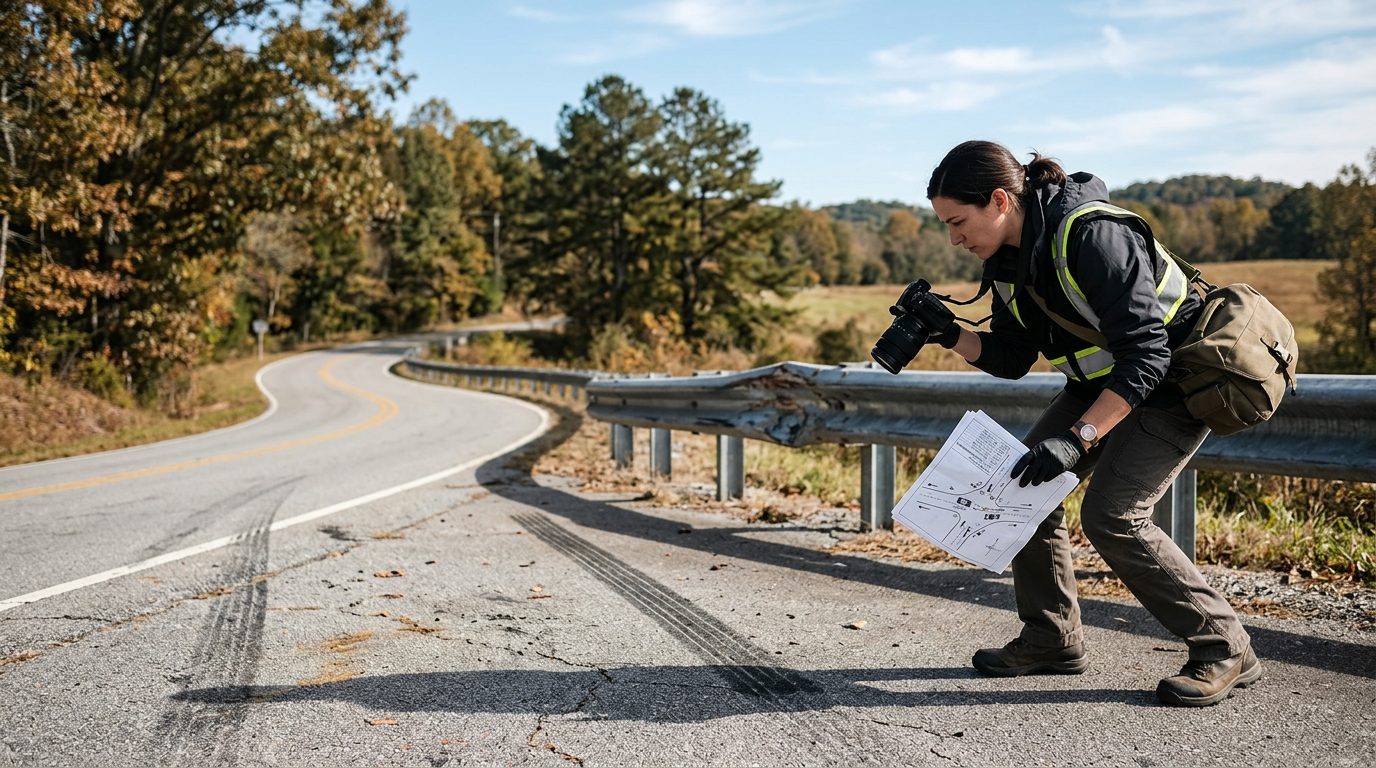
Proving the other driver’s fault is part of the claim. Useful proof often includes the crash report, witness names and phone numbers, photos of the scene and the bike, and any video from a nearby camera or dash cam. Gather these early, while the details are fresh.
Does the 50 percent rule apply to motorcycle crashes in Georgia?
Yes. Under Georgia law, a plaintiff who is 50 percent or more responsible for the injury or damages claimed recovers no damages (O.C.G.A. § 51-12-33(g)).
Working With the Other Driver’s Insurance Company
The other driver’s adjuster investigates fault, values property damage, and evaluates the injury claim. Those are three separate jobs, and each can move at a different pace.
Property damage covers the motorcycle and other property. Bodily injury covers your physical harm. Keep them separate when you talk with the adjuster, so you know which part of the claim each question relates to.
A complete claim file usually includes medical records, a repair estimate or total-loss valuation for the bike, and proof of lost income. Missing pieces can slow things down, so start collecting them early.
Medical bills need attention too. Under O.C.G.A. § 51-12-2, special damages such as medical bills actually flow from the crash and must be proved. Under O.C.G.A. § 51-12-1.1, the focus is the reasonable value of medically necessary care. If you have any form of public or private health insurance, including benefits under a governmental workers’ compensation program, that evidence must include both the amounts charged and the amounts actually needed to satisfy those charges under your insurance contract or the applicable program, whether or not the insurance has been or will be used.
Adjusters sometimes make an early settlement offer before doctors know the full extent of your injuries. A quick offer can feel like relief. Before you respond, make sure your treatment and bills are documented, so you can see what the offer would cover.
Using Your Own Motorcycle Policy When the Other Driver Is Not Covering Everything
Your own motorcycle policy can pay for some costs, depending on the coverages you bought.
Start with your declarations page, which lists your coverages and limits. Common coverages include medical payments, collision, and uninsured or underinsured motorist coverage. Ask your insurer to explain any term you don’t understand, in writing.
Collision coverage can pay to repair the motorcycle, after any deductible you chose. Your insurer may handle that repair while the other driver’s property damage claim is still open.
Medical payments coverage may help pay medical bills regardless of who caused the crash, within the policy’s terms and limits. Read those terms closely, because the limits control what it pays. Tell your insurer about the crash promptly, and keep copies of everything you send and receive.
Why Your Premium Might Change After a Crash You Did Not Cause
Insurers can consider claim history when they set premiums, and the effect varies by insurer and policy.
Many riders are surprised when a renewal rate goes up after a crash they didn’t cause. How the claim was recorded matters. Ask your insurer whether the claim was classified as at fault, not at fault, or still open. Ask for that answer in writing.
Each insurer sets rate changes under its own policy terms. Ask what changed on your renewal notice and which factors the insurer used. If an answer doesn’t match the crash report, bring the report into the conversation and ask the insurer to explain the difference.
Recorded Statements, Early Offers, and Medical Records
A recorded statement is a question-and-answer session that the adjuster records, usually by phone. It covers how the crash happened and how you were hurt.
Adjusters often ask for one early. You can ask what the statement is for and take time before answering questions about your injuries. Say what you know clearly. If you don’t know an answer yet, say so.
An early offer may come before your treatment is finished. Your medical records and bills show what care you’ve had and what it cost. Review them before accepting any payment.
A signed release usually closes the claim. Read its terms first. Ask what it covers, including whether it reaches future medical care.
Do I have to give a recorded statement to the other driver’s insurer?
You can ask what the statement is for and take time before answering questions about your injuries.
Not sure what your next step is?
Talk it through with our team — the first consultation is free, confidential, and carries no obligation.
When the Other Driver Is Uninsured or Underinsured
If the at-fault driver has no insurance or too little, your own uninsured or underinsured motorist coverage may apply.
Under O.C.G.A. § 33-7-11, Georgia auto liability policies generally must include uninsured motorist coverage. The insured can reject that coverage only as the statute describes.
Uninsured motorist coverage may help protect against vehicle damage or injuries when an uninsured driver causes the accident.
Crashes in Clayton County and Jonesboro follow the same Georgia rules as crashes anywhere else in the state. T. Madden & Associates has an office in Jonesboro. For local context, read our Clayton County motorcycle accident guide.
Talking Through Your Own Crash With T. Madden & Associates, P.C.
T. Madden & Associates, P.C. handles motorcycle accident cases, and the first step can be a conversation about your own crash.
The firm has been in practice since 1999. It handles motorcycle accident cases on a no-fee-unless-we-win basis, but you may still be responsible for court costs and case expenses. Your first consultation is free, confidential, and without obligation to continue.
The responsible attorney is Terance Madden. The firm has offices in Jonesboro, Atlanta, Decatur, Macon and Augusta.
If you’re juggling injuries, a damaged bike, and calls from insurers, reach out through our contact page and let our team talk through your crash with you. For the full picture of Georgia motorcycle claims, see our motorcycle accident lawyer Georgia guide.
Frequently Asked Questions
Whose insurance pays for my motorcycle accident if the other driver caused the crash?
After a crash, the other driver’s insurance may be one source of payment for injury and property damage claims, and how those claims work depends on the facts of each case. Your own policy may also help through medical payments or uninsured motorist coverage.
What if the at-fault driver has no insurance or not enough coverage?
Your own uninsured or underinsured motorist coverage may apply in that situation.
Do I have to talk to the other driver’s insurance adjuster?
The adjuster works for the at-fault driver’s insurance company, not for you, so be careful about giving recorded statements or signing releases before you understand your claim. T. Madden & Associates, P.C. offers a free first consultation, confidential and with no obligation to continue, where you can ask questions before you respond.
How long do I have to file a claim or lawsuit after a motorcycle crash in Georgia?
Georgia generally allows two years from the date of injury to file a personal injury lawsuit, but insurance claim deadlines can be different. Contact T. Madden & Associates, P.C. for a free first consultation, confidential and with no obligation to continue, to learn which deadlines may apply to your case.
How We Approach Your Motorcycle Accident Claim
Clear Answers About Coverage
We review the policies and claims that may apply to your crash, including the other driver's coverage and your own.
Support From Our Team
Our team keeps you informed and handles the calls and paperwork so you can focus on your recovery.
No Fees Unless There Is a Recovery
You pay no attorney fees unless there is a recovery. You may still be responsible for court costs and case expenses, and we will explain these before you decide.
Before You Speak With an Insurance Adjuster
Adjusters may ask for a recorded statement soon after a crash. Talk with a lawyer before you give one, and keep your medical records and repair estimates in one place.
What to Expect When You Contact Us
1. Tell Us What Happened
Share the basic facts of your crash and the insurance information you have so we can understand your situation.
2. Get Clear Information
We explain how not-at-fault insurance claims work in general and which coverage may be relevant to your case.
3. Decide Your Next Step
Our team walks you through your options. You decide whether to continue, with no obligation from your free consultation.