

Truck Accident Lawyer | Georgia
Hurt in a Truck Crash? Driver Fatigue May Matter to Your Claim
Logbooks, dispatch records and trip data can show whether a driver was pushed past the rules. Here is how that evidence is used, and how to start a conversation with our team.
Serving Georgia Since 1999
1999
Year the firm began practicing law
Free
First consultation, confidential, no obligation
24/7
Call availability
By Terance Madden · Published November 6, 2026
Truck Driver Over Hours of Service Crash Georgia Can I Sue?
Truck driver over hours of service crash Georgia can I sue? Hurt in a truck crash involving a driver over hours of service? The short answer is that a claim may be possible. In these cases, the key question is whether driver fatigue or an unsafe truck helped cause the crash. Whether a claim succeeds depends on the evidence, and no lawyer can promise a result. This page explains the federal rules that often come up, the records that show what happened, and how Georgia fault and deadline rules work.
Not sure what your next step is?
Talk it through with our team — the first consultation is free, confidential, and carries no obligation.

Truck Driver Over Hours of Service Crash Georgia Can I Sue? The Short Answer
A claim may be possible when a driver’s fatigue or a mechanical defect contributed to a truck crash. Three paths matter most. The driver may have been negligent by driving tired or past legal limits. The trucking company may have been negligent in how it scheduled, supervised, or maintained the truck. Equipment failure may trace back to whoever was responsible for keeping the truck safe.
Each path leads to different records. That is why one crash can support more than one kind of claim. Fatigue is also hard to see from the outside. In some cases, the records that show what happened are held by the trucking company, so early action can matter.
If you’re looking into a crash for a family member, you may be asking these questions for someone who can’t yet ask them. Many families start with one question: what was the driver allowed to do that day? The sections below answer that question and the ones that usually follow.
What Hours-of-Service Rules Require for Commercial Truck Drivers
Federal hours-of-service rules limit how long a property-carrying truck driver may drive and when the driver must rest. Under 49 C.F.R. § 395.3, except as otherwise provided in § 395.1, a driver of a property-carrying commercial motor vehicle must take 10 consecutive hours off duty before starting to drive. Subject to the same § 395.1 exceptions, that driver is also barred from driving once 14 consecutive hours have passed after coming on duty following 10 consecutive hours off duty. Under 49 C.F.R. § 395.3, a driver may drive a total of 11 hours during the period specified in paragraph (a)(2) of this section.
The rules also require a break during the driving day. Under 49 C.F.R. § 395.3, driving is not permitted once more than 8 hours of driving time pass without at least a consecutive 30-minute interruption, except for drivers who qualify for certain short-haul exceptions. Longer limits apply too. Under the same section, a driver may not drive after 60 hours on duty in any period of 7 consecutive days if the carrier does not operate every day of the week, or after 70 hours in any period of 8 consecutive days if it does.
Fatigue is its own issue. 49 C.F.R. § 392.3 says no driver may operate a commercial vehicle when fatigue, illness, or another cause makes it unsafe to do so, except in a grave emergency where compliance would increase the hazard to occupants or other highway users, in which case the driver may continue to the nearest place at which that hazard is removed. A driver who drove past these limits may have been too tired to drive safely.
How Electronic Logs and Logbooks Show Whether a Driver Was Overworked
Electronic logs and written duty records show when a driver was on duty, driving, or resting. Logs are only one source of proof. Dispatch messages, fuel receipts, toll records, and GPS data can show where a truck was and when. A case review compares those records with the log. When the log says the driver rested, but other records show the truck was on the road, that gap matters.
Timing matters too. Records can be replaced or lost over time, so a written request early on helps keep them available.
When the Truck Itself Was Unsafe: Maintenance, Inspection, and Repair Rules
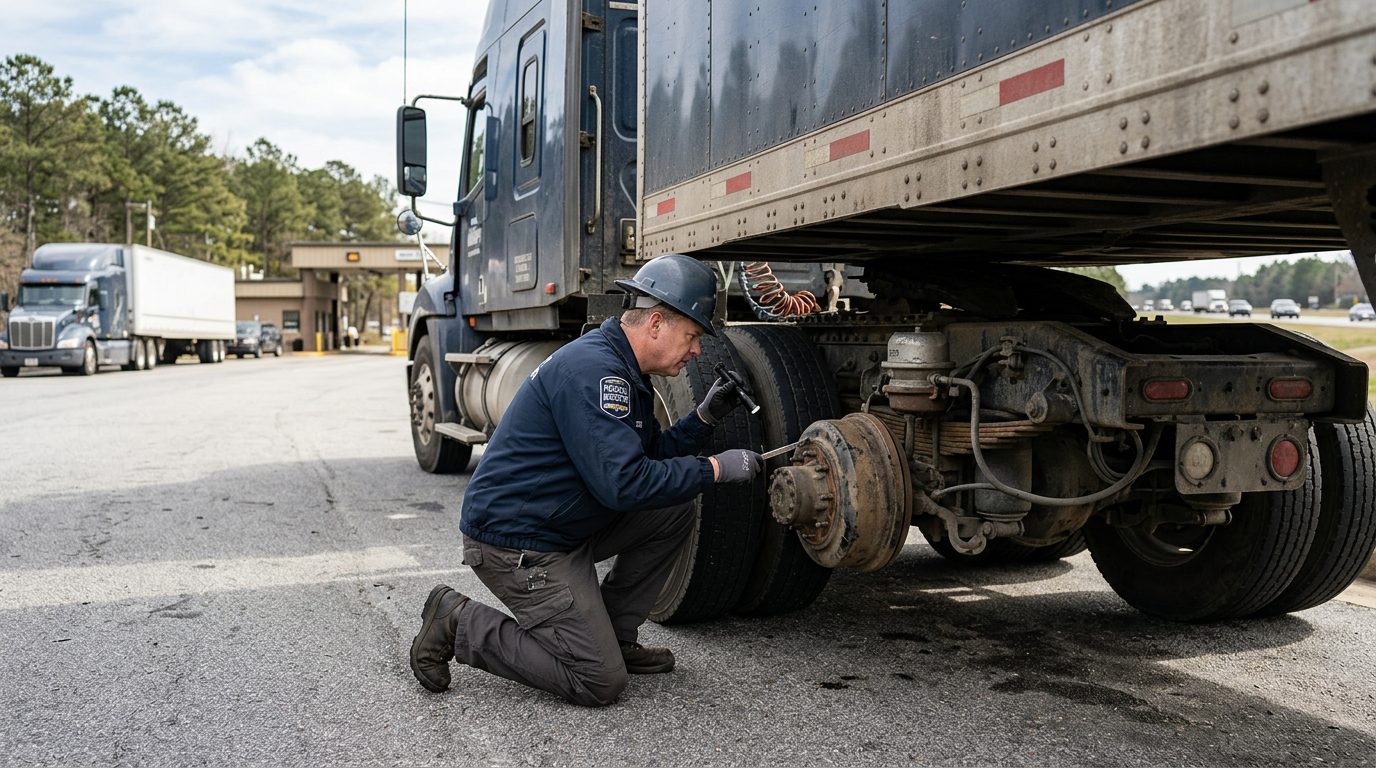
A truck’s maintenance and inspection history can show whether its parts were kept in working order. Brakes, tires, steering, lighting, and trailer coupling are equipment items that may be examined in a truck crash case. Written defect reports completed by drivers are also part of what a review looks at.
A defect written on a report and never fixed can link the equipment to a crash. A repair that was never completed is also a gap a review looks for. Maintenance records show what was done, and what was skipped.
Who Can Be Held Responsible in a Georgia Truck Crash Case
The driver, the trucking company, and other companies in the chain can all be possible defendants. Georgia law makes a person liable for torts committed by a servant by the person’s command or in the prosecution and within the scope of the person’s business. O.C.G.A. § 51-2-2 states that rule. Under O.C.G.A. § 51-2-2, a trucking company may answer for a driver’s negligence when the driver is its servant and the act is done in the prosecution and within the scope of its business, so whether this applies depends on the employment relationship and the scope of the work.
Companies may also face claims over their own decisions. A company that pushed tight schedules or ignored repeated violations may share responsibility. These claims turn on what the company knew and did.
Other parties can matter too. A truck owner or lessor, a maintenance contractor, or someone who loaded or secured the cargo may be relevant when their work contributed to the crash.
Not sure what your next step is?
Talk it through with our team — the first consultation is free, confidential, and carries no obligation.
Evidence to Preserve After a Truck Crash Involving Fatigue or Equipment Problems
Driver logs, dispatch and payroll records, and maintenance files are often central evidence. Put any request to the trucking company in writing, so there is a record of it. Ask the company to keep its logs, driver files, repair records, and inspection reports.
Key records include ELD and logbook data, dispatch and payroll records, driver qualification files, maintenance and repair logs, and written driver defect reports.
Your own evidence matters too. Photos of the truck and the scene help. So do the police report, names of witnesses, and medical records that connect your injuries to the crash. Waiting can affect the deadlines that apply to a claim. The sooner these items are gathered, the easier they are to review.
How Georgia Fault Rules and Filing Deadlines Affect a Truck Claim
Georgia reduces damages by the injured person’s share of fault, and bars recovery at 50 percent or more. O.C.G.A. § 51-12-33 says the judge reduces the award in proportion to the plaintiff’s percentage of fault. A plaintiff who is 50 percent or more responsible is not entitled to receive any damages.
Each liable person pays only its own share. Under O.C.G.A. § 51-12-33, damages apportioned among liable persons are not a joint liability.
Timing is another key rule. O.C.G.A. § 9-3-33 provides that, except as otherwise provided in this article, actions for injuries to the person shall be brought within two years after the right of action accrues, and different periods apply to some other claims, such as injuries to reputation and loss of consortium. Treat that as a deadline to plan around. How these rules apply to a particular crash is a question an early review of the timeline can help answer.

Talking With a Georgia Truck Accident Law Firm About Your Situation
A review with T. Madden & Associates, P.C. looks at the driver’s hours, the truck’s maintenance history, and the records to request. If a crash changed someone’s life, you may be trying to understand what happened while also deciding what to do next for them.
T. Madden & Associates, P.C. is a Georgia personal injury firm led by attorney Terance Madden. It has been in practice since 1999, with offices in Jonesboro, Atlanta, Decatur, Macon, and Augusta. The firm handles car and truck wrecks, motorcycle and e-bike crashes, slip and falls, nursing home abuse, medical malpractice, negligent security, and wrongful death cases.
The firm works on a no-fee-unless-we-win basis, but you may still be responsible for court costs and case expenses. The first consultation is free, confidential, and carries no obligation to continue.
Can I sue a trucking company if the driver was too tired?
Possibly. A claim may be possible when fatigue contributed to the crash, and Georgia law can hold a company responsible for its driver’s negligence within the scope of the job, under O.C.G.A. § 51-2-2.
How long do I have to file a truck crash injury claim in Georgia?
Georgia generally sets a two-year deadline for injuries to the person under O.C.G.A. § 9-3-33.
What should I save first after a truck crash?
Save the police report, photos, witness names, and medical records. Ask the trucking company in writing to keep its logs and maintenance files.
If a tired driver or an unsafe truck played a part in what happened to you or someone you love, you don’t have to sort through these records alone. Request a free case evaluation with our team.