

Car Accident Lawyer | Jonesboro and Clayton County
Hurt in a crash in Jonesboro? Start with a free case evaluation.
Terance Madden and our team listen first, then look closely at what the evidence shows about how the crash happened.
T. Madden & Associates, P.C.
1999
In practice since
5
Offices across Georgia
24/7
Call us any time
Free
First consultation
By Terance Madden · Published November 19, 2026
A serious car crash can take your health, your paycheck and your peace of mind in one afternoon. If another driver’s careless choice put you or someone you love in that spot, you need to know who pays and how fast the clock runs.
In Georgia, a person hurt by another driver can bring a claim for damages, which means money for losses. Georgia generally gives two years to file an injury lawsuit (O.C.G.A. § 9-3-33; Kenneth B. Cameron v. Jmp Pizza, Inc (2026)). Your own share of fault can also reduce what you recover.
Who This Jonesboro Car Accident Law Firm Represents
T. Madden & Associates, P.C. represents people hurt in car and truck crashes, and families who lost someone in a fatal crash. The firm has practiced since 1999. It has offices in Jonesboro (Clayton County), Atlanta, Decatur, Macon and Augusta.
The work is built for serious injuries. That means broken bones that need surgery, brain and spinal injuries, and losses that change how a person lives and works.
Often, the person managing the recovery is a spouse, a mother or an adult daughter. That person may be making appointments, sorting bills and taking insurance calls at the kitchen table. The firm knows the case is hard on the whole household, and it works with that person as a partner in the case.
Not sure what your next step is?
Talk it through with our team — the first consultation is free, confidential, and carries no obligation.
What a Georgia Car Accident Claim Can Cover
A car crash can leave you with medical bills, lost pay and changes to your daily life. The legal responsibility for the crash is called liability. Common losses include:
- Past and future medical bills, plus rehabilitation
- Lost wages and lost ability to earn in the future
- Help at home with tasks you can no longer do
- A crash can damage or destroy a vehicle, so repair or replacement costs often come up.
Georgia splits damages into two kinds. Some losses from an injury have no receipt, such as physical discomfort and emotional distress. Special damages are actual costs, like bills and lost pay, and you must prove them. O.C.G.A. § 51-12-2
When an injury is permanent, the claim has to cover the rest of your life, not just the first few months. A jury may reduce future money to present value, which means today’s worth, using a 5 percent rate or another rate it picks. O.C.G.A. § 51-12-13
Georgia also weighs fault. Comparative fault (shared blame) lowers your award by your share. Under O.C.G.A. § 51-12-33, a person who is 50 percent or more responsible cannot recover damages.
If the at-fault driver has no insurance or too little, uninsured motorist (UM) and underinsured motorist (UIM) coverage on your own policy may help.
Common Car Crashes the Firm Handles in Jonesboro and Clayton County
Many car crash claims start with a driver who made a reckless choice or failed to use care. The firm handles crashes like these:
- Rear-end crashes, often from a distracted driver or one following too close
- Intersection and left-turn crashes, where a driver did not yield
- Lane-change crashes on crowded roads
- Speeding crashes, where a driver’s pace left no room to stop
- Hit-and-run crashes, where the at-fault driver leaves the scene
O.C.G.A. § 40-6-270 If the other driver flees, UM coverage on your own policy can become the key source of recovery. Georgia also requires injury crashes to be reported right away to police or the sheriff. O.C.G.A. § 40-6-273
Hit by a drunk driver? You may have a claim against that driver. Georgia’s DUI law, O.C.G.A. § 40-6-391, makes it illegal to drive or be in actual physical control of a moving vehicle while under the influence of alcohol to the extent that it is less safe for the person to drive.
Crashes involving commercial trucks, motorcycles and e-bikes raise different issues. The firm covers those in its separate practice areas.
What Happens After You Call: The Process Step by Step
After you call, the firm starts with a free consultation. Then it builds the evidence, handles the insurer and prepares the claim as if it may go to trial.
- Free first consultation. The first consultation is free, confidential and comes with no obligation to continue.
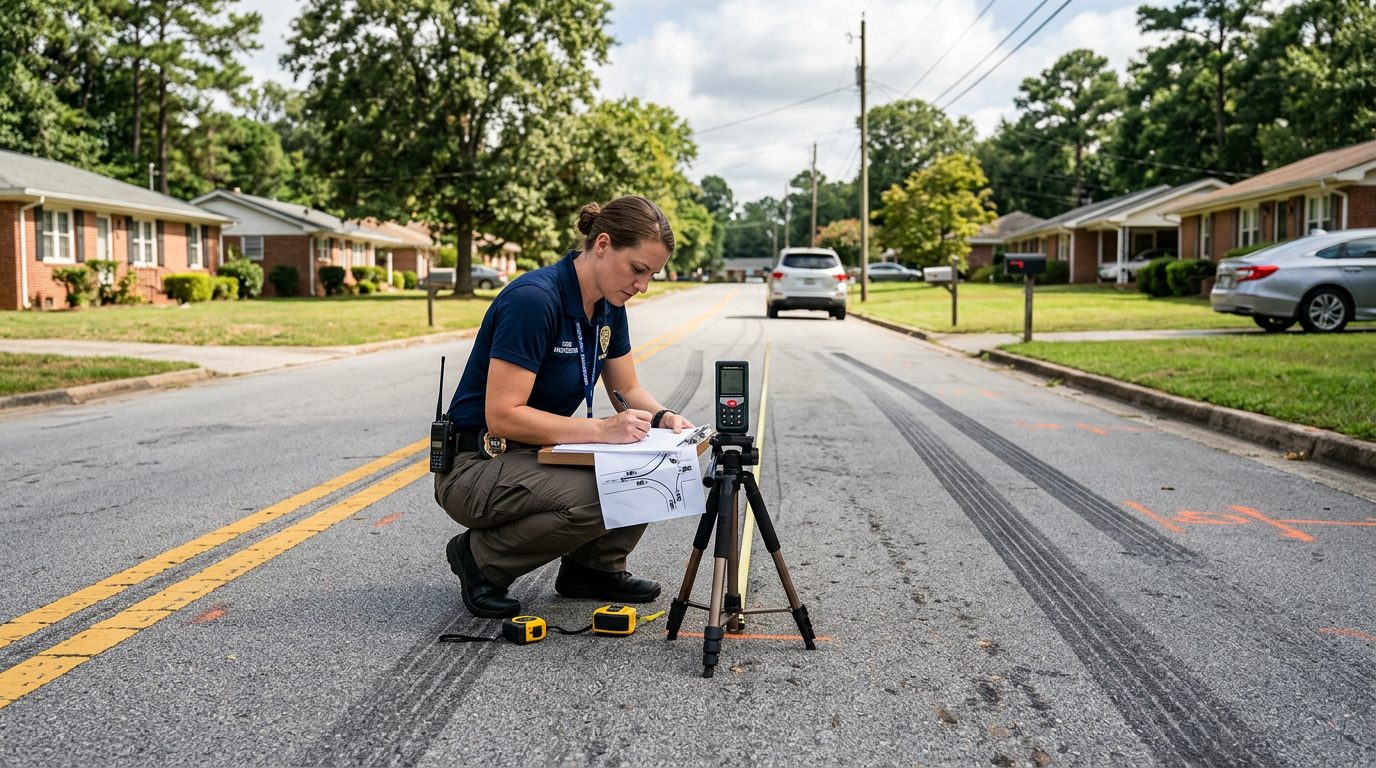
- Evidence gathering. The firm collects the police report, photos, medical records and any vehicle data. Many newer vehicles save a short record of speed and braking before a crash. That record can be lost if nobody asks for it early.
- Insurance handling. The firm handles calls and letters with the insurer, so you are not on the phone alone.
- Demand and negotiation. A demand letter (a written request for payment) lays out your injuries, losses and the amount sought. The firm then negotiates with the insurer.
- Filing suit if needed. If talks stall, the firm can file a lawsuit. Waiting too long can end the claim. O.C.G.A. § 9-3-33
The timeline depends on your injuries, your treatment and how the insurer responds.
How Big Insurance Handles Car Crash Claims, and How the Firm Responds
Big Insurance is not on your side, and its first offer is rarely what your claim is worth. The firm knows how to pursue what is owed.
Expect these tactics:
- Low offers made before the full cost of your injuries is known
- Recorded statements taken soon after the crash
- Delays and repeated requests for the same papers
- Disputes over whether your treatment was needed
- “Low impact” arguments that say the crash was too minor to cause real harm
The firm pursues every coverage layer. That includes the at-fault driver’s liability policy, your own UM or UIM coverage, any umbrella or excess policy (extra coverage above basic limits), and corporate coverage when a business or employer vehicle is involved.
Under Quynn v. Hulsey, claims for negligent hiring, training, supervision, and retention are based on the alleged negligent acts of the employer. The Georgia Supreme Court’s decision in Quynn v. Hulsey describes these employer claims as based on the alleged negligent acts of the employer, including negligent hiring, training, supervision, and retention.
Against a “low impact” argument, the firm looks at physics. Terance Madden’s engineering training helps him read crash data, including delta-V (the change in speed during impact), to test the claim.
Georgia limits medical expense claims to the reasonable value of medically necessary care. Medical expense claims are limited to the reasonable value of medically necessary care under O.C.G.A. § 51-12-1.1. Fees are paid only if the firm wins your case, under its no-fee-unless-it-wins basis. You may still be responsible for court costs and case expenses, and a medical lien (a provider’s claim against your recovery) may affect what you receive. What you keep depends on the facts of your case and your contract.
Why Clients Choose T. Madden & Associates for a Car Crash Claim
The firm’s approach is plain English, close reading of the evidence and pursuit of every insurance layer.
Before law school, Terance Madden trained as an electrical engineer. Before law school, Terance Madden trained as an electrical engineer, so he starts a case by asking what the evidence shows and how the crash happened. In a crash case, he starts by asking what the evidence shows, how the crash happened and which records must be preserved before they disappear.
The firm works on a no-fee-unless-we-win basis, but you may still be responsible for court costs and case expenses.
The firm aims for plain English, no gaps in communication, dignity for your family, and preparation as if the case may go to trial. The Terance Madden Foundation also supports community work across the firm’s service areas.
Not sure what your next step is?
Talk it through with our team — the first consultation is free, confidential, and carries no obligation.
Questions People Ask Before Calling a Car Accident Lawyer in Jonesboro
Here are short answers to common questions about Georgia car crash claims.
Should I give a recorded statement to the other driver’s insurer?
Be careful. Give basic facts, and speak with the firm before you answer detailed questions.
What should I tell my lawyer?
Tell the firm everything, including prior injuries, gaps in treatment and social media posts. The full picture protects your claim.
What if the other driver has no insurance?
Uninsured motorist (UM) coverage on your own policy may apply. Underinsured motorist (UIM) coverage may apply when the other driver’s policy is too small.
What if I was partly at fault?
Georgia reduces your award by your share of fault, and a person 50 percent or more at fault cannot recover damages. O.C.G.A. § 51-12-33 The facts decide how fault is shared.
How long do I have to file?
Georgia generally gives two years to file an injury lawsuit. O.C.G.A. § 9-3-33 requires most injury actions to be brought within two years after the right of action accrues. Acting early also protects the evidence.
If a careless driver hurt you or someone you love on a Jonesboro road, don’t wait for Big Insurance to set the terms. Call the firm today to start your free case evaluation. The firm is available 24/7 by phone.