

Car Accident Lawyer | Georgia
Other Driver Says the Crash Was Your Fault? Get Clear Answers.
T. Madden & Associates, P.C. has represented people hurt in Georgia crashes since 1999. Our team helps you respond to blame, protect your claim and understand your options. Your first consultation is free, confidential and without obligation.
Why Clients Call Us
1999
Year the firm began practicing law
5
Georgia offices: Jonesboro, Atlanta, Decatur, Macon and Augusta
24/7
Phone line available around the clock
By Terance Madden · Published October 23, 2026
If the other driver says the crash was your fault, you can still get paid in Georgia. Being blamed does not end a claim on its own. What matters is how much fault each driver carries, and Georgia law sets a firm limit you need to understand early.
You may be hurt, facing a damaged car, and taking calls from an insurance adjuster all at once. This page explains the basic rules in plain language. It is general information, not advice about your specific case.
Short Answer: Yes, a Claim Can Still Exist When the Other Driver Blames You
Yes. A claim can still exist in Georgia even when the other driver or that driver’s insurer says you caused the crash. The real question is how fault is divided among everyone involved.
Georgia uses a modified comparative fault rule. Your share of fault reduces what you can recover. The judge reduces damages in proportion to your percentage of fault (O.C.G.A. § 51-12-33). If you are 50 percent or more responsible, you cannot recover damages at all (O.C.G.A. § 51-12-33).
An insurer’s statement that the crash was your fault is a position, not a final ruling. Adjusters work for the insurance company. Their early conclusion is often the opening point in a negotiation, and it can be questioned with the facts.
If the other driver is blaming you, you may still have a claim, and our team can review the facts with you in a free, confidential first consultation. Talk it through with our team — the first consultation is free, confidential, and carries no obligation.

Fault Is the Starting Point, Not the End of the Claim
Fault is decided by the facts of how the crash happened. It is not decided by what one driver says happened. A solid claim starts with a clear picture of the crash, the traffic rules that applied, and the injuries and property damage that followed.
Georgia measures negligence by care. Under O.C.G.A. § 51-1-2, ordinary negligence is the absence of the care an ordinarily prudent person would use in similar circumstances. The question is whether each driver acted with reasonable care.
People often make a costly mistake here. They accept the first explanation because it arrives in a letter or on the phone. A written timeline and photographs can test that explanation. The insurer’s version is a claim, and claims can be checked.
Determining Who Is at Fault
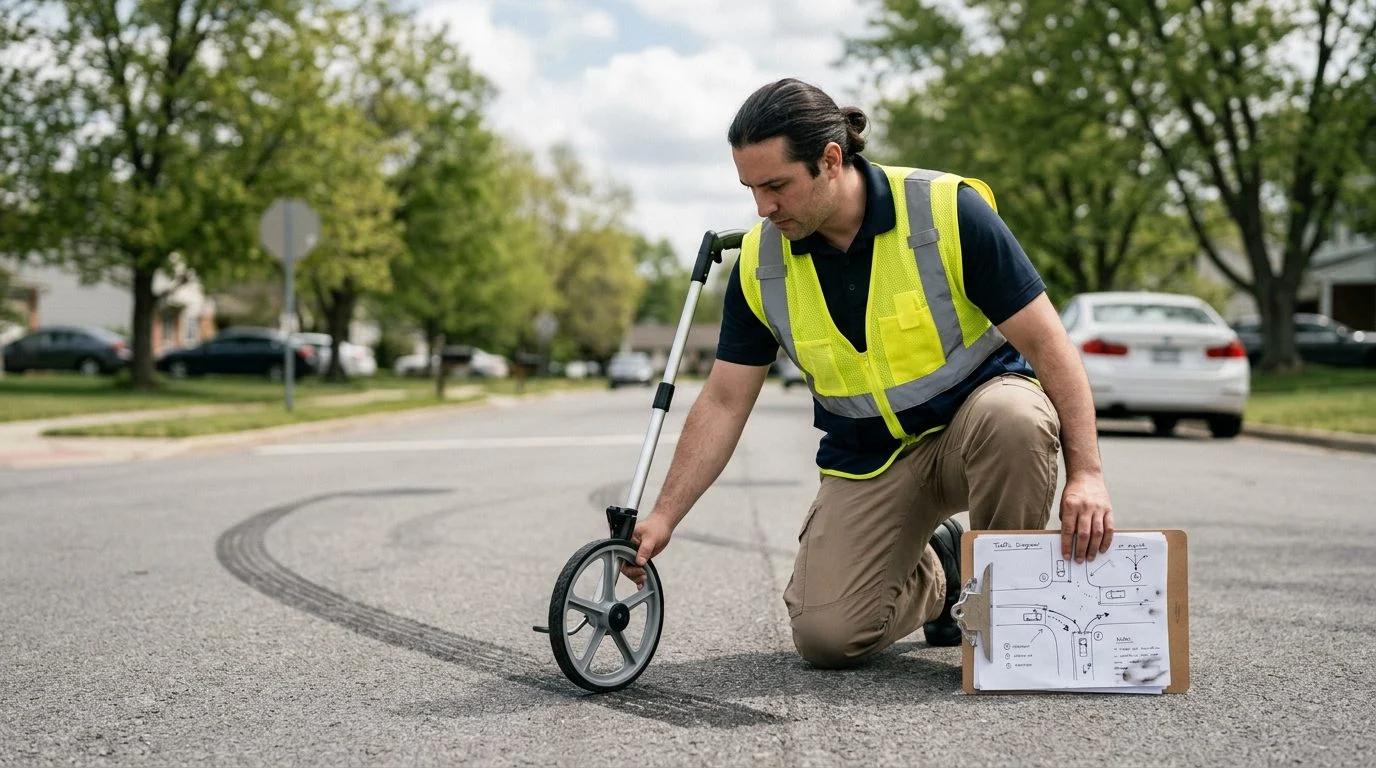
Fault is usually shown through evidence from the scene and after it. The most useful items include the police crash report, photos of the vehicles’ positions and damage, witness names and statements, video from nearby businesses or traffic cameras when available, and vehicle data.
Traffic violations matter too. Failing to yield, following too closely, and running a signal are common examples. Georgia’s Department of Driver Services explains the state’s distracted-driving and hands-free rules, which matter when phone use is part of the story.
Georgia’s crash-scene rules cover stopping, notifying law enforcement, and sharing identifying information. Those steps create records, such as contact details and a report. Those records are the starting point for sorting out fault.
When two stories conflict, physical evidence can help decide between them. Damage patterns and final vehicle positions often tell a clearer story than memory. Write your own timeline soon after the crash, while details are fresh.
Receiving Compensation When You’re Partially at Fault
You can still recover when you share some blame, as long as your share stays below 50 percent. Under O.C.G.A. § 51-12-33, the judge reduces the award in proportion to your fault.
Here is an illustration with made-up numbers, not a prediction. Suppose a trier of fact finds your damages total $100,000 and assigns you 20 percent of the fault. The award would be reduced by 20 percent, leaving $80,000. At 50 percent, the rule bars recovery altogether.
When more than one person is at fault, each pays only its own share. Under the same statute, apportioned damages are not joint liability and are not subject to any right of contribution. A second driver, a property owner, or another party can change how the percentages are assigned.
How Georgia’s Modified Comparative Fault Rule Applies Even When the Other Driver Seems at Fault
Under Georgia’s modified comparative fault rule (O.C.G.A. § 51-12-33), damages are reduced by the injured person’s percentage of fault, and a person who is 50 percent or more responsible recovers nothing. Georgia’s avoidance rule matters here. Under O.C.G.A. § 51-11-7, if you could have avoided the consequences of the other driver’s negligence with ordinary care, you are not entitled to recover. In other cases, the defendant is not relieved just because you contributed in some way.
Insurers often point to a few common issues: speed, distraction, following distance, and lane position. Each one is checked against the facts. How much fault applies depends on the facts of each crash.
Early recorded statements can shape the insurer’s file. Answer only what you know. Avoid guessing about speed, distance, or time, because a guess that proves wrong can be used to question your whole account.
Who Should Pay for Damages?
A claim against an at-fault driver is usually made against that driver’s liability insurance. Liability coverage pays for injury and property damage the policyholder causes to others.
Your own policy may still matter. Check your policy for that coverage and for medical payments (MedPay) coverage.
Some payers may have a claim on your recovery. The Medicare recovery process explains how that works.
Not sure what your next step is?
Talk it through with our team — the first consultation is free, confidential, and carries no obligation.
Property Damage and Injury Claims May Move Separately
Your vehicle claim and your injury claim often run on separate tracks. They may involve different adjusters and different timelines. A repair check does not settle the medical side. Keep medical records and vehicle paperwork in separate files.
The injury deadline comes from statute. Under O.C.G.A. § 9-3-33, actions for injuries to the person must be brought within two years after the right of action accrues, unless the article provides otherwise.
Property damage claims have their own filing clock. That clock can differ from the injury clock, so track it separately. Deadlines keep running while an insurer investigates, and waiting for a decision can cost time.
What Losses May Be Part of the Claim
A claim can include medical bills, lost income, vehicle repair or replacement, and pain and suffering. Georgia separates damages into two groups. Under O.C.G.A. § 51-12-2, general damages are presumed to flow from a wrong and can be recovered without proof of an amount. Special damages actually flow from the wrong and must be proved.
Necessary expenses from an injury are a legitimate part of the damage estimate under O.C.G.A. § 51-12-7. For medical costs, O.C.G.A. § 51-12-1.1 limits special damages to the reasonable value of medically necessary care.
Proof matters. Keep receipts for medical care, towing, storage, and rental cars. Keep records of missed work, and a simple daily journal of pain and limits. These records help show what the crash changed in your life.

Deadlines and Evidence to Save Right Now
Start saving evidence today. Keep these items in one place:
- The police report number and a copy of the report
- Photos of both vehicles, the scene, and your injuries
- The other driver’s name, insurer, and policy details
- Names and phone numbers of any witnesses
- Every insurer claim number and adjuster name
- Medical records, bills, and a written timeline
Can I still get paid if the other driver says I caused the crash?
Possibly. Georgia generally allows recovery if you are less than 50 percent at fault, with damages reduced by your share. However, under O.C.G.A. § 51-11-7, if the plaintiff by ordinary care could have avoided the consequences to himself caused by the defendant’s negligence, he is not entitled to recover.
Does Georgia have a deadline for injury claims?
Yes. Under O.C.G.A. § 9-3-33, injury actions generally must be brought within two years after the right of action accrues.
Will insurance pay if someone else wrecks my car?
Possibly. The at-fault driver’s liability coverage is the usual source, and your own policy may apply if that driver is uninsured.
T. Madden & Associates, P.C. has practiced since 1999 and has offices in Jonesboro, Atlanta, Decatur, Macon and Augusta. The firm offers a free first consultation that is confidential and comes with no obligation to continue. Cases are handled with no fee unless we win, but the client may still be responsible for court costs and case expenses.
If the other driver is blaming you right now, you may still have a claim, and you don’t have to sort it out alone. Reach out through our contact page to talk about your situation.
This page is general information, not legal advice. The responsible lawyer is Terance Madden, T. Madden & Associates, P.C.
How We Help When Blame Is Disputed
Reviewing the Facts
We look at the crash report, photos, witness information and vehicle damage to understand what happened and how the crash unfolded.
Handling the Insurance Companies
We communicate with the other driver's insurer so you do not have to face adjusters alone while fault is being argued.
Connecting Injuries to the Crash
We help document your medical care and how your injuries affect your work, life and family.
Clear Answers Without Pressure
Our team explains your situation in plain language so you can decide what to do next, with no obligation to continue.
Be Careful What You Say at the Scene
Stay calm and get medical attention if you need it. Avoid apologizing, guessing about what happened or signing anything from the other driver's insurer until you have spoken with a lawyer.
Steps to Take After the Other Driver Blames You
Get Medical Care
See a doctor even if you feel okay at first. Some injuries do not show symptoms right away, and records of your care matter.
Document the Scene
Take photos of vehicles, road conditions, traffic signs and injuries. Write down names, contact details and what witnesses saw.
Limit Recorded Statements
Be cautious about giving recorded statements to the other driver's insurance company before you understand your situation.
Call a Georgia Car Accident Lawyer
Our team can review your facts, respond to the fault dispute and explain how we handle cases. Your first consultation is free and confidential.
Facing a Fault Dispute? You Do Not Have to Sort It Out Alone.
Related practice areas
- Lost Wages 18 Wheeler Crash Georgia: Proof Guide