

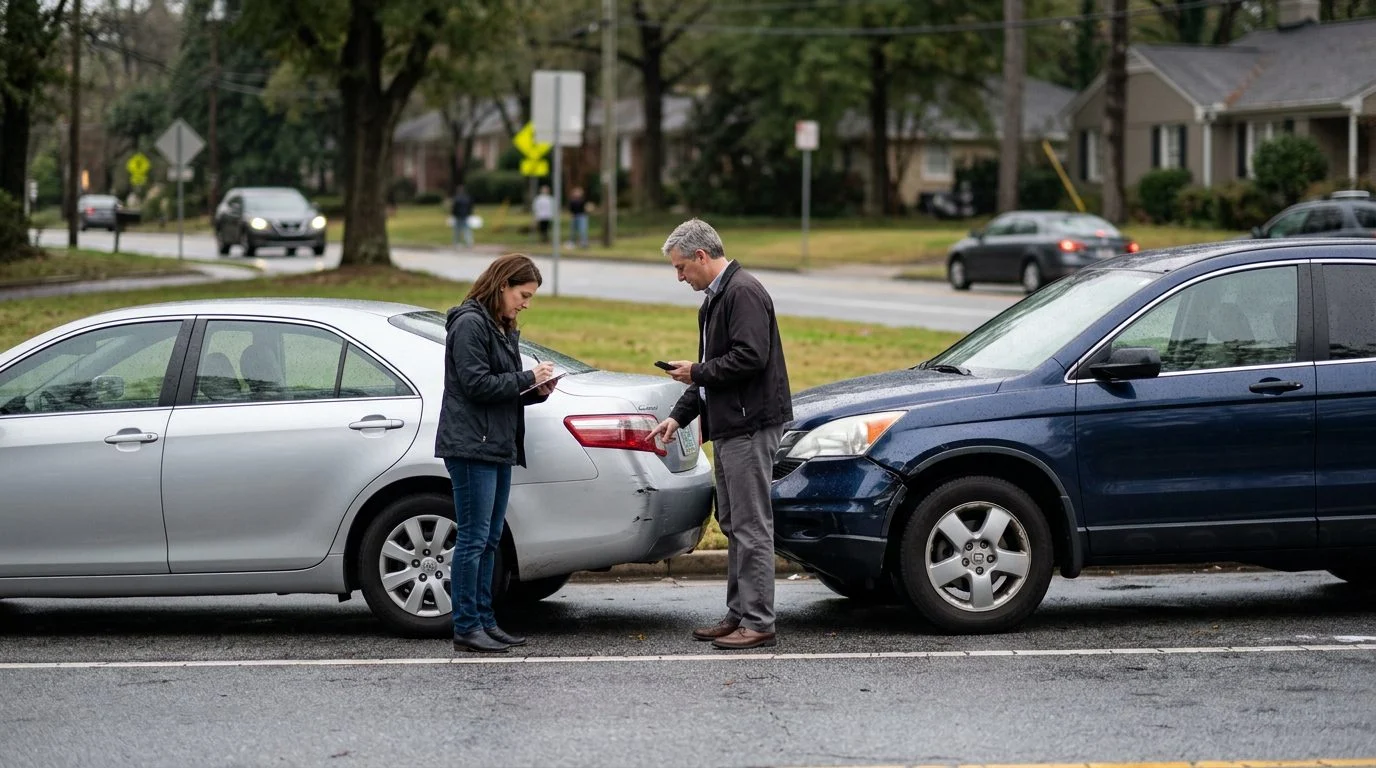
Georgia Car, Truck & Motorcycle Crashes
Think Before You Admit Fault After a Georgia Crash
A few careless words at the scene can shape the claim that follows. Learn what to say, what to hold back, and when to call T. Madden & Associates, P.C.
Serving Injured Georgians
Since 1999
Representing people hurt in Georgia
5
Offices in Georgia: Jonesboro, Atlanta, Decatur, Macon and Augusta
By Terance Madden · Published October 28, 2026
Admitting fault can hurt your Georgia injury claim. Georgia reduces what you can recover by your share of fault. Even a short, honest apology can become a point the other side uses to push that share higher.
So why shouldn’t you admit fault in an accident? Because fault is usually decided later, using the full facts. A remark made in shock can be repeated as if it were the final word.
If you’re reading this right after a crash, you may be hurt and shaken. Other drivers, police, and insurers may be asking questions before you’ve had time to think. This page is general information about Georgia car accident claims. It is not advice about your crash.
What Counts as Admitting Fault
Admitting fault means saying or signaling that you caused the crash. A direct statement counts. So does an apology like “I’m sorry, I didn’t see you.” Agreeing with the other driver’s account counts too, and so does signing a form that describes the crash.
Fault is about how the crash happened. Answering that usually takes the police report, photos, witness accounts, and sometimes video. A driver standing on the shoulder minutes after impact has only part of the picture. An early guess about blame can be incomplete or wrong.
Short, emotional remarks are the ones that get repeated. A few seconds of shock can end up in a report, an email, or a later call with an adjuster. Passengers and family members should be careful too. A passenger who says “he was going way too fast” has made a statement about fault.
If you're replaying what you said after a crash, you don't have to sort it out alone. Our team offers a free, confidential first consultation with no obligation to continue. Talk it through with our team — the first consultation is free, confidential, and carries no obligation.
How Georgia Divides Fault
Georgia uses a shared-fault rule. Your damages are reduced by your percentage of fault, and you recover nothing if you are 50 percent or more responsible. Under O.C.G.A. § 51-12-33, the trier of fact (the person or group who decides the facts) sets the injured person’s percentage. The judge then reduces the award in proportion to it.
Under Georgia law, a plaintiff’s damages are reduced in proportion to the plaintiff’s percentage of fault, and a plaintiff who is 50 percent or more responsible for the injury or damages claimed cannot recover damages (O.C.G.A. § 51-12-33). Under O.C.G.A. § 51-12-33, the judge reduces the damages otherwise awarded to a plaintiff in proportion to the plaintiff’s percentage of fault, and the plaintiff is not entitled to receive any damages if the plaintiff is 50 percent or more responsible for the injury or damages claimed.
Why does a small admission matter? Each percentage point changes the math. As a simple example, not a prediction, suppose a claim were valued at $100,000. If the fact-finder assigned 20 percent fault to the injured person, the award would drop by $20,000.
Georgia defines ordinary negligence as the absence of the care an ordinarily prudent person would use in similar circumstances. See O.C.G.A. § 51-1-2.
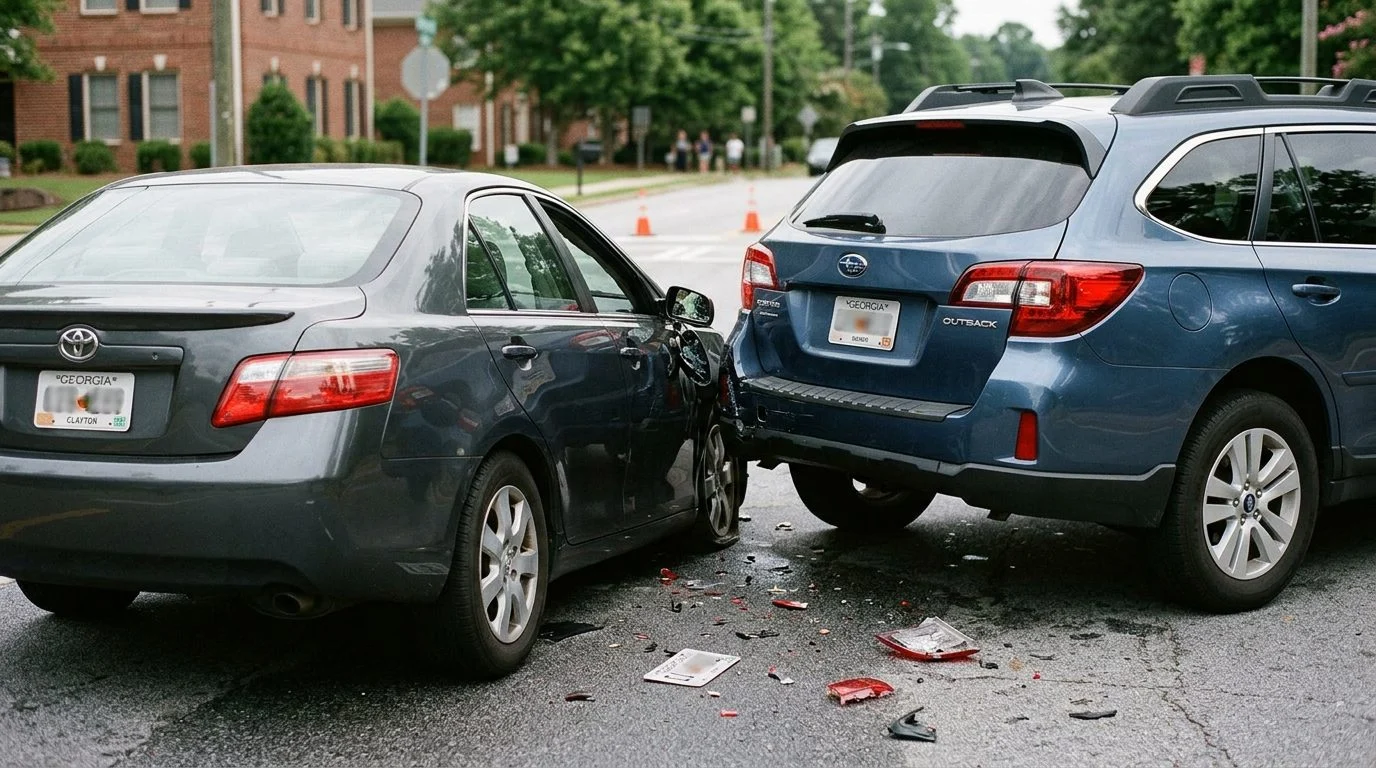
A common question is who is usually at fault when a car hits the back of you. The Georgia Department of Driver Services lists tailgating as aggressive driving, and that conduct can matter when fault is assigned in rear-end crashes. Sudden braking, lane changes, and signal problems can also matter. The answer still depends on the facts.
Statements at the Scene and to Police
Stay calm, check on everyone, and share basic facts. Give your name, insurance details, and license plate number. You don’t need to explain who caused the crash.
Facts and conclusions are different. “The light was green for me, and the other car came from the left” describes what you saw. “I ran the red light, it’s my fault” is a conclusion. Stick with facts. Say “I’m not sure yet” when you don’t know.
Gather evidence without making an admission. Take photos of the vehicles, where they came to rest, skid marks, road conditions, signs, and the weather. Write down witness names and phone numbers. The Georgia auto claim tips list these steps, along with notifying police and your insurer and avoiding statements about fault.
Ask the officer for the report number. The police report is a record you can check later against what you remember.
Should You Contact Your Insurance Company if You Are Not at Fault?
Yes, you should report the crash to your own insurer promptly. A recorded statement to the other driver’s insurer is a separate step. Georgia’s insurance regulator lists prompt notice to police and your insurer among its auto-claim steps.
Your own insurer is the company you pay. The other driver’s insurer’s adjuster works for the other side of the claim. Anything you say can be used to question your account, dispute your injuries, or shift blame onto you.
You don’t have to give a recorded statement the moment someone asks. “I need time to review the facts before I answer” is a reasonable reply. A statement that conflicts with the police report or later medical records can lead to disputes and delays. Review the report before you describe events.
Read your policy’s notice requirements early. Knowing what your policy asks you to report, and when, is a sensible first step.
Text Messages, Social Media, and Recorded Statements
Texts, posts, and recorded statements about a crash can be read back to you later. Treat each one as if it will be read by someone you don’t know.
A text to a friend, a comment on a community page, or a story post can be saved, shared, or screenshotted. Group chats can reach people you never meant to tell. Assume anything written about the crash will be read later.
Avoid posting photos of the damage with captions, apologies, or jokes. Don’t discuss fault in group chats. And don’t text while you drive. The Georgia Department of Transportation says texting while driving impairs attention and reaction ability.
A recorded or written statement given without preparation can be used in later steps. Those steps can include written questions and depositions, which are sworn testimony given before trial. That’s why careful wording matters.
Practical Steps for Communicating After an Accident
Describe what you saw and felt in plain words, and leave out guesses about speed or blame. That approach keeps your account accurate and easy to check.
- Describe what you saw, heard, and felt, in the order it happened.
- Skip guesses about speed, distance, or who should have braked.
- Don’t sign anything you haven’t read.
- Keep copies of every letter, email, and claim number.
- Write down the date, time, and name of each call.
Useful replacement phrases include “I’m glad you’re okay,” “I’m not sure yet what happened,” and “I need time to review the facts.” Each one is honest and doesn’t assign blame.
Keep records in one folder. That folder should hold the police report, medical visit notes, bills, and insurance letters. Organized records make it easier to see how the crash and your injuries are documented.
Not sure what your next step is?
Talk it through with our team — the first consultation is free, confidential, and carries no obligation.
Talk With a Georgia Car Accident Lawyer Before You Say More
If you’ve already said something at the scene or in a text, you still have options. Wording can be reviewed, and what you say next is still in your hands.
You may be dealing with a crash you didn’t choose, questions from people who want a quick answer, and a decision about what to say to an insurer. That’s a lot to carry while you may still be hurt.
T. Madden & Associates, P.C. has been in practice since 1999, with offices in Jonesboro (Clayton County), Atlanta, Decatur, Macon and Augusta. Our team can talk through your crash with you during a free, confidential first consultation with no obligation to continue.
Common questions
Why shouldn’t you admit fault in an accident?
Georgia reduces your recovery by your share of fault, so an admission can raise that share. Describe facts and leave conclusions to the full record.
What should you say to police after a crash?
Share your name, insurance details, and what you saw, such as the signal and the lanes. Skip who caused it.
Is it okay to say “I’m sorry” after a crash?
Choose words that show concern without sounding like blame. “I’m glad you’re okay” is one option.
This page is general information, not legal advice. Responsible lawyer: Terance Madden, T. Madden & Associates, P.C. Contact the firm through its contact page.
Why Careful Words Matter
Protect Your Account
Statements made in the first minutes can be repeated later by insurers and other parties, so stick to what you directly saw and felt.
Describe Facts, Not Conclusions
Say where you were, what the signal showed and how the vehicles moved. Leave the question of who caused the crash to the full record.
Focus on Your Health
Symptoms can appear hours or days later. Tell medical providers everything that hurts, even if it seems minor.
Be Courteous, Not Apologetic
You can be kind to the other driver and still avoid saying you were at fault.
Watch Out for Quick Apologies
"I'm sorry" and "I didn't see you" can be heard as admissions. Before you give a recorded statement to any insurance company, talk with a lawyer about what to say.
What to Do Instead at the Scene
Share Basic Information
Exchange names, contact details, insurance information and license plate numbers with the other driver.
Describe What You Saw
Note the weather, road conditions, traffic signals and lane positions, and write down what you remember while it is fresh.
Gather Evidence
Photograph vehicles, damage, skid marks and the surrounding area, and collect names of any witnesses.
Call a Lawyer Early
A consultation can help you understand how to handle insurance contacts before you say more about the crash.
Not Sure What You Should Have Said?
Talk With Us First. Your First Consultation Is Free, Confidential and Comes With No Obligation to Continue.