

Crash Injuries | Georgia
Hurt Your Back in a Georgia Crash? Learn What Drives a Herniated Disc Settlement
Talk with the firm about your back, your bills and your work before you respond to any offer.
About T. Madden & Associates, P.C.
1999
Year the firm began practice
5
Offices across Georgia
Free
First consultation, confidential and with no obligation
By Terance Madden · Published November 12, 2026
If a herniated disc followed a crash, you’re probably asking one question: what is it worth? Here’s the direct answer. There is no single average settlement for a herniated disc caused by a motor vehicle crash (MVA) in Georgia.
A herniated disc means the soft cushion between two spine bones has pushed out of place. It can press on a nerve. Many families first learn this in a hard week, with bills piling up and a loved one who can’t sleep. Here is what really sets the value, and what to do now.
Why there is no single average for a herniated disc settlement
No single average sets the value of a herniated disc claim. Published ranges come from other people’s cases. Those cases differ in the injury, the treatment, the insurance and the facts. Some sites post wide ranges and say they are averages drawn from other claims. An average from a stranger’s file doesn’t tell your family what your file is worth.
A claim is built from its own records. The medical chart, the imaging, the bills, the work history and the proof of who caused the crash all count. Two people with the same diagnosis can have very different claims. One may need a spinal procedure. The other may be back at work in a few weeks.
Think of a published range as a weather report for another town. It may be close. It may miss your street entirely. That is why the first step is to gather the records, not to pick a number off a website.
If a family member's back and legs changed after a crash someone else caused, you don't have to sort out the insurance calls alone, and we can talk through the facts with you. Talk it through with our team — the first consultation is free, confidential, and carries no obligation.

What a herniated disc is and why it is a serious injury after a crash
A herniated disc becomes a serious injury when it changes how a person lives. The disc is the cushion between the bones of the spine. In a hard impact, that cushion can push out and press on a nearby nerve.
When the nerve is pressed, the person may feel pain, numbness, tingling or weakness that runs into an arm or a leg. Some people feel it when they sit, bend or lift a grocery bag. Others can’t stand through a full shift. Those limits are part of the injury, and they belong in the claim.
Doctors often use an MRI (magnetic resonance imaging, a scan that shows soft tissue) to confirm a disc problem. The scan matters, but the doctor also looks at symptoms and when they began. The crash story and the medical record have to match. If they don’t, the other side will argue the disc problem came from something else.
You may also hear the words “bulging disc.” Insurers sometimes argue a bulge is minor. The chart and the symptoms decide what it means for the case.
What drives the value of a herniated disc car crash settlement
Four things drive the value most: the bills, the time away from work, the long-term effects and who is at fault.
Economic damages are the losses you can count, like medical bills and lost pay. Non-economic damages cover pain and limits on daily life. Under O.C.G.A. § 51-12-2, general damages are those the law presumes flow from a tortious act (a wrongful act that causes harm), while special damages must be proved.
O.C.G.A. § 51-12-1.1 limits medical expense damages to the reasonable value of medically necessary care.
Treatment matters. Some people improve with conservative care, like physical therapy, medication and rest. Others need injections or surgery such as a discectomy (surgical removal of part of the disc). Each step adds to the record. A long gap in treatment gives the other side a reason to argue the injury wasn’t serious. Steady follow-up keeps the record clear.
Lifetime damages describe the long view: future care, lost earning power and the daily life the injury takes away. Under O.C.G.A. § 51-12-13, a fact-finder may reduce future economic losses to present value (today’s dollars), using a 5 percent discount rate or another rate it finds right.
How the crash evidence shapes the case
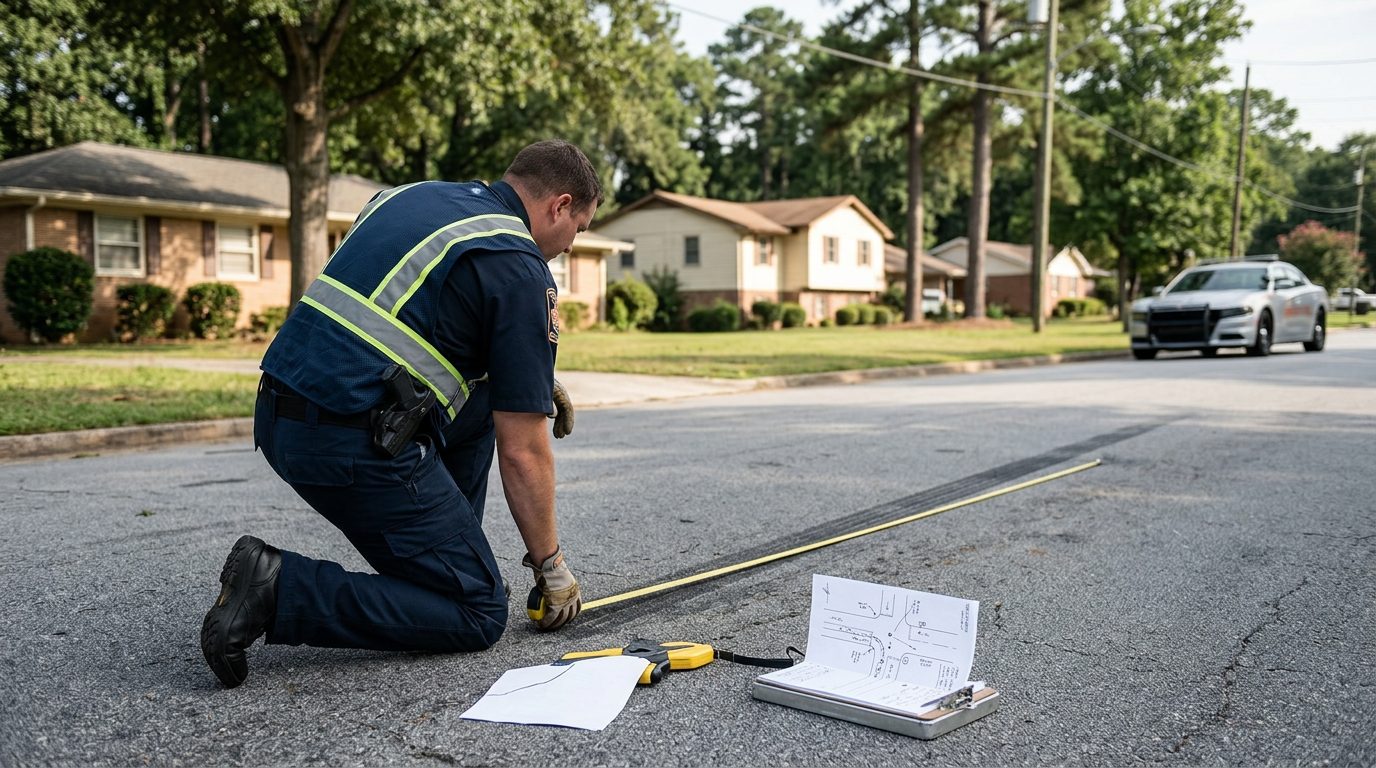
Crash evidence shows how the impact happened, and that shapes how the medical records are read.
Before law school, Terance Madden trained as an electrical engineer, so he starts a case by asking what the evidence shows and how the crash happened. Before he works on a claim, he asks what the evidence shows and how the crash happened. That habit matters in a spine case, because the medical story has to fit the physical one.
Crash physics asks how fast each vehicle was moving, which way it hit and how much force reached the body. Engineers call the change in speed during impact delta-V. It is a plain measure of how hard the body was pushed. Photos of the damage, the crash report and speed information help show it.
Many newer vehicles also record data around a crash in an event data recorder (a box that saves speed, braking and throttle for a short window). That data can show whether a driver braked hard or stayed on the gas. Reading it takes care, and the records must be preserved before they are overwritten.
Big Insurance often calls a crash “low impact” to argue a person couldn’t have been hurt. A low-speed hit can still load the spine, depending on the body and the seat position. Physics and data answer that argument with proof, not opinion.
How Big Insurance approaches a herniated disc claim
Big Insurance is not on the injured person’s side, and its job is to pay as little as it can. An insurer’s first offer is rarely what a claim is worth.
Expect a few common tactics. A fast, low offer often arrives before treatment ends. A recorded statement may be requested early, when the injured person is on pain medicine and hasn’t reviewed the chart. Payments and decisions get delayed. Treatment gets disputed as unneeded, or the bills get called unreasonable. And the “low impact” argument shows up.
Give a recorded statement only with guidance. Words said in the first days can be pulled out later and used to shrink the claim.
Georgia sets rules for written settlement offers on motor vehicle claims. Early in a claim, an offer prepared with an attorney’s help must be in writing. Under O.C.G.A. § 9-11-67.1, it must give the recipient at least 30 days to accept when sent by certified mail or statutory overnight delivery. It must also include medical or other records sufficient to evaluate the claim.
Read every offer slowly, and check its deadline against the calendar.
What the firm pursues: every layer of insurance and the full value of the claim
The firm looks at every layer of insurance that could pay, not just the first policy someone mentions.
The at-fault driver’s liability coverage is the first layer. Uninsured and underinsured motorist coverage (UM/UIM) on the injured person’s own policy is another. Georgia law requires many auto policies to include provisions that pay the insured for bodily injury caused by an uninsured motor vehicle’s owner or operator, under O.C.G.A. § 33-7-11.
Umbrella and excess policies can add coverage above the primary limits. O.C.G.A. § 33-7-11 reads: “The coverage required under paragraph (1) of this subsection excludes umbrella or excess liability policies unless affirmatively provided for in such policies or in a policy endorsement.” A business vehicle or company may carry corporate coverage. Under Quynn v. Hulsey, an employer that admits responsibility for its driver can still face claims for its own negligent entrustment, hiring, training and supervision.
If the policy has medical payments coverage, it can help with early bills.
The firm pursues the full lifetime cost of the injury, not just the bills to date. It builds each claim as if it will go to trial. The firm reviews the evidence before it discusses a first offer. A settlement is one possible result, and every case turns on its own facts.
Not sure what your next step is?
Talk it through with our team — the first consultation is free, confidential, and carries no obligation.
Georgia rules that affect a herniated disc claim
Georgia’s filing deadline and fault rules shape every herniated disc claim.
Generally, O.C.G.A. § 9-3-33 requires an injury lawsuit to be brought within two years after the right of action accrues. Some exceptions apply, so the date should be checked early and not guessed at.
O.C.G.A. § 51-12-33(g) sets a hard line: a plaintiff found 50 percent or more at fault cannot recover damages. If the plaintiff is 50 percent or more responsible for the injury, the plaintiff is not entitled to receive any damages (O.C.G.A. § 51-12-33; Quynn v. Hulsey (2020)).
The jury must also consider the fault of a person who contributed to the injury but is not a party to the case, but only in limited situations: when the injured person settled with that nonparty, or when a defendant gave notice at least 120 days before trial that the nonparty was wholly or partially at fault, under O.C.G.A. § 51-12-33(d)(1). Each at-fault party pays only its own share. That is why fault gets argued so hard in every case.
What the family member managing the recovery can do now
The person managing the recovery can protect the claim now by keeping one file, every appointment and every paper.
Start a folder. Keep the crash report, photos, medical bills, prescriptions, work-absence notes and a short daily log of pain and limits. Write down what each day’s activities look like. The log shows the injury in real life.
Keep every appointment. Tell the treating doctor about each symptom, even the small ones. Ask for copies of records as they arrive. Write down the name of each insurance representative and the date of every call.
Don’t sign a release or accept a check until you understand what it covers. A release can end a claim for good.
Keep the injured person in the room. Decide together who speaks to insurers. Protect their dignity and privacy, especially when family members and insurers are on the phone at the same time.
If someone else’s fault caused the herniated disc, talk through the facts with the firm
If someone else’s fault caused the herniated disc, you may have a claim worth talking through.
T. Madden & Associates, P.C. is a Georgia personal injury firm in practice since 1999. It has offices in Jonesboro, Atlanta, Decatur, Macon and Augusta. Terance Madden is the responsible lawyer for this page.
If a family member’s back and legs changed after a crash someone else caused, you don’t have to face the insurance calls alone. Start a free case evaluation and talk through the facts with our team.
The client may still be responsible for court costs and case expenses.
The first consultation is free, confidential and comes with no obligation to continue.

Frequently Asked Questions
Is there a set average settlement for a herniated disc from a Georgia car crash?
No single average exists. Settlement value depends on the medical proof, the cost of care, lost income, and how the crash happened.
Why is the first offer from an insurer often so low?
Big Insurance adjusters often open with a low offer. An insurer’s first offer is rarely what a claim is worth.
What makes a herniated disc claim stronger?
Clear medical records carry the most weight, including imaging such as an MRI scan and a doctor’s explanation of how the crash caused the disc injury. Proof of lost income and documented limits on daily life also matter.
Can more than one insurance policy pay on a Georgia crash claim?
Yes. A claim may reach the at-fault driver’s liability policy and your own uninsured or underinsured motorist (UM/UIM) coverage, which applies when the at-fault driver has too little or no insurance. Umbrella or excess policies can add more coverage where they exist.