

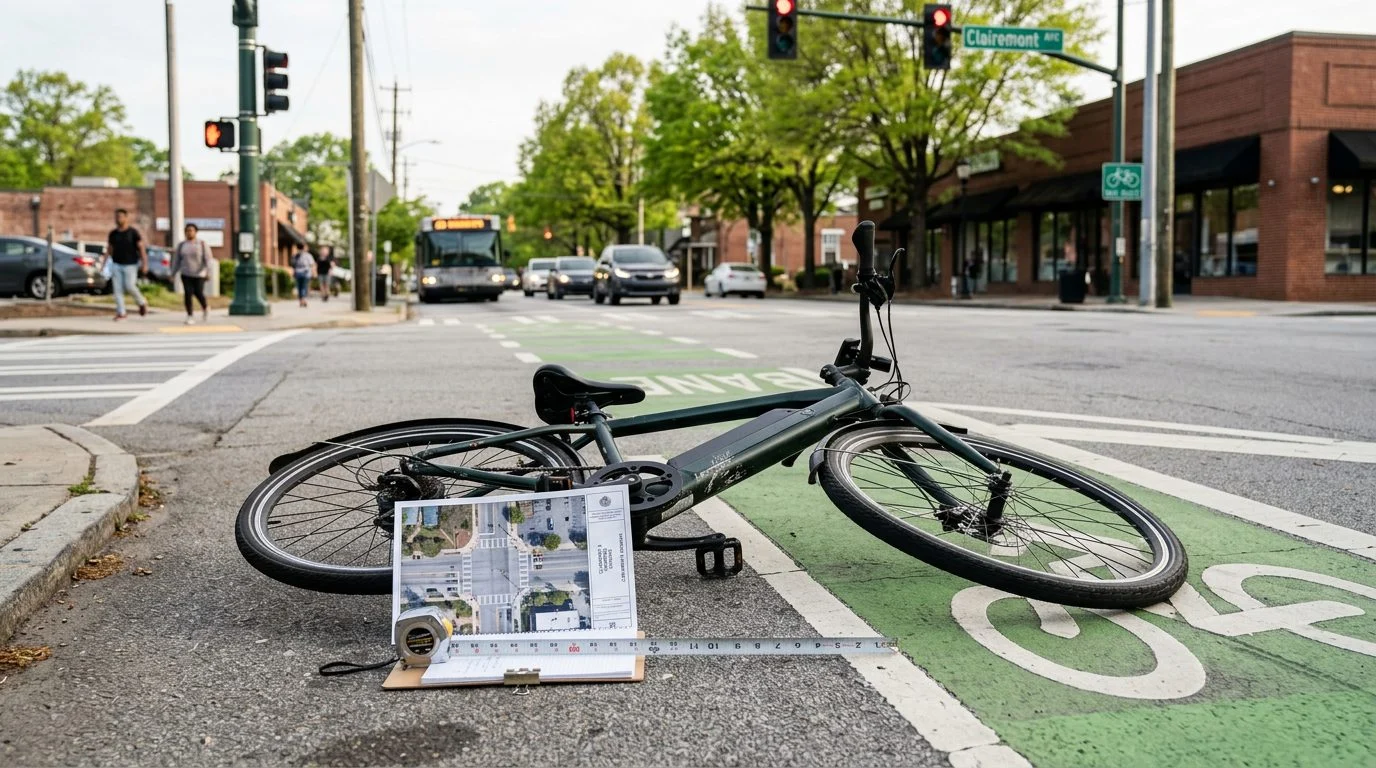
E-Bike Crash Claims | Jonesboro, Atlanta, Decatur, Macon, Augusta
Hurt on an e-bike in Georgia? Find out who may be responsible.
Medical bills, a damaged bike and lost work can add up fast. The firm can look at what caused your crash and help you decide what to do next.
T. Madden & Associates, P.C.
1999
Year the firm began practicing law
5
Offices: Jonesboro, Atlanta, Decatur, Macon and Augusta
By Terance Madden · Published November 21, 2026
You were riding your e-bike when a car turned across your path. Now the bills are stacking up, and you want to know who should pay.
Who pays for an e-bike crash in Georgia? Usually, the person or company whose fault caused the harm pays. That can be a driver, a maker, a seller, a property owner, or an employer. Georgia then reduces your recovery by your own share of fault.
The Rider Does Not Automatically Pay for an E-Bike Crash
The rider does not automatically pay the medical bills or the cost of repairs. Someone else may be liable. Liability means legal responsibility for harm another person caused.
Being on two wheels does not make you responsible for your injuries. The questions that matter are simple. Did someone act carelessly, break a safety duty, or sell a defective product? Did that choice cause the harm?
The answer may point to more than one party. Each party’s share of fault matters, and so does your own share. That is why the first step is a review of what happened, not a quick decision about what to sign.
Many people assume the other driver’s insurer will cover everything. Coverage can be lower than the losses, and the facts are often disputed. A clear picture of the facts comes first.
If a driver, a defective battery, or a delivery vehicle hurt you on an e-bike, our team can review who may be responsible and what coverage may apply. Call for a free consultation. Talk it through with our team — the first consultation is free, confidential, and carries no obligation.
Who Can Be Liable When an E-Bike Crash Happens
Several parties can be liable, and the right one depends on what caused the crash. Each possibility needs its own proof.
- Drivers who turn across a rider’s path, pass too close, or run a red light.
- Makers, sellers, and assemblers when a defective battery, controller, brake, or frame caused the crash or made injuries worse.
- Property owners when a hazard, such as a broken path surface or an unmarked drop-off, contributed. Georgia law requires an owner or occupier to use ordinary care in keeping the premises and approaches safe for people invited onto them.
- Employers when a delivery or rideshare driver was working. Georgia law makes a person liable for torts committed by a servant “in the prosecution and within the scope of his business.” Under the same Title 51 rules, a company can also face its own claims for how it hired, trained, or supervised the driver. The Georgia Supreme Court’s decision in Quynn v. Hulsey says those claims are based on the employer’s own alleged negligent acts.
The same test applies if a child on a bike hits your car. The question is who was at fault and what coverage applies to that person’s conduct.
How Georgia’s 50% Bar Shrinks Recovery
Georgia reduces your recovery by your share of fault, and it bars recovery entirely at 50 percent or more. This is called comparative fault (shared fault). Under O.C.G.A. § 51-12-33, if the plaintiff is to some degree responsible for the injury or damages claimed, the judge reduces the damages awarded to the plaintiff in proportion to the plaintiff’s percentage of fault.
If you are 50 percent or more responsible, you “shall not be entitled to receive any damages (O.C.G.A. § 51-12-33; Quynn v. Hulsey (2020)).”
Here is a simple, hypothetical example. Say a jury values your losses at $100,000 and finds you 20 percent at fault. The award drops by 20 percent, to $80,000. At 50 percent, you would recover nothing.
The other side often tries to push fault onto the rider. Common arguments are speed, lane position, or looking at a phone. The evidence decides how the fault is split. The statute also says the jury considers everyone who contributed to the harm, even someone who was never sued.
Each liable party pays only its own share. That is why each party’s conduct needs to be documented.
Can I Ride an Electric Bike on the Road in Georgia?
Where and how you ride can become part of the fault argument. The other side may claim you should have been on a different surface, or that your speed was unsafe.
The rules that applied on the day of the crash get checked during case review. A rider’s path of travel is one of the first things an insurer will question.
Keep the bike, the battery, the charger, your helmet, and the clothes you wore. These items show how the crash happened and what failed. Do not repair or throw away a damaged battery before someone has looked at it.
Photos of the scene, the road surface, and any traffic signs also help. Ask the people who saw the crash for their names and phone numbers while the details are fresh.
When a Battery Fire or Defective Part Causes the Crash
A maker or seller can be liable when a defective battery or part causes injury or fire. This is called product liability, which means legal responsibility for harm from a product.
Georgia separates a manufacturer from a product seller. A product seller is a person who, in the course of a business, leases or sells and distributes, installs, prepares, blends, packages, labels, markets, or assembles a product pursuant to a manufacturer’s plan, intention, design, specifications, or formulation, or repairs, maintains, or otherwise is involved in placing a product in the stream of commerce. Under § 51-1-11.1, a product seller is generally not liable as a manufacturer for strict liability (liability without proof of carelessness). In Alltrade, Inc. v. McDonald, the court held that a company that only puts its name on a product, with no input into its design or making, is a product seller.
Manufacturers can be liable to people who are injured, even without a direct contract with the buyer. Under § 51-1-11, a claim generally must be brought within ten years after the product’s first sale. The statute has exceptions. In Chrysler Corp. v. Batten, the court explained that the exclusion places failure-to-warn causes of action outside the ambit of the statute of repose.
Terance Madden leads the firm, which has been in practice since 1999. Before law school, he trained as an electrical engineer, so he starts with what the evidence shows. In a battery fire, that means the cells, the charging circuit, the certification marks, and the origin-and-cause investigation that traces where the fire began. A damaged cell, a mismatched charger, or an off-brand part can each leave different marks. Those marks help show what failed and why.
Maintenance vendors and parts suppliers can also be other liable parties, which can mean more insurance.
The Coverage Layers That May Pay
More than one insurance layer may pay. Every layer should be checked, not just the first policy the other side names.
- Liability coverage on the at-fault driver’s auto policy, and any other policy that applies to that driver.
- Uninsured and underinsured motorist coverage (UM/UIM) on your own auto policy, if you have one.
- Umbrella and excess policies that sit above a primary policy. Required uninsured motorist coverage excludes umbrella or excess liability policies unless affirmatively provided for in such policies or in a policy endorsement.
- Corporate coverage for a business that owned, leased, or sold the bike or battery, or employed the driver.
Coverage is often the gap that matters most. Georgia’s minimum limits set a floor, not a full measure of a serious injury. For more on driver limits, read Georgia minimum auto insurance limits in an e-bike crash.
Not sure what your next step is?
Talk it through with our team — the first consultation is free, confidential, and carries no obligation.
How Big Insurance Handles an E-Bike Injury Claim
Big Insurance is not on your side, and a first offer is rarely what your claim is worth. Its goal is to pay as little as it can.
Expect the tactics. A fast, low first offer. A request for a recorded statement early, before the medical picture is clear. Delays in paying bills. Disputes over whether treatment was needed. And “low impact” arguments that say a bike crash could not cause serious harm.
Crash physics helps answer those arguments. Terance Madden’s engineering training helps him look at how the bike and the vehicle moved, and how force reached the body. That is the kind of evidence a “low impact” argument needs to address.
Georgia has rules for written settlement offers in motor vehicle collision claims. Under § 9-11-67.1, an offer to settle a motor vehicle injury claim that is prepared by or with the assistance of an attorney, and made before the defendant’s answer is filed, must allow at least 30 days to accept from receipt sent by certified mail or statutory overnight delivery. Under subsection (j) of O.C.G.A. § 9-11-67.1, the Code section ‘shall not apply to any offer to settle a product liability claim, including failure to warn arising under product liability,’ even though subsections (a) and (i)(2) apply it to offers to settle a tort claim for personal injury, bodily injury, or death arising from a motor vehicle collision.
The response is steady. Our team pursues every coverage layer. We value lifetime costs, including future care. We prepare the claim as if it will go to trial.
What Settlement Money Covers After an E-Bike Crash
Settlement money can cover money losses you can prove and harm the law presumes. Georgia treats these differently.
General damages are those “the law presumes to flow from any tortious act.” They may be recovered without proof of an amount. Special damages “actually flow from a tortious act” and must be proved. Medical bills and lost wages are usually special damages, so records matter. See § 51-12-2.
Future losses are valued in today’s dollars. Under § 51-12-13, a jury may reduce future medical costs, lost wages, and other economic losses to present value, using a 5 percent rate or another rate it finds appropriate.
Serious injuries need a lifetime view. Bills that have arrived so far do not show what care will cost next year or in ten years.
If Medicare paid for care, the settlement may need to repay it. CMS explains that a Medicare conditional payment must be repaid when a settlement, judgment, award, or other payment is made.
Frequently Asked Questions About Who Pays After an E-Bike Crash
Short answers to the questions people ask most about who pays after an e-bike crash.
Who pays if a delivery or rideshare driver hit me?
The driver, the company, and their insurers may each be part of the claim, depending on whether the driver was working. Georgia also has a ride share statute with its own conditions, so the company’s role needs review.
What if I was partly at fault?
Georgia reduces your recovery by your share of fault. If you are 50 percent or more at fault, you recover no damages under § 51-12-33.
What if the driver fled the scene?
Your own uninsured motorist coverage may still apply. Check the policy, and do not assume it does not.
How long do I have to file?
Georgia generally gives two years for injury claims, under § 9-3-33. Some exceptions apply, so do not wait.
What to Do Next If Someone Else May Be Responsible
If someone else may be responsible, the next step is a talk about your facts. That is true whether the other party is a driver, a battery maker, or a delivery company.
Maybe you’re a rider hurt by a driver, a defective battery, or a delivery vehicle. You may be deciding whether to talk to an insurer or wait. Waiting can cost you evidence, and an early call to an insurer can cost you leverage.
Our team can review your facts for free. The firm has practiced since 1999, with offices in Jonesboro, Atlanta, Decatur, Macon, and Augusta. Start a free case evaluation. The first consultation is free, confidential, and carries no obligation to continue.
If you’re managing the recovery for a parent, spouse, or adult child, you can make that call for them. Bring the bike, the battery, the medical records, and the names of any witnesses.