


Medical Malpractice Lawyer, Georgia
Hurt by a Medical Mistake? Talk to a Georgia Lawyer Who Will Listen.
Your health is your family's foundation. When a provider's care falls short, you deserve straight answers and a team that takes your side.
T. Madden & Associates, P.C.
1999
Year the firm began practice
5
Georgia offices: Jonesboro, Atlanta, Decatur, Macon, Augusta
Free
Confidential first consultation, no obligation
By Terance Madden · Published November 6, 2026
A medical malpractice claim in Georgia may be possible when a provider’s care falls below the accepted standard and that failure causes harm. Georgia’s deadlines can be short, so early questions matter. For medical malpractice questions, T. Madden & Associates, P.C. has offices in Jonesboro, Atlanta, Decatur, Macon and Augusta. The first consultation is free, confidential, and carries no obligation to continue.
What Medical Malpractice Means and Who This Page Is For
Medical malpractice is harm caused when a health care provider’s care falls below the accepted standard of care. The standard of care is the level of care a reasonable provider would give in similar circumstances. Georgia law covers injury from medical, dental, or surgical service, and from care at hospitals, nursing homes, and clinics, as O.C.G.A. § 9-3-70 explains.
Not every bad result is malpractice. Some treatments fail even when the provider acts with care. The key question is whether the care departed from what a reasonable provider would have done, and whether that departure caused the harm.
This page is for patients and families in Georgia who want to know whether a medical injury may be a claim. For broader background, read our medical malpractice lawyer guide.
If a medical error left you or someone you love hurt, you may have a claim worth reviewing, and you don't have to sort out the deadlines alone. Reach out to our team today. Talk it through with our team — the first consultation is free, confidential, and carries no obligation.

Common Types of Medical Malpractice Claims in Georgia
Medical malpractice claims take several common forms. Each one turns on what the provider did, or failed to do, and what that did to the patient.
- Misdiagnosis or delayed diagnosis: a condition is missed, or found too late to treat well.
- Surgical errors: wrong-site surgery, or an object left inside the body after an operation.
- Medication errors: the wrong drug or dose, or a dangerous interaction that was never checked.
- Lack of informed consent: you were not told the material risks or the alternatives before you agreed to treatment.
- Facility negligence: hospital or nursing staff failures that lead to infection, falls, or other harm.
- Wrongful death: medical negligence that causes a death. Families can raise these cases in the same consultation, since the firm handles wrongful death matters too.
What Georgia Requires You to Show and the Deadlines That Apply
A Georgia malpractice claim generally has to show that care fell below the accepted standard, that this caused harm, and that the harm led to losses. Georgia also adds early filing rules and firm deadlines.
Under O.C.G.A. § 9-11-9.1, a plaintiff suing a professional licensed by the State of Georgia and listed in subsection (g) of that section, or a licensed health care facility alleged to be liable based on the action or inaction of such a professional, must file an affidavit with the complaint. The affidavit comes from a witness competent to testify, and it must name at least one negligent act and its factual basis. The statute has a narrow rule for cases near the deadline: if the limitation period will expire, or there is a good faith basis to believe it will expire, within ten days of filing, and the plaintiff alleges that, because of time constraints, a sworn statement from a qualified witness could not be prepared, and the attorney files an affidavit swearing that the law firm was not retained more than 90 days before the period of limitation expires, the plaintiff shall have 45 days after the complaint is filed to add the affidavit to the pleadings. The trial court may not extend that time for any reason without the consent of all parties. If either affidavit is not filed within the periods the statute sets, or the law firm or any attorney on the pleadings was retained more than 90 days before the period of limitation expires, the complaint shall be dismissed for failure to state a claim.
The deadlines. Under O.C.G.A. § 9-3-71, a medical malpractice action generally must be brought within two years after the injury or death. The statute also sets a five-year outer limit from the negligent act, which it calls a statute of ultimate repose. Exceptions exist. When a foreign object (not including a chemical compound, fixation device, or prosthetic aid or device) is left in a patient’s body, O.C.G.A. § 9-3-72 gives one year after the negligent act is discovered. O.C.G.A. § 9-3-73 sets separate rules for some minors and for people who are legally incompetent.
Fault. Georgia reduces damages by the injured person’s share of fault under O.C.G.A. § 51-12-33. Under the same section, a plaintiff who is 50 percent or more responsible recovers nothing.
Because these rules are strict, act promptly. Waiting can shrink your options and make records harder to gather.
How a Medical Malpractice Case Works, Step by Step
A medical malpractice case usually moves from a free case evaluation to records review, professional review, a demand, and, if needed, a lawsuit.
- Free case evaluation. You share what happened, which providers were involved, and the key dates. The firm then reviews whether the facts fit a claim.
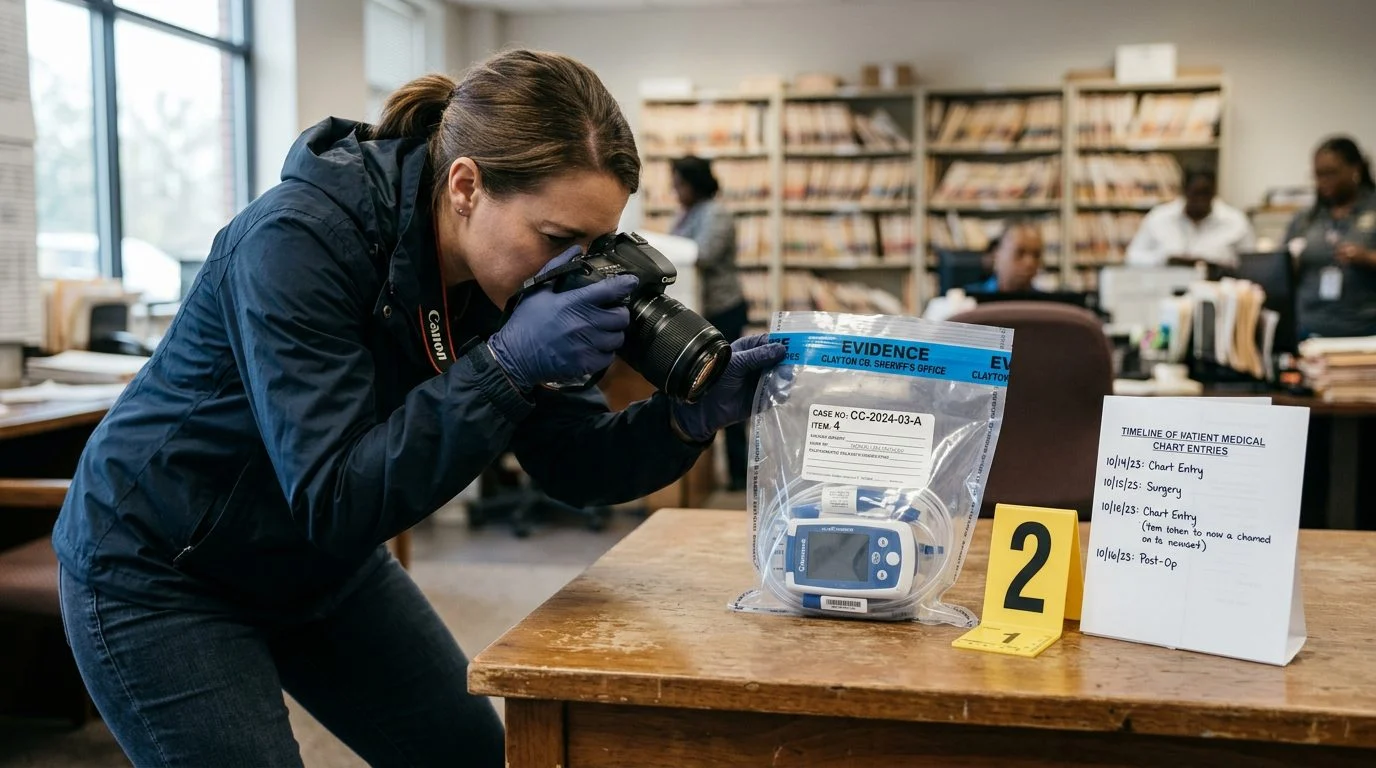
- Records collection. The firm requests your medical records and bills and builds a timeline of your care.
- Professional review. Reviewing the care with qualified medical professionals is one way to see whether the standard of care was breached.
- Demand and negotiation. A demand letter may go to the responsible parties and their insurers, and settlement talks may begin.
- Filing and litigation, if needed. If a fair resolution is not reached, the case may be filed in court, followed by discovery, depositions, and trial preparation.
How long this takes depends on the facts and how the other side responds. General damages are presumed to flow from a wrongful act, so they can be recovered without proof of an amount, under O.C.G.A. § 51-12-2. Special damages must be proved. Under O.C.G.A. § 51-12-2, general damages are those the law presumes to flow from a tortious act and may be recovered without proof of any amount, while special damages are those that actually flow from a tortious act and must be proved.
Questions About a Medical Injury Claim in Georgia
T. Madden & Associates, P.C. is a Georgia personal injury firm that has practiced since 1999. The firm represents people hurt in car and truck wrecks, motorcycle and e-bike crashes, slip and falls, nursing home abuse, medical malpractice, negligent security, and wrongful death cases.
Terance Madden is the responsible lawyer for this page. Shenia Madden is also a lawyer at the firm. Our team includes assistants and office staff who help keep records and scheduling moving.
The firm’s offices are in Jonesboro (Clayton County), Atlanta, Decatur, Macon and Augusta. The firm does not have an office in Newnan. If you live in Newnan or Coweta County, you can still call and ask how the firm can help with your situation.
The first consultation is confidential, and it carries no obligation to continue. You can decide what to do next after you hear how the firm would review your facts.
Questions to Answer Before You Call
Most people ask the same few questions before they reach out. Here are direct answers.
Do I need my medical records before I contact a medical malpractice lawyer?
No. The firm can request records after you share what happened.
Georgia generally requires a personal-injury lawsuit to be filed within two years after the right of action accrues (O.C.G.A. § 9-3-33).
What if a hospital or clinic was involved, not just one doctor?
A review of medical care can look at each provider and facility involved in the care.
What if a loved one died?
When death results from negligence, the personal representative may recover funeral, medical, and other necessary expenses under O.C.G.A. § 51-4-5.
What should I do in the meantime?
Keep copies of records, bills, and a written timeline of symptoms and conversations with providers.
Not sure what your next step is?
Talk it through with our team — the first consultation is free, confidential, and carries no obligation.
Questions to Ask About Your Medical Care
If a doctor, hospital, or nurse’s care left you or a family member hurt, the facts and the deadlines deserve a closer look now. Request a free case evaluation, or call our team 24/7. The first consultation is free and confidential.