

Premises Liability | Georgia Families
Hurt on Someone Else's Property? Here Is What Georgia Families Need to Know
A fall on a broken step or a fire in an unsafe rental can change a family's life overnight. Learn how property owners can be held responsible and what to do first.
Serving Georgia Families
1999
Practicing law for Georgia families since
5
Offices in Jonesboro, Atlanta, Decatur, Macon and Augusta
24/7
Call us any time
By Terance Madden · Published November 22, 2026
If someone you love was hurt on property they didn’t own, you probably have a lot of questions. Hurt on someone else’s property? Premises liability is the legal responsibility a property owner or occupier has when unsafe conditions on the property cause injury.
Premises means the land and the buildings and structures on it. If a fall or other injury happened on someone else’s property, Georgia law expects the owner to keep it reasonably safe, and it gives you a way to hold them responsible when they don’t.
Premises liability, in plain words
Premises liability is a claim that a property owner or occupier failed to keep people safe from hazards on the property.
It grows out of negligence. Negligence means a person failed to use reasonable care, and that failure caused harm. Many slip and fall claims are premises liability claims for that reason.
Georgia’s core rule is in O.C.G.A. § 51-3-1. It says an owner or occupier who invites people onto the property for a lawful purpose must use ordinary care in keeping the premises and approaches safe.
Under O.C.G.A. § 51-3-50, that definition reaches tenants and business operators, not just the name on the deed.
If someone you love was hurt on property that wasn't theirs, you don't have to sort out the rules alone, and our team can talk through what happened with you. Talk it through with our team — the first consultation is free, confidential, and carries no obligation.
Who the property owner owes a duty to
The duty depends on why the person was on the property. Duty of care means the legal obligation to act the way a reasonably careful owner would toward the people there.
Georgia law sorts visitors into three groups. Each group gets a different level of protection.
An invitee is someone invited onto the property for a lawful purpose, like a customer in a store. Under § 51-3-1, the owner must use ordinary care to keep invitees safe.
Georgia’s rule is more favorable to owners here: the owner is liable to a licensee only for willful or wanton injury (deliberate or reckless disregard for safety), as set out in O.C.G.A. § 51-3-2.
A trespasser has no permission to be there. The rules for trespassers are different again, so the facts of each visit matter.
Here is the practical point. A shopper who slips on a wet floor is usually an invitee. A friend hurt at a cookout may be a licensee. That label can change the standard a court applies, so it gets checked first.
An occupier can carry this duty too. A tenant or business operator that controls the space may be the one who had to fix the hazard, even if someone else owns the building.
What has to be shown in a premises liability claim
The owner owed a duty. The owner broke that duty. The break caused the injury.
Proving the break often comes down to knowledge.
Records answer that question. Incident reports, inspection logs, cleaning and repair schedules, prior complaints and surveillance video often show how long a hazard existed. Video and logs can be overwritten or lost, so they should be requested early.
Time limits matter too. Georgia generally gives two years to file most injury claims, under O.C.G.A. § 9-3-33. Missing that deadline can bar the claim, so the clock is worth watching from day one.
Georgia also uses comparative fault, which means shared blame. Under O.C.G.A. § 51-12-33, a judge reduces damages by the injured person’s percentage of fault. A person who is 50 percent or more responsible cannot recover any damages.
Common settings for premises liability claims
Common settings include stores, stairs, walkways, parking lots, apartment common areas and any place where crime is a risk.
Typical hazards include wet floors with no warning sign, broken stairs and railings, cracked or uneven walkways, poor lighting and debris in store aisles. The focus stays on the owner’s failure, not the injured person’s footing.
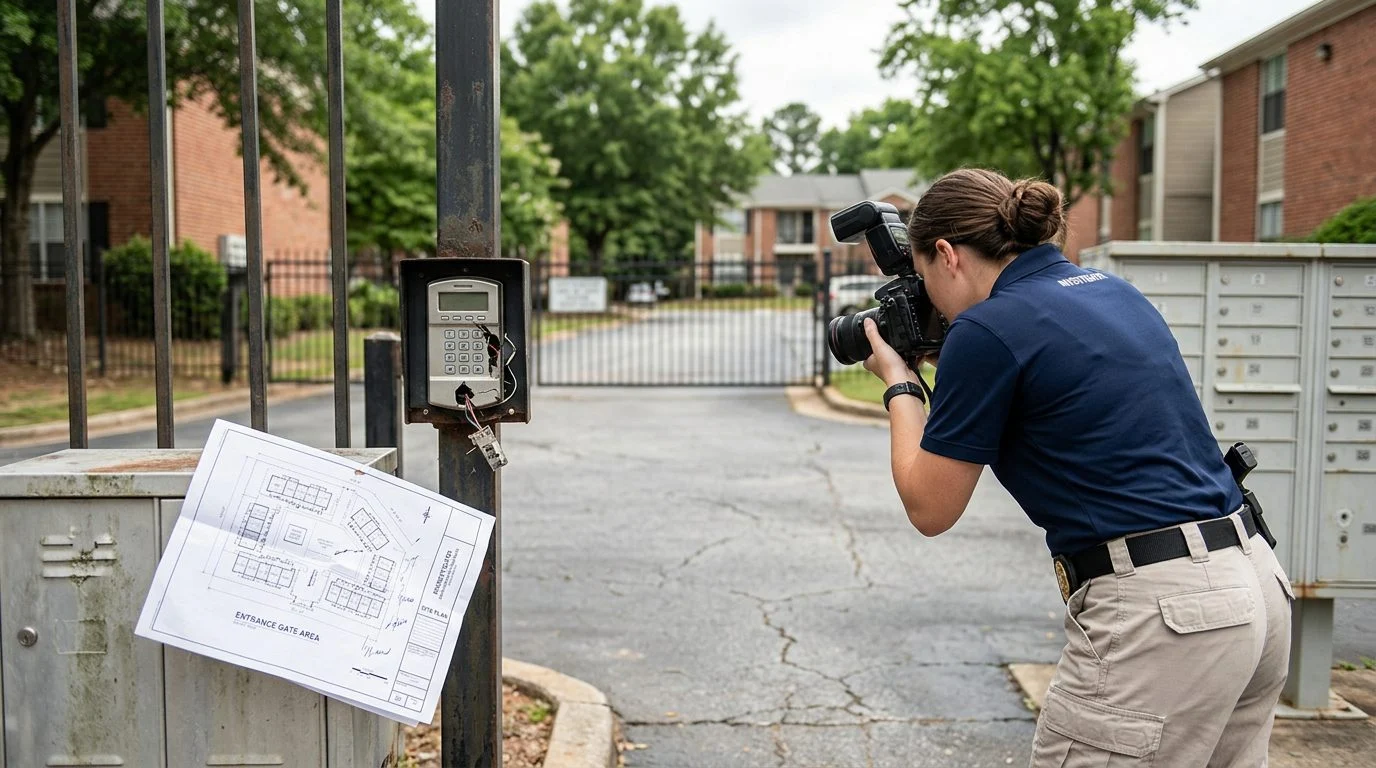
Hallways, stairwells and gates are part of the premises and its approaches, so they carry the same duty.
Negligent security is a claim against an owner or occupier, or a security contractor, for bodily injury or wrongful death that arises from a failure to keep the premises and approaches safe from the wrongful conduct of third persons. Georgia sets out that definition in O.C.G.A. § 51-3-50.
Owners are not required to use extraordinary care against crime, under O.C.G.A. § 51-3-55.
How Big Insurance responds to premises claims
Big Insurance is not on the injured person’s side, and its first offer is rarely what a claim is worth.
Expect a few common moves. A quick, low offer often comes before the medical picture is complete. A recorded statement gets requested early, while the injured person is still hurting or on medication. Bills get delayed. Treatment gets called unnecessary. The fall gets described as minor, or the injured person gets blamed for sharing fault.
Each move is meant to shrink the claim. The response has to be just as organized.
The response starts with every coverage layer that may apply. That includes the owner’s liability policy, any umbrella or excess policy, and corporate coverage if a business is involved, and, in a crash where a vehicle was part of the event, the injured person’s own uninsured or underinsured motorist coverage.
A claim’s value can reflect the cost of the injury over time. That can include future medical care and lost earning ability, where the facts support them. A case may need to be prepared as if it will go to trial.
How an engineer-attorney reads the property evidence
Before law school, Terance Madden trained as an electrical engineer. He starts a premises case by asking what the physical evidence shows, how the hazard formed and how long it was likely there. That habit shapes which records get preserved first.
Property evidence can be more technical than it looks. Timestamped photos and video show lighting and surface condition. Measurements of stair treads, floor coatings and drainage can show whether a walking surface was unsafe.
Maintenance contracts and repair tickets show who was responsible for upkeep. A contractor who did poor work can be another liable party, which can mean another source of insurance. A repair ticket that shows a problem was reported months earlier makes a very different case than a hazard that appeared an hour before the fall.
Not sure what your next step is?
Talk it through with our team — the first consultation is free, confidential, and carries no obligation.
For the person managing a family member’s recovery
If you’re handling the appointments, bills and phone calls, you’re holding the file. Start a simple record now. Good notes made early are worth a lot later.
- Photograph the spot and the hazard if it’s still there. Write down the date, time and lighting.
- Collect names and phone numbers of anyone who saw the fall.
- Keep every bill, discharge paper and appointment card.
- Ask for a copy of any incident report the property made.
Take care with the insurer. Big Insurance often asks for a recorded statement early. Before the injured person gives one, talk with a lawyer. The request can sound routine, but the answers can be used to shrink the claim.
Keep the pace steady. Caring for someone who is hurt is hard work, and you don’t have to do every part of it at once.
Key points to know
If you’re reading this after a fall on someone else’s property, you may be juggling a hurt family member, a bill that keeps growing and a decision you didn’t plan to make. Maybe a hazard was never fixed or marked, or an insurer is asking for a statement, or a filing deadline is getting closer.
If that sounds like your family, the team at T. Madden & Associates, P.C., with offices in Jonesboro, Atlanta, Decatur, Macon and Augusta, can review the facts with you in a free case evaluation. The initial consultation is free, confidential, and without obligation to continue.
Frequently Asked Questions
What is the meaning of premises liability?
Premises liability is the legal duty a property owner or manager has to keep a property reasonably safe for people who are invited onto it. If an unsafe condition on the property hurts someone, the owner may be held responsible when they knew or should have known about the danger.
Is premises liability the same as a slip and fall claim?
A slip and fall is one common type of premises liability claim, but it is not the only one. Premises liability can also cover hazards like broken stairs, loose handrails, poor lighting, and falling objects, as well as injuries from inadequate security.
Who can be held responsible for an unsafe property?
The property owner is the most common target, but others can be responsible depending on who controlled the space. A tenant, property manager, or contractor who created or maintained the hazard may also share responsibility.
What does an injured person usually have to prove?
Generally, the injured person must show that the owner knew or should have known about the hazard, and that the hazard caused the injury. Under Georgia law, if the injured person is found 50 percent or more at fault for their own injury, they cannot recover damages.