

Riverdale and Clayton County, GA
Hurt in a Slip and Fall? Talk to a Riverdale Lawyer Today
Wet floors, broken steps and missing warnings can turn an ordinary errand into a serious injury. Tell us what happened, and our team will listen.
T. Madden & Associates, P.C.
1999
Year the firm began practice
5
Georgia offices, including Jonesboro in Clayton County
24/7
Call line for injured people
By Terance Madden · Published November 20, 2026
You fell in a store, your back still aches, and the store’s insurer wants to talk. In Georgia, a business that invites you onto its property must use ordinary care to keep that property safe, and you may have a claim if it failed to do so.
A slip and fall claim is a type of premises liability, which means a property owner’s legal responsibility for injuries on its property. Each fall has its own facts, and the details of what caused it matter. The firm’s Jonesboro office serves Clayton County, including Riverdale. This page explains what to expect.
What a Slip and Fall Claim Is and Who It Covers
A slip and fall claim is a premises liability claim for a fall caused by an unsafe condition on someone else’s property. Common causes include:
- Wet or waxed floors with no warning sign
- Spilled liquids left in an aisle
- Loose mats, curled rugs and torn carpet
- Uneven steps, cracked walkways and broken handrails
- Poor lighting in a stairwell or parking lot
- Cords stretched across a walkway
These falls happen in grocery and big-box stores, restaurants, gas stations, apartment common areas, parking lots, offices and entryways.
The claim belongs to a customer or visitor the business invited onto the property for a lawful purpose, such as shopping or dining.
The firm has been in practice since 1999. Our team handles these claims from the Jonesboro office in Clayton County. The firm also works from offices in Atlanta, Decatur, Macon and Augusta.
Hurt in a store fall in Clayton County and still in treatment? You may have a claim, and our team can review the facts with you in a free case evaluation. Talk it through with our team — the first consultation is free, confidential, and carries no obligation.

What Georgia Law Requires of Property Owners
Georgia law requires an owner or occupier (the business that controls the property) to use ordinary care to keep the premises and approaches safe. O.C.G.A. § 51-3-1 makes the owner liable to people the owner induces or leads to come upon the premises for any lawful purpose, for injuries caused by a failure to use ordinary care to keep the premises and approaches safe.
Expect the other side to argue you should have watched your step. Georgia handles that through comparative fault (shared fault). Under O.C.G.A. § 51-12-33, a judge reduces your damages in proportion to your share of fault. If you are 50 percent or more responsible, you cannot recover damages.
Timing matters too. Under O.C.G.A. § 9-3-33, an action for injuries to the person generally must be brought within two years after the right of action accrues. Acting early also helps keep video and records from disappearing.
What a Store Fall Claim Can Recover
A store fall claim can recover general damages and special damages, and the law treats them differently. General damages cover losses the law presumes from a fall, such as pain, suffering and loss of enjoyment of life. They can be recovered without proof of an exact amount. Special damages cover actual losses, like medical bills and lost wages, and you must prove them. See O.C.G.A. § 51-12-2.
Medical bills are limited to the reasonable value of medically necessary care. See O.C.G.A. § 51-12-1.1.
Serious injuries change the whole claim. A fracture, head injury or spinal injury can mean surgery, months of therapy, time away from work and care that lasts for years. A claim for those losses should value the full cost over a lifetime, not just the first bills.
Future losses can be reduced to present value (today’s dollar value). A jury may use a 5 percent rate or another rate it chooses. See O.C.G.A. § 51-12-13.
Our team investigates the fall, preserves evidence, gathers medical records, documents the losses and negotiates.
The Evidence That Decides a Store Fall Case
The evidence that decides a store fall case is what was on the floor, how long it was there, and what the store recorded in the first few days. Video can be written over on a schedule. Cleaning crews mop up spills. Witnesses walk out the door.
These items usually decide the case:
- Incident reports and any notes the store made
- Surveillance video and the camera angles that cover the spot
- Cleaning, sweep and inspection logs
- Maintenance records for lights, mats and flooring
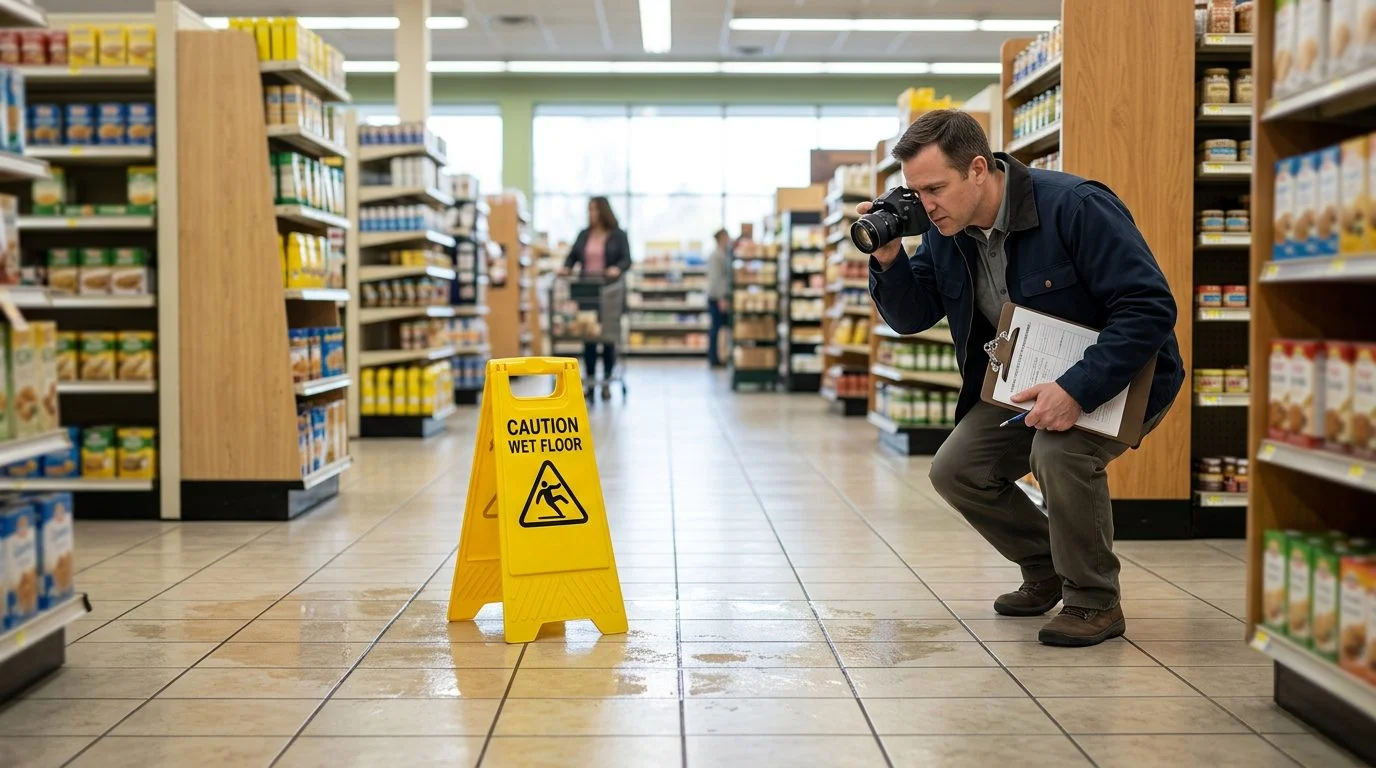
- Photos of the spot, the lighting and the hazard
- The shoes and clothing you wore that day
- Names and phone numbers of witnesses
Terance Madden holds a B.S. in Electrical Engineering and trained as an electrical engineer before law school. He reviews a store fall the way he reviews any technical problem: what the evidence shows, how the fall happened, and which records must be preserved. He looks at lighting levels at the spot and whether the surface was wet, glossy or unmarked. Timestamped video can show when a spill started, and he checks what a camera angle can and cannot show.
The firm starts by asking what the evidence shows and how the fall happened, before it values anything.
How Big Insurance Responds and How the Firm Answers
Big Insurance is not on your side, and its first offer is rarely what a store fall claim is worth. Expect these tactics:
- A low offer made before your treatment is finished
- A request for a recorded statement soon after the fall, while you are still hurting
- The argument that you should have watched where you walked
- Partial-fault arguments meant to shrink your damages
- Delays, and disputes over whether your treatment was needed
The response starts with coverage. The firm looks at every layer: the business’s liability policy, any umbrella or excess policy above it, and any policy held by a management company, contractor or property manager responsible for the floor.
The firm values the claim on the reasonable value of medically necessary care, including future care. Our team prepares every case as if it may go to trial.
How the Process Works, From First Call to Resolution
A store fall case moves through four steps, beginning with a first call.
- The first call. We gather where and when the fall happened, what you saw, who was there and what care you have had. The first consultation is free, confidential and carries no obligation to continue.
- Preservation and investigation. The firm asks the business in writing to keep its video and logs. Then it reviews the spot and contacts witnesses.
- Medical documentation. Your care comes first. We collect records and bills so the claim matches what your providers found.
- Demand, negotiation or lawsuit. We present a settlement demand and negotiate. If the claim does not settle fairly, we file suit in time. How long each step takes depends on the facts.
If a family member is managing the recovery, a simple system helps. Keep a dated log of symptoms, appointments, missed work and help needed at home. Save receipts, photos and discharge papers in one folder, and route insurer calls to the firm.
Not sure what your next step is?
Talk it through with our team — the first consultation is free, confidential, and carries no obligation.
Frequently Asked Questions
Can I still recover if I was partly at fault?
Possibly. Georgia reduces your damages by your share of fault, and you cannot recover damages at 50 percent or more (O.C.G.A. § 51-12-33; Quynn v. Hulsey (2020)).
How long do I have to file?
Generally two years after the claim arises under Georgia’s injury deadline. Claims against counties and cities have shorter notice rules, so call early.
What if the fall happened on county or city property?
Claims against a county must be presented within 12 months after they accrue or become payable, or they are barred; minors and other persons under disabilities have 12 months after the disability is removed to present their claims. See O.C.G.A. § 36-11-1. Claims against a city need written notice to its governing authority within six months. See O.C.G.A. § 36-33-5.
Will I have to go to court?
Some claims settle, and some go to trial. Our team prepares every case as if it may go to trial.
Should I give the store’s insurer a recorded statement?
Talk with the firm before you do, because a recorded statement can be used to argue fault.

Hurt in a Fall at a Clayton County Business?
A fall in a Riverdale store or a Clayton County parking lot can leave you with medical bills, lost pay and hard questions about who pays. You can start a free case evaluation today, or call the firm, available 24/7, before you talk with the store’s insurer again.
Related practice areas
- Slip and Fall Lawyer in Georgia
- How Hard Is It to Sue for Negligence in Georgia?