


Truck Accident Lawyer | Georgia
Driver Fatigue Can Be Proven. Start With the Records.
T. Madden & Associates, P.C. has represented Georgia injury victims since 1999. We help people hurt in truck wrecks look into hours of service violations, driver logs and related trucking records.
Serving Georgia Since 1999
1999
Year the firm began practice
5
Georgia offices: Jonesboro, Atlanta, Decatur, Macon and Augusta
24/7
Phone line for reaching our team
By Terance Madden · Published November 2, 2026
How Do Hours-of-Service Violations Under Federal Trucking Rules Help Prove Driver Fatigue in a Georgia Lawsuit?
Hours of service violations can help show driver fatigue because federal rules limit how long a commercial driver may drive and require rest. If a driver’s records show those limits were broken before a crash, the records can suggest the driver was too tired to drive safely. This is evidence for a negligence claim. It does not decide a case on its own.
Georgia law describes ordinary negligence through O.C.G.A. § 51-1-2. It defines ordinary diligence as the care that ordinarily prudent people use in the same or similar circumstances. Failing to use that care is ordinary negligence.
If you’re reading this because someone you love was hurt by a big rig, you may want to know what the driver’s records could show. You don’t need to know every rule yet. This page explains the basics and how they connect to a fatigue claim in Georgia.
If you're trying to make sense of a truck crash that hurt someone you love, you don't have to sort through the rules alone. Our team can talk it through with you. Talk it through with our team — the first consultation is free, confidential, and carries no obligation.
What the Federal Hours-of-Service Rules Require of Property-Carrying Truck Drivers
The federal rules set driving limits, rest periods and weekly caps for drivers of property-carrying commercial trucks. The core limits appear in 49 C.F.R. § 395.3. In plain terms, they work like this:
- A driver must take 10 consecutive hours off duty before driving.
- A driver may not drive after 14 consecutive hours that start after that 10-hour break.
- Within the period specified in paragraph (a)(2) of 49 C.F.R. § 395.3, a driver may drive a total of 11 hours.
- Driving is not permitted once more than 8 hours of driving time pass without a 30-minute break. Some short-haul drivers have exceptions.
- A driver may not drive after 60 hours on duty in 7 days, or 70 hours in 8 days, depending on whether the carrier runs every day of the week.
A driver can restart the weekly count with an off-duty period of 34 or more consecutive hours. The same section says an 8-day period may end with the beginning of an off-duty period of 34 or more consecutive hours.
These rules bind the company as well as the driver. The rules in this part apply to all motor carriers and drivers, except as provided in paragraphs (b) through (x) of 49 C.F.R. § 395.1; the duty not to permit or require a driver to break them is stated in 49 C.F.R. § 395.3(a). That shared duty matters later, when the claim looks at what the company allowed.
How Driver Logs and Electronic Logging Device Records Can Show a Violation
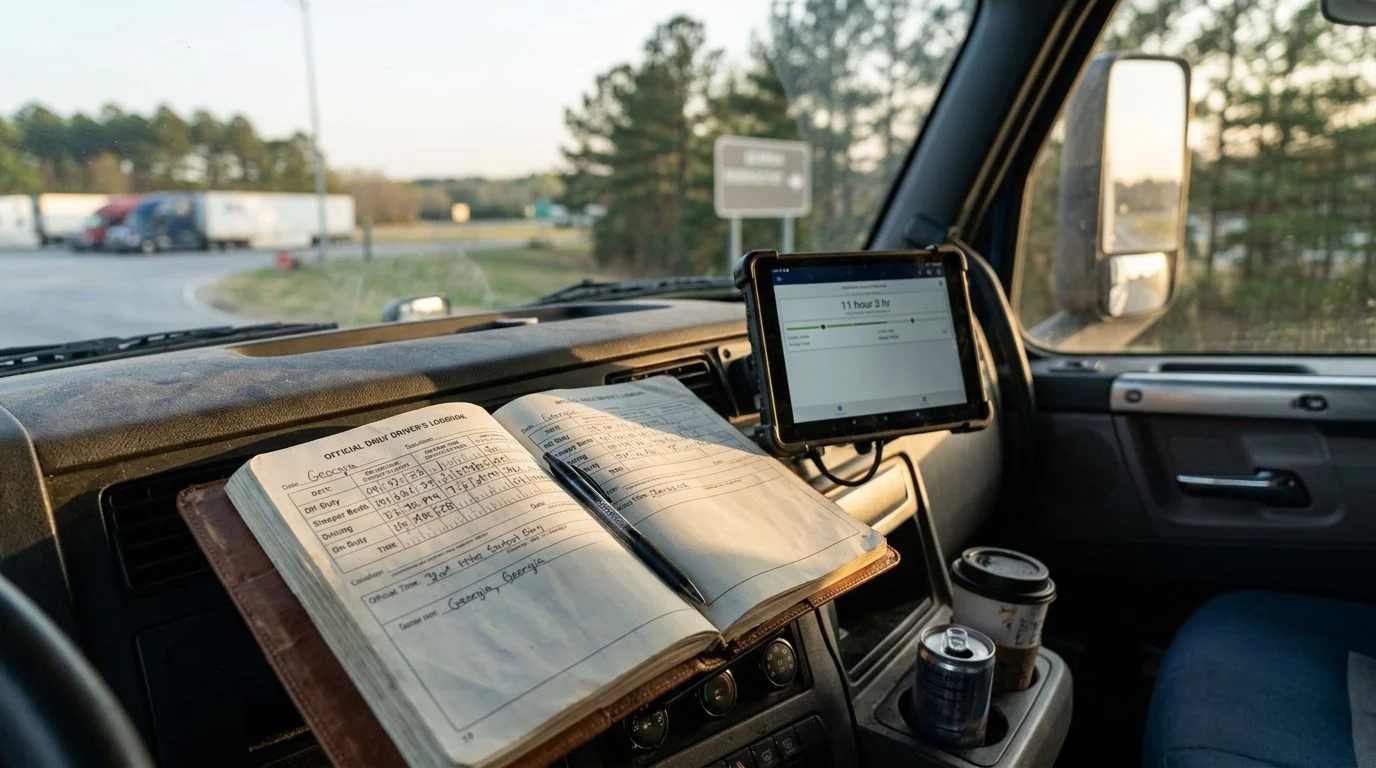
Federal rules require most carriers to have drivers record duty status on an electronic logging device (ELD), with limited exceptions for manual logs. The requirement is in 49 C.F.R. § 395.8. An ELD records date, time, vehicle location, engine hours and vehicle miles on its own, as described in 49 C.F.R. § 395.26. Because the device logs these items automatically, the data does not depend only on what a driver remembers.
A record can show a driver driving past the 11-hour limit, working outside the 14-hour window, or going without a required break. Each of these is a specific rule you can check against the log.
Logs can also be compared with other records. Carriers must keep supporting documents, such as dispatch records, trip records, expense receipts and electronic mobile communication records. These must be matchable to the driver’s duty status record (49 C.F.R. § 395.11). If the times in those records don’t line up with the logs, that mismatch can become a point of inquiry in the case. The same section bars any motor carrier or driver from obscuring, defacing, destroying, mutilating or altering existing information in a supporting document.
Why an Hours-of-Service Violation Supports a Fatigue Argument in a Georgia Case
A violation supports a fatigue argument by connecting the driver’s hours to the way the crash happened. Federal rules bar a driver from operating a commercial vehicle when fatigue has impaired alertness enough to make driving unsafe, as stated in 49 C.F.R. § 392.3. A driver who has been on the road too long may react more slowly, drift between lanes or miss warning signs. Logs showing long hours help explain why that happened.
Georgia brings these federal rules into state law. O.C.G.A. § 40-1-8 allows regulations governing the safe operation of motor carriers, commercial motor vehicles and drivers to be adopted by administrative order, including by referencing compatible federal regulations or standards. O.C.G.A. § 40-1-8 reads: “(c)(1) Regulations governing the safe operations of motor carriers, commercial motor vehicles and drivers, and the safe transportation of hazardous materials may be adopted by administrative order, including, but not limited to, by referencing compatible federal regulations or standards without compliance with the procedural requirements of Chapter 13 of Title 50, the “Georgia Administrative Procedure Act,” provided that such federal regulations or standards shall be maintained on file by the department and made available for inspection and copying by the public, by means including, but not limited to, posting on the department’s website.” It also says every driver must “be fully competent and sufficiently rested to operate the motor vehicle under his or her charge.”
An hours violation is one piece of evidence. It is weighed alongside the crash report, witness statements, vehicle data and medical records. How much it counts depends on the facts of the specific crash. Under 49 C.F.R. § 390.11, it is the motor carrier’s duty to require that drivers observe these rules. Dispatch practices and how the trip was scheduled may also matter to the claim. Those questions are developed as the case moves forward.
For the broader claim process, see our truck accident lawyer page for Georgia.
Records Families Often Ask About Early After a Truck Crash
The most useful early records show when the truck was moving, where it was and who was involved. Start with the police crash report, photos from the scene and the names of any witnesses. Also note the trucking company’s name and main office address.
Medical records from the first treatment matter too. They show the injuries and when care began. Save appointment dates, bills and notes about lost work.
Timing matters. A trucking company and its insurer may begin collecting their own records soon after a crash. Federal rules require carriers to keep a back-up copy of ELD records for 6 months on a separate device, as stated in 49 C.F.R. § 395.22. Because that period is limited, the timing of your early requests can matter.
Write a simple timeline while memory is fresh. Note what you saw, what the driver or company said and what others told you. Save every letter, email and call record from the company or its insurer. Georgia also sets a filing deadline for injury lawsuits, so waiting can cost time.
Talking With a Georgia Truck Accident Lawyer About Your Situation
Helping an injured relative while handling medical visits, lost work and calls from an insurance company is a heavy load. You don’t have to sort through federal trucking rules alone. If the driver may have been on the road too long, a conversation can help you see whether the logs and other records might matter in your case.
T. Madden & Associates, P.C. offers a free first consultation that is confidential and carries no obligation to continue. The firm works on a no-fee-unless-we-win basis, but you may still be responsible for court costs and case expenses. Start a free case evaluation when you’re ready to talk.
Terance Madden is the responsible lawyer for this page. The firm has practiced since 1999, with offices in Jonesboro (Clayton County), Atlanta, Decatur, Macon and Augusta. This page is general information, not legal advice about your case.
Not sure what your next step is?
Talk it through with our team — the first consultation is free, confidential, and carries no obligation.
Frequently Asked Questions
What are the hours of service rules for truck drivers in Georgia?
Federal hours of service rules, which Georgia enforces for commercial trucks, provide under 49 C.F.R. § 395.3 that a driver may drive a total of 11 hours during the period specified in paragraph (a)(2) of that section. Drivers also must take a 30-minute break after 8 cumulative hours of driving and cannot exceed weekly on-duty limits.
How can hours of service violations lead to a truck accident?
Drivers who go without enough rest can become fatigued, which slows reaction time, weakens focus, and raises the risk of drifting out of a lane or failing to stop in time. Fatigue is one reason these rules exist, and it can be a factor in crashes involving large trucks.
What kind of evidence can show a driver broke hours of service rules?
Records such as electronic logging device data, paper logs, fuel receipts, toll and dispatch records, and bills of lading can help show when a driver was on duty and driving. Some of this evidence can be lost over time, so it is often important to act quickly after a crash.
Who can be responsible when a truck driver violates hours of service rules?
Responsibility can extend beyond the driver to the trucking company or other parties who pressured or scheduled the driver, depending on the facts. Our team at T. Madden & Associates, P.C. offers a free first consultation that is confidential and carries no obligation to continue, so you can discuss your situation and options with no commitment.
Records We Look at After a Truck Crash
Driver Logs and ELD Data
Electronic logging device data and paper logs can show when a driver was on duty, driving and resting. Gaps or inconsistencies are often the first thing we examine.
Dispatch and Communications
Messages, load assignments and dispatch schedules can reveal pressure to keep moving when a driver should have stopped.
Trip and Fuel Records
Bills of lading, fuel receipts, tolls and GPS history can help confirm the timeline of a trip and whether the driver's reported hours match the route.
Maintenance and Driver Files
Employment, training and prior-violation files give context on how the carrier monitored driver hours and fatigue.
Act Early on Trucking Records
Logs, dispatch messages and GPS data are not always kept indefinitely. Reaching out soon after a crash helps us request these records while they are still available.
How We Work With Injured Clients
Free First Consultation
Your first consultation is free, confidential and comes with no obligation to continue.
No Fees Unless There Is a Recovery
Our fee is contingent on a recovery. You may still be responsible for court costs and case expenses, which we will explain before you decide.
Attorneys Who Handle Trucking Cases
Terance Madden and Shenia Madden, along with our team, focus on serious truck and car crash claims for people across Georgia.
Records Requests Handled Promptly
Our team drafts preservation letters and records requests to help keep critical trucking evidence intact.
Talk With Our Team About What Happened
Related practice areas
- What Percentage Do Accident Lawyers Take in Georgia?