

Truck Accidents | Georgia
Truck Maintenance Records Can Matter After a Georgia Crash
Learn what maintenance records show, who keeps them, and how T. Madden & Associates, P.C. uses them in truck accident cases.
About T. Madden & Associates, P.C.
1999
Year the firm began practice
5
Georgia offices: Jonesboro, Atlanta, Decatur, Macon, Augusta
24/7
Phone line available
By Terance Madden · Published October 24, 2026
Truck maintenance records after crash Georgia cases often start with one question: what paperwork should exist, and what can it show? In short, these are the repair logs, inspection reports and driver checklists that a trucking company must keep for each truck it controls. They can show whether a known problem was written down, repaired or left alone before a crash. They cannot prove fault by themselves.
If you were hurt in a Georgia truck crash, or you are helping someone who was, this paperwork can feel confusing. This page explains what the records are, what they can show, and why they can disappear if no one asks for them early.
What Truck Maintenance and Inspection Records Are
The records are the written files a trucking company keeps on each truck it controls. Federal rules require carriers to keep maintenance records for each motor vehicle they control. 49 C.F.R. § 396.3 lists what those files must include: the truck’s identity, when inspections and maintenance are due, and a dated record of each repair.
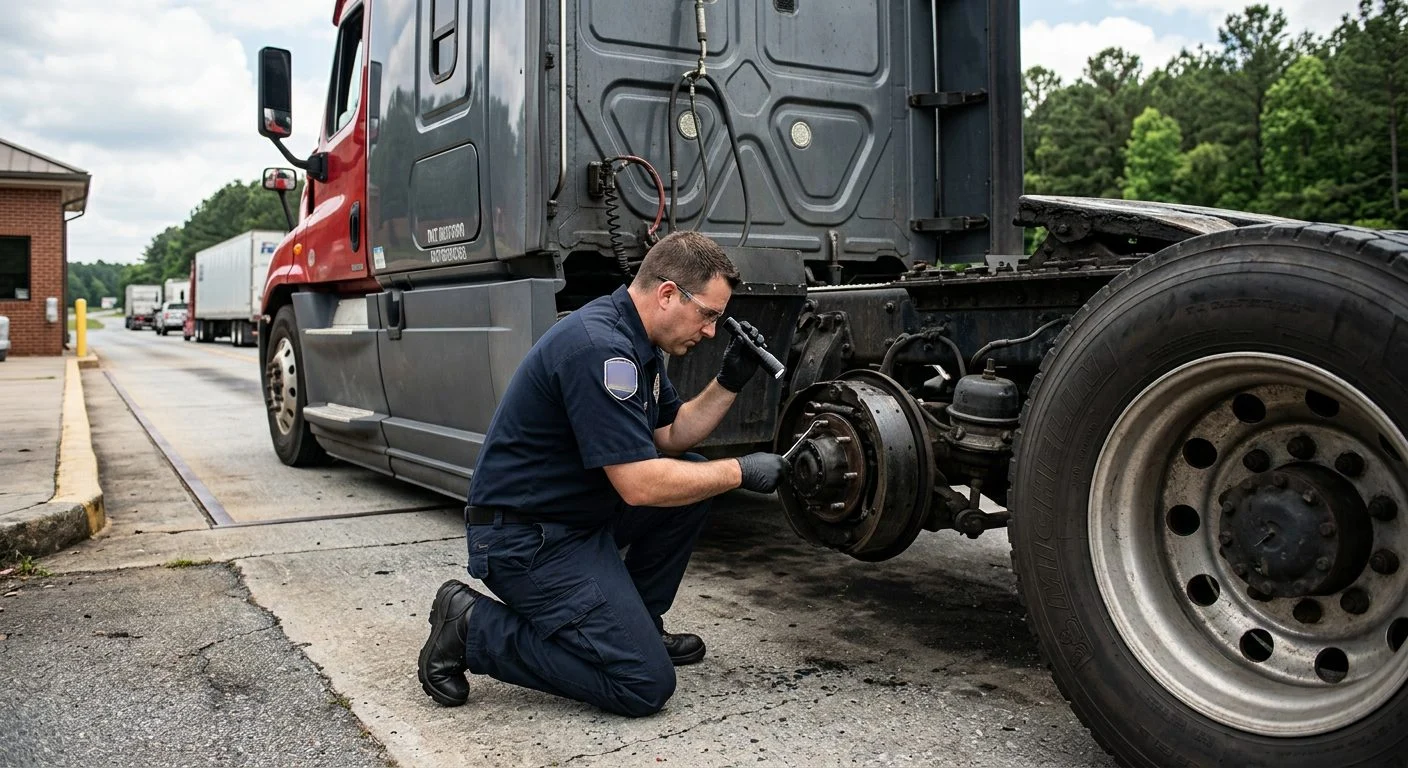
Three kinds of paper matter most. A maintenance record tracks repairs and service. A periodic inspection report records an annual check of the truck’s parts. A driver vehicle inspection report, or DVIR, is the checklist a driver fills out.
A driver must prepare a written DVIR at the end of each day’s work on each vehicle operated. The driver must sign it when a defect affecting safety is found. 49 C.F.R. § 396.11 sets this rule, though it does not apply to a private motor carrier of passengers (nonbusiness), a driveaway-towaway operation, or a carrier operating only one commercial motor vehicle. Drivers do not need a report if they find no defect.
These files belong to the trucking company and the shops it hires. The injured person does not hold them. Records are only as complete as what the carrier actually kept. A missing page can mean a missing repair, or a repair that was never logged.
If you are trying to make sense of carrier paperwork while you recover from a crash, our team can talk through your situation whenever you are ready. Talk it through with our team — the first consultation is free, confidential, and carries no obligation.

Why These Records Matter in a Georgia Truck Crash Claim
These records can show whether a problem was reported, repaired or ignored before the crash. Georgia law ties truck safety to federal standards. O.C.G.A. § 40-1-8 says every commercial motor vehicle must be kept in a safe condition at all times. Its brakes, lights and equipment must meet the federal standards in 49 C.F.R. Parts 393 and 396.
That gives the records a clear job. A lawyer can compare an entry with the crash itself. Was a brake problem written on a DVIR the day before? Was it marked as repaired? Did the truck run again before the repair was done?
The link is the hard part. A documented problem must connect to the crash. Whether it does depends on the facts. Those facts include how the truck was damaged, what the crash report says and what other evidence shows.
Records alone do not decide a case. Lawyers also review the crash report, photos, witness accounts, the scene and medical records. A file that looks concerning on paper still has to be tied to what happened on the road.
Brake, Steering, Suspension and Lighting Problems Records Can Reveal
Maintenance and inspection records can document problems with brakes, steering, suspension and lights, if the carrier wrote them down. Federal rules set clear minimums for each system.
For brakes, a non-steering axle on an air-braked commercial motor vehicle may not run with lining thinner than 6.4 mm (1/4 inch) for drum brakes, or to the wear indicator if the lining is so marked, or with lining thinner than 3.2 mm (1/8 inch) for disc brakes. 49 C.F.R. § 393.47 sets those limits. Brakes must also be capable of operating at all times, with listed exceptions. 49 C.F.R. § 393.48 covers that rule.
For suspension, no leaf spring may be cracked, broken, missing or shifted out of position. No axle positioning part may be cracked, broken, loose or missing. 49 C.F.R. § 393.207 sets these standards.
For steering, the steering wheel must be secured, and steering joints may not be worn or faulty. 49 C.F.R. § 393.209 covers these parts.
For lighting, required lamps must work at all times. The load, dirt or other equipment may not block them. 49 C.F.R. § 393.9 sets this rule.
What gets examined is the entry, or the absence of one. A repeated brake write-up or a deferred repair draws questions. Reading these entries in context takes care, so talk through your own facts before drawing conclusions.
How Hours-of-Service and Driver Records Fit Alongside Maintenance Records
Hours-of-service and driver logs show when a driver was working and driving. They work alongside maintenance files. O.C.G.A. § 40-1-8 requires compliance with 49 C.F.R. Part 395.
Drivers record duty status either on an electronic logging device (ELD) or on paper grids. An ELD is a device that records driving time automatically. Carriers must keep these records for at least six months. Under 49 C.F.R. § 395.8(a)(1), except for a private motor carrier of passengers (nonbusiness), a motor carrier subject to the requirements of this part must require each driver to record the driver’s duty status for each 24-hour period, using the method prescribed in that section. 49 C.F.R. § 395.8 sets these recording requirements.
Comparing the logs with the crash time can show whether the driver’s day matched the rules. Driver qualification files and prior violations can also be reviewed with vehicle records.
These records often work together. A brake problem and a fatigue problem can both appear in one case. Each record answers a different question, so each needs its own review.
Where the Records Come From: Crash Reports, the Carrier and Public Requests
The carrier holds the maintenance, driver and dispatch files. The crash report comes from the agency that investigated the crash. These are two different sources.
A crash report usually lists the parties, the vehicles and the investigating officer’s observations. To get a copy, contact the investigating agency and ask about its request process.
A crash report is not a driving record. It is also not the carrier’s safety file. Each document has a different owner and a different purpose.
Under O.C.G.A. § 9-3-33, Georgia generally allows two years from the date of injury to bring a personal injury lawsuit. O.C.G.A. § 9-3-33 sets that timing.
How Records Disappear and What Spoliation Means in Georgia
Records can be discarded once their retention period ends. Spoliation means losing or destroying evidence that matters to a claim.
Federal retention periods are short. A DVIR must be kept three months from the date it was prepared. 49 C.F.R. § 396.11 sets this period. A periodic inspection report must be kept fourteen months. 49 C.F.R. § 396.21 covers that rule. Maintenance records must be kept one year, and then six months after the truck leaves the carrier’s control. 49 C.F.R. § 396.3 sets those periods.
49 C.F.R. § 379.3 states this rule.
Timing matters. A written preservation request sent soon after a crash asks the carrier to keep its files before routine cleanup. Waiting can let a retention period run out.
Not sure what your next step is?
Talk it through with our team — the first consultation is free, confidential, and carries no obligation.
How a Truck Accident Lawyer Requests and Reviews These Records
A truck accident lawyer usually starts by asking the carrier in writing to keep its records. Then the lawyer requests the files and compares them with the crash report.
The request letter, often called a preservation letter, asks the carrier to keep maintenance, inspection, driver, dispatch and hours-of-service files. Next come formal requests for those files. Then the records are compared with photos, medical records and scene evidence.
Our lawyers review these records together with the other evidence in a case. When a question calls for technical input, the firm may consult outside technical sources.
T. Madden & Associates, P.C. handles these matters for clients from its offices in Jonesboro, Atlanta, Decatur, Macon and Augusta. The process is the same at each stage, and it moves on the facts of each case.
Steps to Take Now and Key Takeaways
Right after a crash, a few steps help protect both your health and the evidence. Photograph the truck, its markings and the scene if it is safe to do so. Write down the DOT number and the trucking company’s name. Keep any paperwork from the scene.
Seek medical care promptly. Keep every record of treatment.
Key takeaways:
- Maintenance and inspection records are kept by the carrier.
- They can document brake, steering, suspension and lighting issues.
- They work alongside hours-of-service and driver records.
- They can be lost without a timely request.
Frequently Asked Questions
Who keeps truck maintenance records after crash Georgia cases involve?
The trucking company must keep them under federal rules. The injured person does not hold them.
Does a maintenance record prove fault?
No single record decides a case. Records are reviewed with the crash report and other evidence.
Is a crash report the same as a driving record?
No. A crash report comes from the investigating agency. A driving record is a separate document.

Talk With a Georgia Truck Accident Lawyer About Your Situation
If you are gathering records after a crash, you do not have to sort them out alone. You may be holding a crash report, a stack of carrier papers and a claim you did not expect. You may also be helping an injured relative make sense of it all.
T. Madden & Associates, P.C. offers a free first consultation that is confidential and carries no obligation to continue. To discuss your situation, contact our team.
This page is general information, not legal advice. Terance Madden is the responsible lawyer for this page. T. Madden & Associates, P.C. has been in practice since 1999 and has offices in Jonesboro, Atlanta, Decatur, Macon and Augusta. Contact the firm at tmaddenlaw.com/contact.
How our team approaches maintenance records
Requesting the right files
We identify which maintenance, inspection and repair records a trucking company should hold and pursue them in an organized way.
Reviewing records with the crash report
Maintenance files are read alongside the crash report, driver logs and other evidence, because no single document tells the whole story.
Protecting evidence early
We focus on preserving records that may be altered, lost or overwritten as a case develops.
Explaining each step
Our lawyers keep clients informed about what the records show and what questions remain open.
Preserving evidence matters
Trucking companies control their own maintenance files. Early contact with a lawyer can help identify which records exist and ask that they be preserved.
Common truck maintenance records we review
Maintenance and service logs
Dated entries showing oil changes, tire work, brake service and other routine upkeep on the truck involved.
Inspection reports
Pre-trip, post-trip and periodic inspection records that show what was checked and what was flagged.
Repair orders
Shop invoices and work orders that describe repairs made before or after the crash.
Driver qualification files
Records tied to the driver, including training, certifications and medical documentation kept by the carrier.
Talk with our team about your truck crash. Your first consultation is free, confidential and comes with no obligation to continue.
Related practice areas
- How Long After an Accident Can You Sue in Georgia?