

Truck Accident Lawyer | Georgia
When a Trucking Company Puts an Unsafe Driver on the Road
Terance Madden has handled Georgia injury cases since 1999. If a trucking company's hiring, screening, training or supervision failed and someone was hurt, our team can review what the company knew and when. Your first consultation is free, confidential and comes with no obligation to continue.
T. Madden & Associates, P.C. at a Glance
1999
Year Terance Madden began practicing law
5
Georgia offices: Jonesboro, Atlanta, Decatur, Macon and Augusta
Free
First consultation, confidential and without obligation
24/7
Phone line available around the clock
By Terance Madden · Published October 18, 2026
A trucking company can be held responsible for its own decisions, not only for what its driver did. If the company knew or should have known a driver was unfit, its own conduct can be part of an injury claim. This page explains how a trucking company negligent hiring lawyer reviews that question, which records matter most, and what to expect. It is written for people hurt in a semi-truck crash and for families who lost someone in one.
What Negligent Hiring and Supervision Means in a Georgia Truck Crash
Lawyers usually sort that conduct into three claims.
- Negligent hiring: the company failed to check a driver before the driver started work. Checks include the driving record, the road test, and the medical certificate.
- Negligent supervision: the company failed to monitor the driver, such as ignoring logs that show too many hours or signs of fatigue.
These claims focus on what the company knew or should have known. They ask about the company’s decisions, not only the driver’s actions. Commercial trucks travel Clayton County roads, metro Atlanta, Macon, Augusta, and every other part of Georgia. The Georgia Department of Public Safety lists driver error and inadequate rest among common contributing factors in truck crashes (Georgia DPS truck crash fact sheet). A free, confidential first consultation can show whether the company’s own conduct is part of your crash.
If a semi-truck driver with a poor record or unexplained logs was part of your crash, we can review what the company knew, and a free case evaluation is available. Talk it through with our team — the first consultation is free, confidential, and carries no obligation.

Records That Can Show the Company Knew or Should Have Known
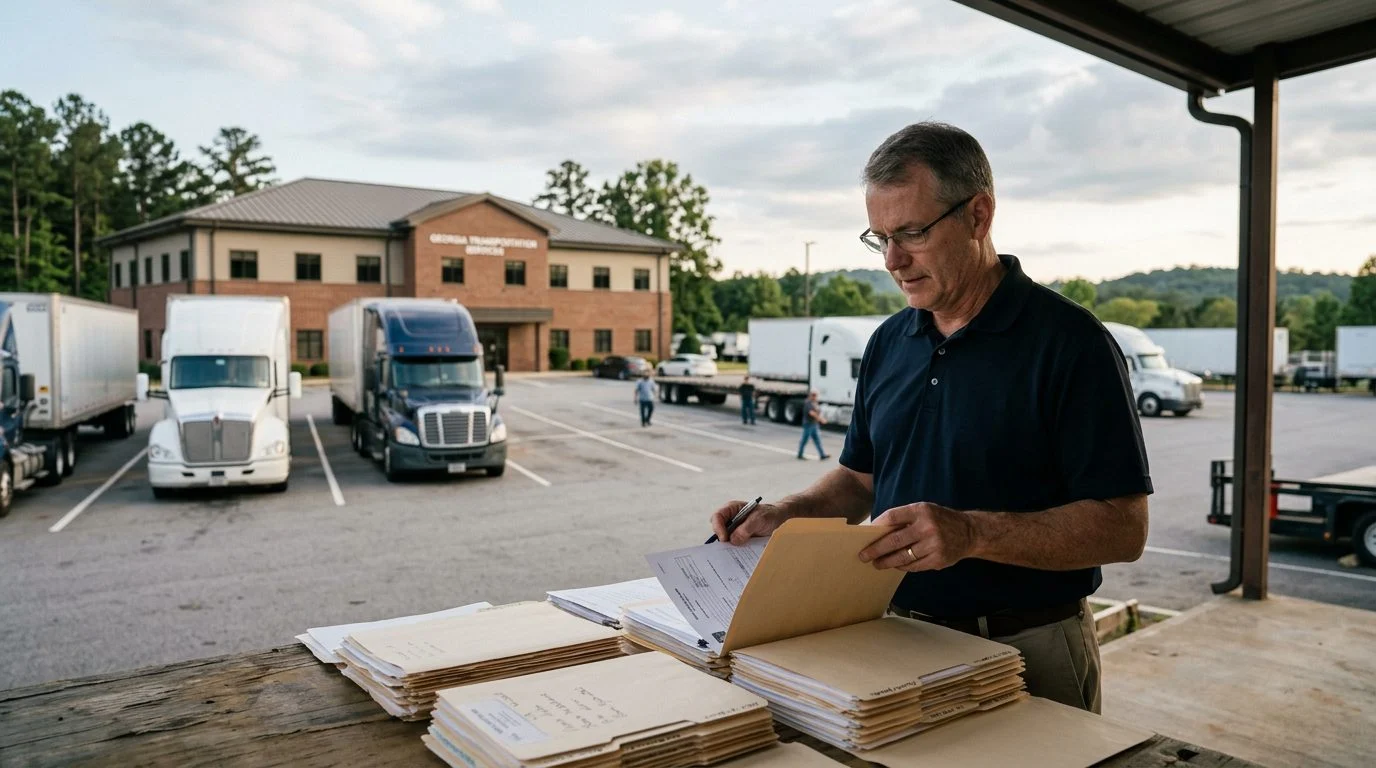
The strongest proof often sits in the carrier’s own files. Those records matter as much as the crash report.
- Driver qualification file. Federal rules require the carrier to keep the driver’s application, a motor vehicle record, a road test certificate or its equivalent, and a medical examiner’s certificate. Each motor carrier shall maintain a driver qualification file for each driver it employs, and a driver’s qualification file may be combined with his or her personnel file (federal driver qualification rule).
- Driver records. Within 30 days of the date a driver’s employment begins, the motor carrier must make an inquiry to each driver’s licensing authority where the driver held or holds a motor vehicle operator’s license or permit during the preceding 3 years, to obtain that driver’s motor vehicle record covering the driver’s prior 3-year driving history (federal driver inquiry rule). Employers must also query the Drug and Alcohol Clearinghouse before a safety-sensitive driver starts, and at least once a year.
- Hours and logs. A driver must take 10 consecutive hours off before driving. A motor carrier shall retain records of duty status and supporting documents for each of its drivers for a period of not less than 6 months from the date of receipt (federal duty status records rule).
- Fatigue. No driver shall operate a commercial motor vehicle, and a motor carrier shall not require or permit a driver to operate one, while the driver’s ability or alertness is so impaired, or so likely to become impaired, through fatigue, illness, or any other cause, as to make it unsafe for the driver to begin or continue to operate the commercial motor vehicle (federal fatigue and illness rule).
- Dispatch, prior crashes, and training. Dispatch messages can show pressure to make late deliveries. Prior citations and crashes can show a pattern. Training and maintenance files show whether known problems were fixed.
Logs, texts, and dispatch data can be lost or overwritten. A written request asking the carrier to keep these records should go out early.
How the Company’s Liability Fits Alongside the Driver’s
A Georgia claim can address both the driver and the company. A jury can assign each one a share of fault.
Georgia’s fault statute works in steps. The jury sets a percentage of fault for each person. The judge then reduces the damages by the injured person’s share (O.C.G.A. § 51-12-33). Under O.C.G.A. § 51-12-33, how fault is divided among several liable parties depends on the number of defendants and the facts of the case, and a trucking company may also be vicariously liable for its employee driver’s share under respondeat superior. The jury must also consider people who contributed to the harm, even if they were never named in the suit.
Georgia law bars recovery entirely when the injured person is found 50 percent or more at fault for the harm (O.C.G.A. § 51-12-33 (Quynn v. Hulsey, 310 Ga. 473 (2020))(g)). If the driver leased the truck or worked under a contract, who controlled the work often becomes central. The facts of each arrangement decide that.
How a Georgia Negligent Hiring Case Moves Forward
A case usually moves from a first consultation to records requests, proof of damages, and then a demand or a lawsuit.
- Consultation and intake. Review the crash report, your injuries, and any records you already have.
- Preservation and records requests. Letters ask the carrier and its insurer to keep logs, dispatch data, and driver files.
- Investigation. Review the driver’s history, the carrier’s safety records, and any hours or fatigue evidence.
- Damages documentation. Gather medical records, bills, and lost income. Families document the losses from a death.
- Demand and negotiation. Pursue a settlement, and file a lawsuit if the claim cannot be resolved fairly.
Georgia’s general deadline for injuries to the person is two years after the right of action accrues (O.C.G.A. § 9-3-33; Cameron v. JMP Pizza, Inc. (2026)). Some claims follow other deadlines, so early review matters.
Fees: T. Madden & Associates, P.C. works on a no fee unless we win basis. You may still be responsible for court costs and case expenses, and those terms are covered at the consultation.
Why Clients Work With T. Madden & Associates, P.C.
T. Madden & Associates, P.C. is a Georgia personal injury firm led by attorney Terance Madden. The firm has been in practice since 1999.
- Offices: Jonesboro (Clayton County), Atlanta, Decatur, Macon, and Augusta.
- Practice areas: car and truck accidents, motorcycle and e-bike crashes, slip and falls, medical malpractice, nursing home abuse, negligent security, and wrongful death.
- Support staff: our team helps with records requests and scheduling.
- Phone access: you can call 24/7 with questions after a crash.
Frequently Asked Questions About Trucking Company Negligence in Georgia
Can the company be sued if it fired the driver after the crash?
Yes. Those earlier hiring and supervision choices can still be examined.
What if the company says the driver was an independent contractor?
That label is only a starting point.
Do I need proof the driver was tired?
Not every claim turns on fatigue. Logs, dispatch times, and the crash time are common evidence of whether a driver had enough rest.
How long do I have to file?
Under O.C.G.A. § 9-3-33 (Cameron v. JMP Pizza, Inc. (2026)), the general limitation period for injuries to the person is two years from the date the right of action accrues (O.C.G.A. § 9-3-33; Cameron v. JMP Pizza, Inc. (2026)). Some claims have other deadlines.
Is the first consultation free?
Yes. The first consultation is free, confidential, and carries no obligation to continue.
Not sure what your next step is?
Talk it through with our team — the first consultation is free, confidential, and carries no obligation.

Talk With Terance Madden About a Crash Involving a Commercial Truck
If a semi-truck driver with a poor record or irregular logs was part of your crash or your family’s loss, the company’s role is worth reviewing early. Records can be overwritten, and filing deadlines keep running. Contact T. Madden & Associates, P.C. for a free case evaluation or a free, confidential consultation.
Terance Madden is the responsible lawyer for T. Madden & Associates, P.C., a Georgia personal injury firm with offices in Jonesboro, Atlanta, Decatur, Macon, and Augusta. Outcomes depend on the facts of each case, and no result is promised.
How We Approach a Negligent Hiring Case
We look past the driver
A crash involving a commercial truck often leads back to the company that chose, trained and kept that driver on the road. We examine those decisions alongside the wreck itself.
We preserve the evidence
Driver qualification files, prior violation records, drug and alcohol testing history and electronic logging data can disappear quickly. Our team works to request and protect these records early.
We stay in direct contact
Terance Madden and our team keep you informed at each stage and answer your questions in plain language, so you always know where your case stands.
We explain your fee terms clearly
There are no fees unless there is a recovery. You may still be responsible for court costs and case expenses, and we will explain exactly how those work before you decide.
Speak With a Lawyer Before You Sign Anything
Trucking companies and their insurers often contact injured people within days of a crash. Requests for recorded statements or quick settlement papers can seem routine, but they can affect your claim. Call us before you give a statement or sign a release.
Questions People Often Ask Us
Can the company be held responsible after it fired the driver?
Yes. The company's earlier hiring and supervision decisions can still be examined, even if the driver is no longer employed there.
What if the company says the driver was an independent contractor?
That label is only a starting point. We look at how the driver was actually hired, dispatched, paid and directed before accepting that explanation.
Do I need proof the driver was tired?
Not necessarily at the start. Logs, dispatch records, trip timing and testimony can help show what the company knew about driver fatigue.
What does the free consultation involve?
You tell us what happened and we listen. The consultation is confidential and comes with no obligation to continue. We will explain what we see in your situation and what the next steps could be.