

Decatur, GA Car Crash Lawyer
Hurt in a Decatur Car Crash? Talk to a Lawyer for Free.
Injured on the road and not sure what comes next? Our Decatur team will listen, explain your options, and answer your questions at no cost.
T. Madden & Associates, P.C.
1999
Serving injured Georgians since
5
Georgia offices, including Decatur
24/7
Call us any time
By Terance Madden · Published November 20, 2026
Your bills are stacking up, your car may be gone, and the insurance calls have started. If another driver’s careless choice caused your crash, you may have a claim for your medical bills, lost pay, and pain and suffering.
This page explains how a Decatur car crash claim works, what it covers, and how the firm responds when Big Insurance pushes for a low settlement.
When a Decatur Car Crash Calls for a Lawyer
Call a lawyer when another driver’s carelessness hurt you and the injuries will change your work, your family, or your future.
This page is for injured drivers, passengers, pedestrians, and motorcyclists hit by a driver who was careless, distracted, reckless, or impaired. It is also for the spouse, mother, or adult daughter now running the recovery, the paperwork, and the insurance calls.
Decatur drivers share busy routes like I-20 and Ponce de Leon Avenue. A serious crash on those roads can mean surgery, months of therapy, and bills that keep coming.
Terance Madden has practiced Georgia personal injury law since 1999, and he is the responsible lawyer for this page. The firm handles car crashes, truck crashes, motorcycle crashes, and e-bike crashes.
Hurt in a crash that someone else caused? You may have a claim, and the firm can start with a free consultation, available 24/7. Talk it through with our team — the first consultation is free, confidential, and carries no obligation.
What a Car Crash Claim Covers
A car crash claim asks the at-fault party to pay for the harm their carelessness caused.
Liability means legal responsibility for harm. Most car crash claims rest on negligence, which means a driver failed to use reasonable care. Speeding, texting, running a red light, and driving impaired are common examples. If an impaired driver hit you, you may have a claim against that driver.
Georgia splits damages into two groups. General damages are harm the law presumes from a careless act, such as pain and suffering. You can recover them without proving an exact amount. Special damages are actual costs, like medical bills and lost wages. You must prove those (O.C.G.A. § 51-12-2).
Future care counts too. Georgia lets the trier of fact (the judge or jury that decides facts) reduce future medical costs and lost earnings to present value. That means today’s dollars for money you’ll spend later.
Liability can reach more than the driver. Georgia makes a person liable for torts committed by his servant within the scope of his business (O.C.G.A. § 51-2-2).
The clock matters. Georgia generally gives two years to file a lawsuit for injuries to the person (O.C.G.A. § 9-3-33). Loss of consortium claims get four years. Some claims follow other rules, so don’t wait to get advice.
How a Truck Crash Claim Differs
A truck crash claim often reaches past the driver to the company that put the truck on the road.
Truck cases can involve several liable parties: the driver, the trucking company, a cargo loader, and maintenance vendors. Each can carry its own insurance.
The firm calls the employer’s own fault The Negligent Five: hiring, training, entrustment, retention, and supervision. Georgia law requires an employer to use ordinary care in selecting employees and not to keep them after learning of incompetency (O.C.G.A. § 34-7-20). In Quynn v. Hulsey, the Supreme Court of Georgia held that negligent hiring, training, supervision, and retention claims are based on the employer’s own alleged negligent acts. Claims for negligent hiring, training, supervision, and retention are based on the alleged negligent acts of the employer (Quynn v. Hulsey, 310 Ga. 473 (2020)).
Truck data is where that work starts. Carriers must install and require electronic logging devices to record driver duty status, unless a manual method is allowed (49 C.F.R. § 395.8).
Federal rules also set minimum insurance. For interstate for-hire carriage of nonhazardous property, the federal minimum is $750,000 for trucks rated 10,001 pounds or more (49 C.F.R. § 387.9). A minimum is a floor, not the full picture.
What Happens After You Call the Firm
After you call, the firm starts with the evidence, builds the damages, and negotiates. It files suit only if the claim requires it.
- Reach out. Share the basics: the date, the place, the other driver, and your injuries.
- Lock down evidence early. Gather the police report, photos, medical records, witness names, and vehicle and phone data. Data can be overwritten or lost, so timing matters.
- Build the damages. Collect medical records, bills, proof of lost wages, and notes on what the injury now stops you from doing.
- Demand and negotiate. The firm presents the claim with that support and every coverage layer in view.
- File suit if needed. A filed case moves into discovery, the formal exchange of evidence, and can end at trial. The firm prepares every case as if it will go to trial.
Simple claims and complex claims run on different clocks. How long yours takes depends on your injuries, the records, and how the insurers respond.
If you manage the recovery for someone, start a plain calendar. List appointments, bills, insurer letters, and missed work days. Bring it to the first call.

How Big Insurance Handles Crash Claims and How the Firm Responds
Big Insurance is not on your side, and its first offer is rarely what your claim is worth.
Expect a few common tactics. Adjusters often open with a quick, low offer, hoping you’ll take it before the full bills are known. They may ask for an early recorded statement while you’re still in pain and on medication. They may delay payment or dispute your treatment as unnecessary. A “low impact” argument says a crash couldn’t have caused real harm.
When the at-fault driver’s coverage is not enough, the response is to pursue every coverage layer. That includes the at-fault driver’s liability limits, your own uninsured and underinsured motorist coverage (UM/UIM), umbrella and excess policies, and corporate coverage when a company is involved. Georgia auto insurers must offer uninsured motorist coverage, and the insured chooses the limits under O.C.G.A. § 33-7-11. If the policy’s liability limits are higher than the minimum uninsured motorist limits the statute sets, the insured may choose uninsured motorist limits equal to those liability limits, and in any event may affirmatively choose a lower amount.
Serious injuries carry lifetime costs. Those belong in the claim from day one. If Big Insurance won’t pay fair value, the firm prepares the case for trial.
How the Firm Reads Crash Evidence
Terance Madden starts a crash case by asking what the evidence shows and how the crash happened.
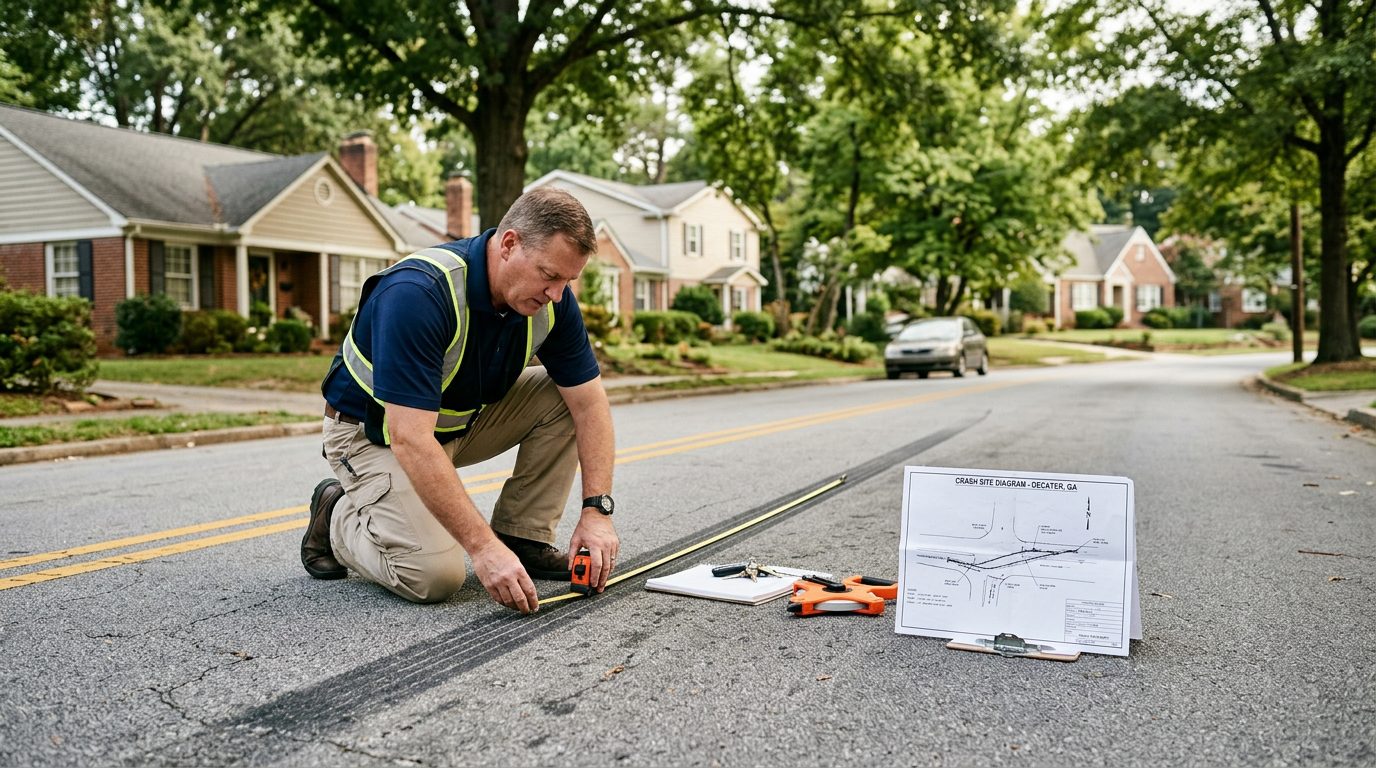
Before law school, Terance Madden trained as an electrical engineer. That training shapes how he works. He asks what the vehicle data records, how the vehicles moved and stopped, and which records must be preserved before they disappear. Crash physics, such as how quickly a vehicle slowed on impact, can test a “low impact” argument.
The firm’s offices are in Jonesboro, Atlanta, Decatur, Macon, and Augusta.
The firm works on a no-fee-unless-we-win basis. You may still be responsible for court costs and case expenses.
Not sure what your next step is?
Talk it through with our team — the first consultation is free, confidential, and carries no obligation.
Questions Families Ask Before Calling a Car Crash Lawyer
Families usually ask about cost, court, and fault first. Short answers follow.
Will I have to go to court?
Some claims settle without a trial. The firm prepares each case as if it will go to trial.
What if I was partly at fault?
Georgia reduces your award in proportion to your share of fault. If you are 50 percent or more responsible, you cannot recover damages (O.C.G.A. § 51-12-33).
What if the at-fault driver has no insurance?
Your own uninsured motorist coverage may apply. Georgia requires auto policies to offer it.
Should I give a recorded statement?
Early recorded statements are a common insurance tactic. Talk with the firm before you give one.
Can a family member call for me?
Yes. A spouse, mother, or adult daughter often makes the first call. The injured person still decides whether to file.
Who pays my medical bills if I have Medicare?
Liability insurance pays first for crash-related care, and Medicare pays second (CMS).
Talk to a Car Crash Lawyer in Decatur Before the Next Insurance Call
If a Decatur crash was someone else’s fault and an insurer wants a statement, get advice before you give one.
Hurt in a crash someone else caused? Start a free case evaluation with T. Madden & Associates, P.C. Call any time, 24/7, before the next insurance call.