


E-Bike Injuries in Georgia
Your Parent Was Hurt on an E-Bike. Here Is What to Do in the First 30 Days.
The first weeks shape both your parent's recovery and the case that follows. Here is a clear, step-by-step plan for the family.
Serving Georgia Families Since 1999
1999
Year the firm began practice
5
Georgia offices: Jonesboro, Atlanta, Decatur, Macon and Augusta
24/7
Call us anytime
By Terance Madden · Published November 17, 2026
Your parent was hurt on an e-bike, and now you’re the one handling the doctors, the calls and the paperwork. Here’s what to do first: get medical care now, protect the bike and the proof, and don’t give an insurer a recorded statement before a lawyer reviews it.
If someone else’s fault caused the crash, your parent may have a claim under Georgia law. The steps below are the ones that matter most in the first 30 days.
The First 72 Hours: Medical Care, the Report and Staying Quiet
The first few days decide what proof you have later. Get your parent checked by a doctor the same day, even if they say they feel fine. Some injuries show up hours or days after a crash.
Ask for a police or incident report. Write down the report number and the agency that responded. Get the other rider’s or driver’s name, phone number and insurance details if you can.
Big Insurance often calls early and asks for a quick talk. Take a message instead. Don’t let your parent give a recorded statement or sign any insurer form until a lawyer has reviewed it. Words said in a hurry can be used later to argue about how the crash happened and how badly your parent was hurt.
If your parent was hurt in an e-bike crash someone else caused, you don't have to sort out the medical bills, the insurance calls and the deadlines alone. Talk it through with our team — the first consultation is free, confidential, and carries no obligation.
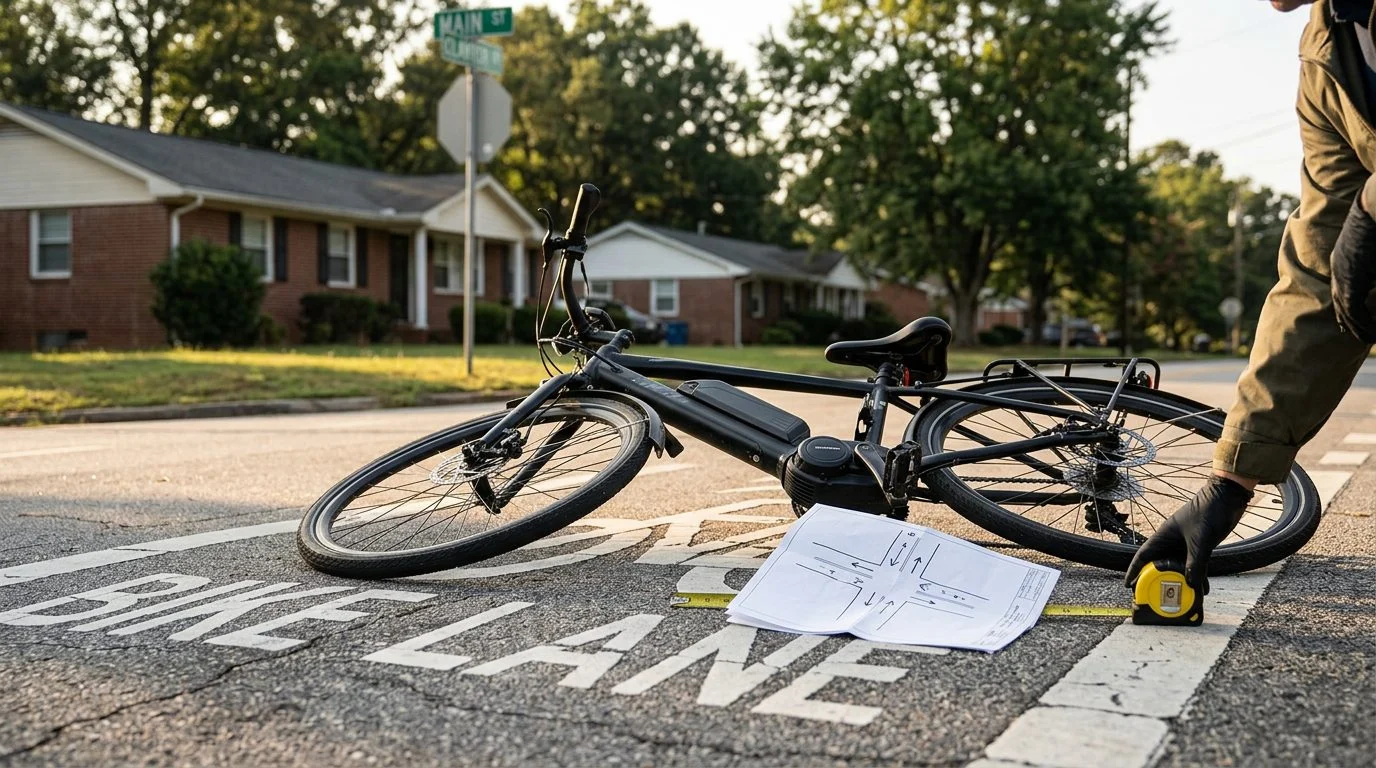
Keep the Bike, the Battery and the Scene
Keep the e-bike exactly as it is. Don’t repair it, sell it or toss it. Store the battery, charger, helmet, clothing, shoes and any broken parts in a safe, dry place.
Photograph the scene, the bike, the damage and any broken sidewalk or road. Save the original files with their dates. Video from nearby homes or businesses can be overwritten fast, so ask for it right away.
Keep receipts, the model and serial numbers, and any warranty or recall papers. If a battery or charger was defective, these records can matter.
Battery evidence is physical. A proper review looks at the cells, the charging circuits and the certification marks on the unit, then traces where a fire or failure began. Terance Madden trained as an electrical engineer (B.S. in Electrical Engineering) before law school. He starts a case by asking what the physical evidence shows, how the crash happened, and which parts and records must be preserved before they’re lost.
Medical Records and the Recovery Paper Trail
Keep one binder or folder for every visit, referral, prescription, bill, test result and discharge summary. Don’t assume the chart tells the whole story. Keep your own copy.
Once a provider receives a signed written request, Georgia’s medical records law gives it 30 days to furnish the records. Ask early.
Track every follow-up visit, physical therapy session and home help. Write down who provides it and how many hours. Keep a simple daily note on pain, sleep, mobility and the tasks your parent can no longer do alone. Plain words and dates work best.
Bills need proof. Georgia law limits medical expenses to the reasonable value of necessary care, and with health insurance, the evidence includes amounts actually needed to satisfy the charges (O.C.G.A. § 51-12-1.1). Keep every explanation of benefits. Money losses you can count must be proved, while general damages like pain are presumed to flow from the crash (O.C.G.A. § 51-12-2).
If your parent has Medicare, tell the firm early. Medicare may pay some bills first and then seek repayment from a settlement (CMS).
The Insurance Calls: What Big Insurance Will Try
Big Insurance is not on your parent’s side. Its job is to pay less. An insurer’s first offer is rarely what a claim is worth.
Expect these tactics: a fast, low offer before the medical picture is clear; requests for a recorded statement; slow answers that drag a file out; arguments that treatment wasn’t needed; and “low impact” claims that say the crash was too minor to cause serious harm.
The response starts with every layer of coverage. The at-fault driver’s liability coverage is the first place to look. Georgia auto policies can include uninsured motorist coverage, which pays the insured for injuries caused by an uninsured vehicle. The insured may reject this coverage or choose lower limits, but only in writing. Umbrella, excess and corporate policies may also apply when a business shares fault.
“Low impact” is a question of physics. Terance Madden’s engineering training helps him check how speed and force relate to the injury, instead of taking the label at face value.
Who Else May Be Responsible for the Crash
Start with the driver or rider who caused the crash. Then look wider. Georgia law requires the fact-finder to consider the fault of everyone who contributed, named in the suit or not (O.C.G.A. § 51-12-33). Each at-fault party pays its own share, not a shared pot. If your parent is 50 percent or more responsible, Georgia law bars any recovery.
A defective battery or charger can point to the manufacturer. Under Georgia law, a manufacturer can be liable, regardless of privity, to a natural person who uses, consumes, or is reasonably affected by personal property sold as new when the property was not merchantable and reasonably suited to the use intended and its condition when sold is the proximate cause of the injury sustained (O.C.G.A. § 51-1-11). That claim generally must be brought within ten years of the product’s first sale. Under O.C.G.A. § 51-1-11(c), the same ten-year limit, counted from the date the product was first sold for use or consumption, also applies to a negligence claim against a manufacturer. It does not apply to a claim that the manufacturer’s negligence made a product that causes a disease or birth defect, or to a claim based on conduct showing a willful, reckless, or wanton disregard for life or property.
A rental or shared e-bike operator may carry responsibilities and insurance of its own. If poor road design or maintenance played a part, a government entity may be involved. Those claims have strict notice rules. A claim against the state requires written notice within 12 months of the date the loss was discovered or should have been discovered (O.C.G.A. § 50-21-26). A claim against a city requires a written claim within six months of the happening of the event the claim is based on, stating the specific dollar amount sought (O.C.G.A. § 36-33-5).
The Clock: Georgia Time Limits You Need to Know
Questions about timing are best raised early, while evidence is still fresh. For most injuries to the person, Georgia gives two years after the right of action accrues (O.C.G.A. § 9-3-33). A spouse’s claim for loss of consortium, the loss of marital companionship, has four years under the same statute.
Under O.C.G.A. § 9-3-99, the time limit for a tort claim brought by the victim of an alleged crime committed in Georgia, when the claim arises out of the facts and circumstances of that crime, is paused, or tolled, from the date of the crime until the prosecution is final or otherwise ends. That pause cannot exceed six years, except as otherwise provided in Code Section 9-3-33.1. Don’t plan around a pause.
Not sure what your next step is?
Talk it through with our team — the first consultation is free, confidential, and carries no obligation.
When to Call the Firm and What the First Consultation Covers
If your parent was hurt in an e-bike crash that someone else’s fault caused, and you’re now running the doctor visits, the insurance calls and the paperwork, a call can help you sort out the next steps. The initial consultation is free, confidential and comes with no obligation to continue.
T. Madden & Associates, P.C. handles personal injury cases on a no-fee-unless-we-win basis. The client may still be responsible for court costs and case expenses. The firm has practiced since 1999, with offices in Jonesboro, Atlanta, Decatur, Macon and Augusta. Terance Madden is the responsible lawyer for this page. Our team is available 24/7, so you can reach out through our contact page any time.
Frequently Asked Questions
What should my mother do first after an e-bike crash in Georgia?
Get medical care right away, even if she feels fine, because some injuries show up hours or days later. Report the crash to the police, and if she can, take photos of the scene, the bike, and any injuries.
Should my mother talk to the other driver’s insurance company?
She should speak with a lawyer before giving a recorded statement or signing anything. Big Insurance is not on her side, and an insurer’s first offer is rarely what a claim is worth.
How long does my mother have to file a claim in Georgia?
For most personal injury claims, Georgia’s statute of limitations, the legal deadline to file a lawsuit, is generally two years from the date of injury (O.C.G.A. § 9-3-33). Some claims have different deadlines, so it is wise to talk with a lawyer early.
I’m helping my mother with her recovery. What should I keep track of?
Keep every medical bill, appointment note, prescription receipt, and record of missed work or help you give her at home. Call T. Madden & Associates, P.C. to start a free case evaluation; the first consultation is free, confidential, and comes with no obligation to continue.