

E-Bike Crashes | Georgia
Gather the Right Evidence After Your E-Bike Crash
Photos, witness names and medical records do the most good when they are collected early. Here is what to keep, and how to keep it organized.
T. Madden & Associates, P.C.
1999
Representing injured Georgians since
5
Georgia offices: Jonesboro, Atlanta, Decatur, Macon and Augusta
24/7
Call line available around the clock
By Terance Madden · Published November 7, 2026
After an e-bike crash in Georgia, the evidence you keep in the first days can shape the whole claim. You need four kinds of proof: the scene and witnesses, the bike and battery, the motor and speed settings, and your medical records. Keep each one as it is, and don’t let anyone reset, repair or clean it up until it is documented.
This page explains what to keep, why it matters and how Georgia law treats it. If you are handling this for someone you love, these steps are written for you too.
What to Record at the Scene First
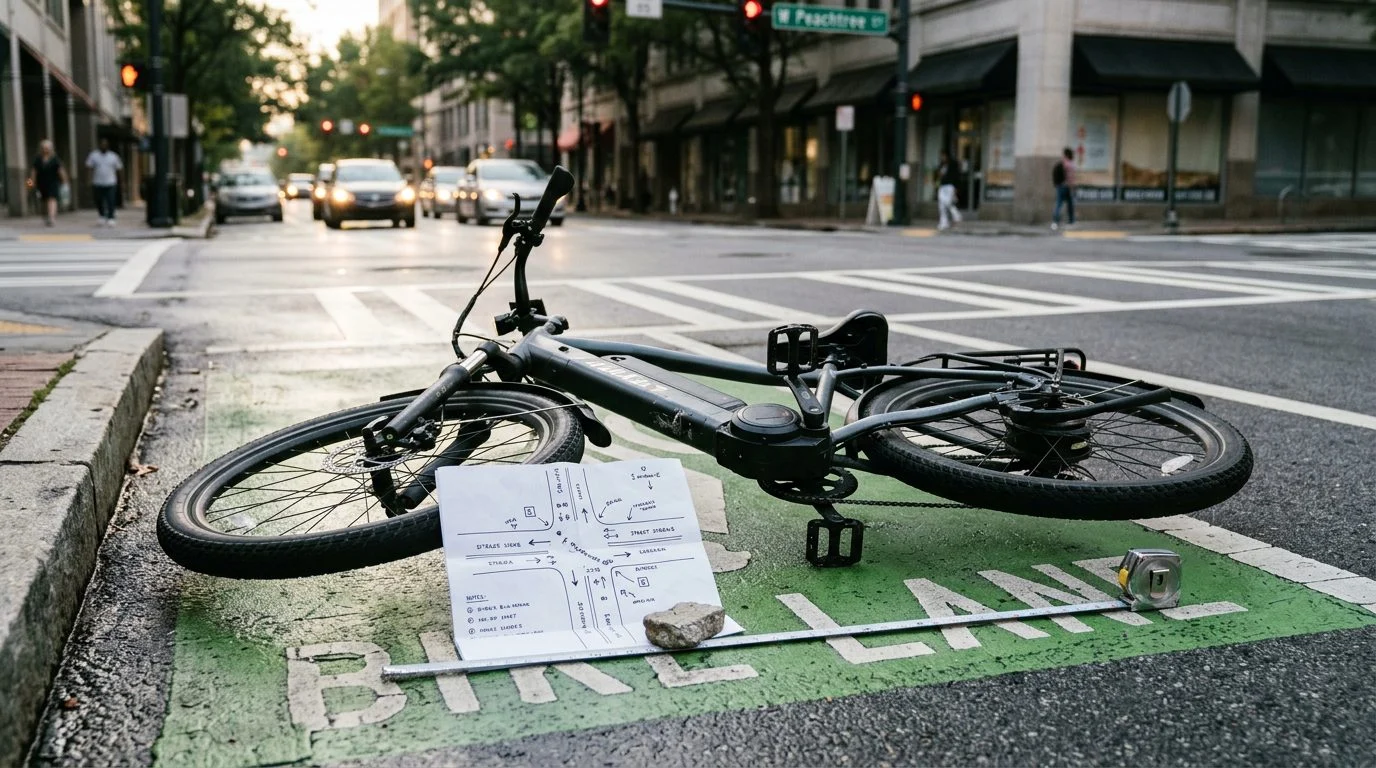
Call 911 first, then record what you can while you are still there. Ask for a police report, even if you feel fine at the time.
Georgia law requires a driver in a crash that causes injury, or property damage of $500.00 or more, to report it right away. Inside a city, that means the local police. Outside one, it means the county sheriff or the nearest state patrol office. O.C.G.A. § 40-6-273
Write down the time, the exact street or intersection, and the report number if you get one. Then take photos before anyone moves the bike. Shoot the bike where it lies, the damage, the roadway, any skid marks and any debris. Get the other vehicle’s plate number if you can.
Witnesses forget details fast. Ask for each person’s name and phone number. Write down what each one saw while it is fresh. A short note works, such as “saw the gray van run the stop sign.”
A costly mistake is moving the bike off the road before photos are taken. Once it is moved, its position is hard to prove. For more on the firm’s e-bike work, read the e-bike claims guide for Georgia.
If your bike, battery or medical file is still unsettled after a crash someone else caused, our team can walk you through what to keep and what it may mean for your claim. Talk it through with our team — the first consultation is free, confidential, and carries no obligation.
The Battery: Model, Condition, and Stored Data
Keep the battery exactly as it was after the crash, and write down what it is. The battery can show what happened to the bike.
Impact damage, swelling, overheating or fire may point to a cause of the crash. Don’t throw the battery away, even if it looks ruined. Write down the brand, model and serial number, which are usually printed on the pack or the frame.
Note whether the battery came with the bike or was a replacement. If it was replaced, keep the receipt. Keep the battery in a dry place away from heat, and tell the firm where it is.
Do not charge, open, repair or discard a damaged battery. A damaged battery can be a fire risk, so handle it with care.
Some e-bike systems store charge and fault records. A qualified inspection can read those records. A reset or software update can erase them, so ask anyone who handles the bike to leave the settings alone until the file is preserved.
Georgia courts have stated the duty to preserve evidence. Preserve early.
The Motor and Controller: Rated Power and Speed Settings
The motor and controller set how much help the bike gives and how fast it can go. Their settings are part of the physical proof of how the bike ran.
The motor’s rated power is its design output. The controller reads the throttle and pedal input, then sets the assist level and the speed cutoff. Those settings affect how hard the bike pushes, which matters when the crash is studied closely.
Write down the assist level, the speed limit setting and the display mode at the time of the crash. If the display still shows those settings, photograph it before you change anything. If you can’t remember them, write that down too.
Flag any change to the bike. Examples include a removed speed limiter, a larger battery or a new controller. These changes affect how the bike performed, so they must be recorded, not hidden. Tell the firm about them early.
Do not take the bike to a shop for repairs or upgrades until it has been inspected and documented. A repair can change the bike’s condition on the day of the crash.
Keep the owner’s manual and any label that shows the motor’s rated power. Those papers help show how the bike was built and set up.
Speed Evidence: App Data, Video and Witnesses
Ride data and video often show speed and path more clearly than memory does. Start with the devices you already own.
Check your phone for ride-tracking apps and GPS history. Fitness watches and the bike’s companion app may also log speed, time and route. Keep the phone and its data. Do not delete ride history, texts or photos from that day.
Nearby businesses, doorbell cameras and traffic cameras may have recorded the crash. Footage is often overwritten on a set schedule, so ask for copies as soon as you can. Write down which businesses are close to the crash site.
A speed reconstruction combines this data with the road layout and the distance the bike needed to stop. Together, those facts show where the rider and the driver were before impact.
Terance Madden has been in practice since 1999, and the firm handles car and truck crash cases. That background helps explain what the numbers mean in plain terms.
Medical Records That Tie Injuries to the Crash
Medical records are the evidence that links your injuries to the crash. Early treatment creates the first records, and those records describe how the injury happened and what you reported at the time.
Keep every bill, discharge paper, prescription receipt and imaging report. Note the mileage to each appointment and the time you lost from work. Georgia law treats special damages, which actually flow from a tortious act, as damages that must be proved. O.C.G.A. § 51-12-2
Keep a daily log of pain, the tasks you can’t do, and each appointment. The person helping with recovery should keep this log, because the rider may not have the energy to write it.
Check who may sign that authorization before you make the request.
When the Driver Leaves the Scene
If the driver left, Georgia law still required them to stop. A driver in a crash that causes injury or death, or damage to a vehicle driven or attended by any person, must stop at the scene and give a name, address and registration number. O.C.G.A. § 40-6-270
If the injured person is unconscious, appears deceased, or is otherwise unable to communicate, the driver must make every reasonable effort to call emergency medical services and police. Knowingly failing to stop after a serious injury or death is a felony, punishable by one to five years in prison.
Under O.C.G.A. § 33-7-11, an auto liability policy issued or delivered in Georgia must contain an endorsement or provisions to pay the insured for bodily injury, loss of consortium or death caused by the owner or driver of an uninsured motor vehicle, and the exact terms of your own policy shape how that uninsured motorist coverage works in your claim.
Record the vehicle’s make, color, partial plate, direction of travel and the driver’s appearance as soon as you can. Ask nearby businesses to keep their video. Note who else saw the driver leave.
Big Insurance adjusters often make a first offer early, before your medical picture is clear, and an offer made that soon can miss treatment you have not had yet. Before you accept any offer or sign a release (a paper that ends your claim for good), finish the care your doctors advise, keep every bill and record, and let our team review the numbers with you. Read any offer with your records in hand. Keep the file complete before you respond.
Not sure what your next step is?
Talk it through with our team — the first consultation is free, confidential, and carries no obligation.
Georgia E-Bike Rules and How They Apply to Evidence
Evidence from the crash scene can matter in every claim. A judge reduces the damages by the injured person’s percentage of fault, and the injured person receives no damages if they are 50 percent or more responsible for the injury or damages claimed. O.C.G.A. § 51-12-33 O.C.G.A. § 51-12-33
Under O.C.G.A. § 51-12-33 (Quynn v. Hulsey (2020))(g), a plaintiff who is 50 percent or more responsible for the injury or damages claimed shall not be entitled to receive any damages. That is why evidence showing the other party’s share of fault matters as much as your injuries.
The fact-finder also considers the fault of everyone who contributed to the harm.
Georgia law generally gives injury claims two years to be filed, though exceptions can apply, so calendar that deadline from the day of the crash and keep your records organized from the start.
Keep the bike’s manual and any label showing its motor rating and speed setup. Physical proof of how the bike was built shows the condition of the bike as well as the rider’s account.
Frequently Asked Questions
What should I check after an e-bike crash?
Check the scene, the bike, the battery, witness names and your medical care. Photograph everything before it is moved, and get medical treatment as soon as you can.
Will insurance pay if the driver leaves?
Under O.C.G.A. § 33-7-11, uninsured motorist coverage is part of most Georgia auto policies unless the insured rejects it in writing. Whether you have this coverage depends on your own policy. The terms of the rider’s own policy decide what it pays.
What evidence do I need after an e-bike crash in Georgia?
Keep the scene photos, witness names, the bike and battery in their post-crash state, the motor and speed settings, app data and your medical records. The e-bike claims guide for Georgia covers the firm’s e-bike work in more detail.
How long do I have to file a lawsuit?
Georgia generally requires a personal injury lawsuit to be filed within two years. Keep your evidence organized from the first day.
Talk With the Firm About Your Evidence
If you’re dealing with this now, you don’t have to decide what to keep on your own. A crash you didn’t choose can leave a bike in a garage, a battery on a shelf and a family sorting through bills. You may not yet know whether to speak with a lawyer, and that is a reasonable place to start.
The firm offers a free first consultation. It is confidential and carries no obligation to continue. The firm works on a no-fee-unless-we-win basis, but you may still be responsible for court costs and case expenses.
You can start a free case evaluation or call the firm’s line, which is available 24/7. The firm has offices in Jonesboro, Atlanta, Decatur, Macon and Augusta.