

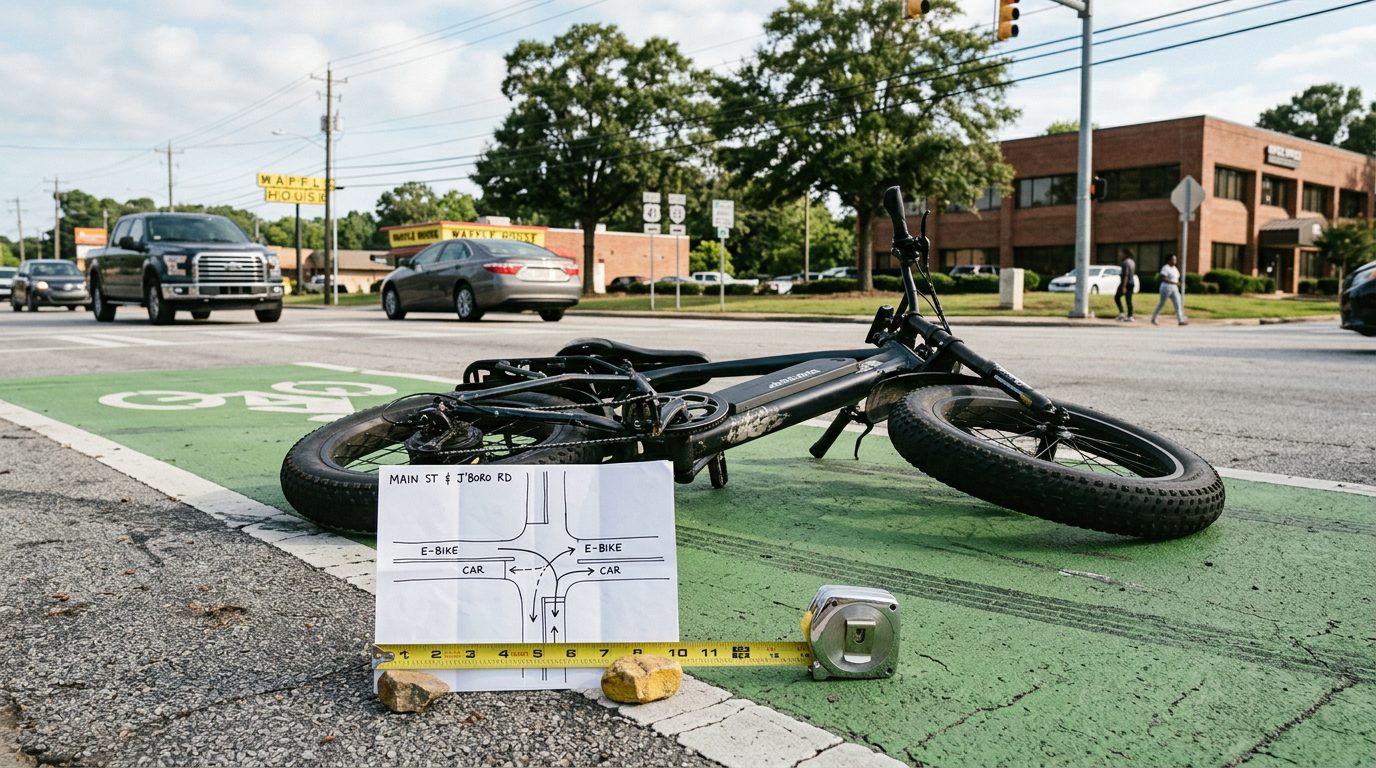
E-Bike Crash Lawyer | Georgia
Hurt in an e-bike crash? Understand the hospital lien before you settle.
Hospital bills, liens and who gets paid first can get confusing fast. T. Madden & Associates, P.C. helps you sort it out.
Serving Georgia since 1999
1999
Year the firm began practicing law
5
Georgia offices: Jonesboro, Atlanta, Decatur, Macon, Augusta
Free
First consultation, confidential, no obligation
By Terance Madden · Published November 13, 2026
After an e-bike crash, the hospital bill doesn’t go away just because a claim is open. It’s one of the first things to check, not the last.
This guide explains how these liens work in Georgia, how Big Insurance handles them, and what the person managing the bills can do now. T. Madden & Associates, P.C. has practiced law since 1999 and represents people hurt in e-bike crashes, car and truck wrecks, and other serious injury cases.
Hospital Bills After an E-Bike Crash: What a Lien Is and Why It Matters
A lien is a legal claim against money or property that secures a debt. A medical lien is a lien tied to unpaid medical care.
A lien doesn’t make the bill disappear. It also doesn’t tell you what the bill is worth. Those are separate questions, and both need answers before any money changes hands.
Here’s the trap. The bills arrive now, while the insurance claim moves slowly. The family ends up stuck between a balance that keeps growing and a case that takes months to resolve.
Many families first hear about a lien when a settlement gets close. Ask about it early instead. Early review gives you time to check the bills and the paperwork.
Not sure what your next step is?
Talk it through with our team — the first consultation is free, confidential, and carries no obligation.
How Georgia Limits Medical Bills in an Injury Claim
In a Georgia injury claim, medical expenses are recoverable only at the reasonable value of medically necessary care, treatment, or services, so the amount on the bill matters in every settlement talk.
Georgia limits medical costs to the reasonable value of care that was medically necessary, and the trier of fact decides that amount (O.C.G.A. § 51-12-1.1). Those costs are called special damages. Special damages are money losses you have to prove, such as bills and lost wages (O.C.G.A. § 51-12-2).
A letter of protection is a promise from a provider to wait for payment until the case settles.
Whether and how a lien applies depends on the facts. Treat it as one more fact to review. Never ignore it or pay it off without checking the bill first.
How Georgia’s Fault Rules Shape an E-Bike Claim
A rider who is 50 percent or more at fault recovers nothing under Georgia’s fault rules (O.C.G.A. § 51-12-33; Quynn v. Hulsey (2020)). Lesser fault reduces the award.
Georgia uses a modified comparative fault rule, which means your award shrinks by your share of fault, and you recover nothing if you are 50 percent or more responsible for the injury or damages claimed. The trier of fact, the jury or judge who decides the facts, sets your percentage. Under O.C.G.A. § 51-12-33, damages are reduced to match that percentage.
- Each defendant pays only its own share. The damages are not a joint liability.
- Under the avoidance rule, if you could have avoided the harm with ordinary care (reasonable care), you can’t recover. See O.C.G.A. § 51-11-7.
Many riders assume the other driver’s fault ends the question. It doesn’t. Big Insurance will look for every share of fault it can put on you.
How Big Insurance Handles Liens and Medical Bills in an E-Bike Claim
Big Insurance isn’t on your side, and a first offer is rarely what your claim is worth.
Expect these tactics:
- A low early offer, made before the medical picture is clear.
- A request for a recorded statement, often before you understand your injuries.
- Slow payment and repeated requests for the same records.
- Disputes over treatment, including claims the care was unrelated to the crash.
- The “low impact” argument, which tries to shrink a serious injury into a small crash.
The response has several parts. The firm pursues every coverage layer: liability coverage, uninsured and underinsured motorist (UM/UIM) coverage, umbrella and excess policies, and corporate coverage when it applies. Georgia auto policies must include uninsured motorist coverage, within limits the policyholder chooses (O.C.G.A. § 33-7-11).
Lifetime costs belong in the picture too. Georgia lets a trier of fact reduce future economic losses to present value, using a 5 percent discount rate or another rate it finds right (O.C.G.A. § 51-12-13).
When a lawyer prepares a written offer on a motor vehicle claim, the offer must follow set rules. If terms are unclear, you may ask for clarification in writing without making a counteroffer.
The firm prepares every claim as if it will go to trial. That preparation doesn’t promise a result. It keeps the claim from moving only on the insurer’s timetable.
How the Firm Checks the Bills Against the Crash Evidence
The firm checks each bill against the crash evidence and the medical records before it agrees to any lien amount.
The bill has to match the treatment, and the treatment has to match the crash. Itemized charges, treatment notes, and crash evidence should line up. When one piece doesn’t fit, the lien amount is open to question.
Before law school, Terance Madden trained as an electrical engineer, so he starts a case by asking what the evidence shows and how the crash happened. He holds a B.S. in Electrical Engineering and a Vanderbilt law degree. In a case like this, he looks at the speed and path of the vehicles, the point of impact, and the injury pattern. Those facts show whether an injury fits the crash, and the bills must fit that same picture.
Sometimes the evidence points past the driver. A brake, tire, or parts maker, or a maintenance vendor, can share fault. Each may carry its own insurance, and more liable parties can mean more coverage to pursue. Crash data and records need to be requested and preserved early.
The firm also reviews bills for charges the records don’t support, such as duplicate entries. A clean review gives a fair basis for resolving the lien.
If You Are Managing a Family Member’s Hospital Bills After an E-Bike Crash
If you handle your family member’s bills, you can request their medical records directly.
Under Georgia law, a provider having custody and control of a patient’s record must furnish a complete and current copy of that record after a written request from the patient or another person authorized under the statute, and the record must be furnished within 30 days of receipt of the request, accompanied by the required HIPAA authorization and a signed written authorization (O.C.G.A. § 31-33-2). A provider may refuse to furnish the record to the patient if it reasonably determines that disclosure will be detrimental to the patient’s physical or mental health, but then the record must be furnished, on written request, to another provider the patient designates. The request needs a signed written authorization indicating that the requester is authorized to have access to the patient’s records under paragraph (2) of subsection (a).
- Keep every bill, discharge paper, and insurer letter in one folder.
- Write down the date, the name, and a short summary for every call.
- Ask for an itemized statement before you sign any payment or settlement paper.
- If your relative has died, the request order is the appointed executor or administrator, then the surviving spouse, then a surviving child, then a parent.
You’ve likely carried a lot of this already. You don’t have to handle the lien, the insurer calls, and the paperwork alone. The firm works with the family on each step.
Not sure what your next step is?
Talk it through with our team — the first consultation is free, confidential, and carries no obligation.

Common Questions About Hospital Liens After an E-Bike Crash
Short answers to the questions families ask most.
What is the lien statute for hospitals in Georgia?
Under O.C.G.A. § 51-12-1.1(b), special damages for medical and healthcare expenses in a civil injury case are limited to the reasonable value of medically necessary care, treatment, or services, and the trier of fact determines that amount. This section does not create or govern hospital liens. Review the bills before any lien is paid.
Should I go to the hospital after a bike crash?
Yes. Get medical care first. Your health comes first, and records from that visit become part of your claim.
Can I recover damages if the at-fault driver was uninsured?
Georgia auto policies must include uninsured motorist coverage, within limits the policyholder chooses. That coverage may apply when the driver had no insurance.
Do I pay the firm if there is no recovery?
The first consultation is free, confidential, and carries no obligation to continue.
If hospital bills are stacking up while a claim sits, or a settlement offer doesn’t match the bills, you don’t have to sort it out alone. Start a free case evaluation with T. Madden & Associates, P.C., and we’ll review the bills and the offer with you.