

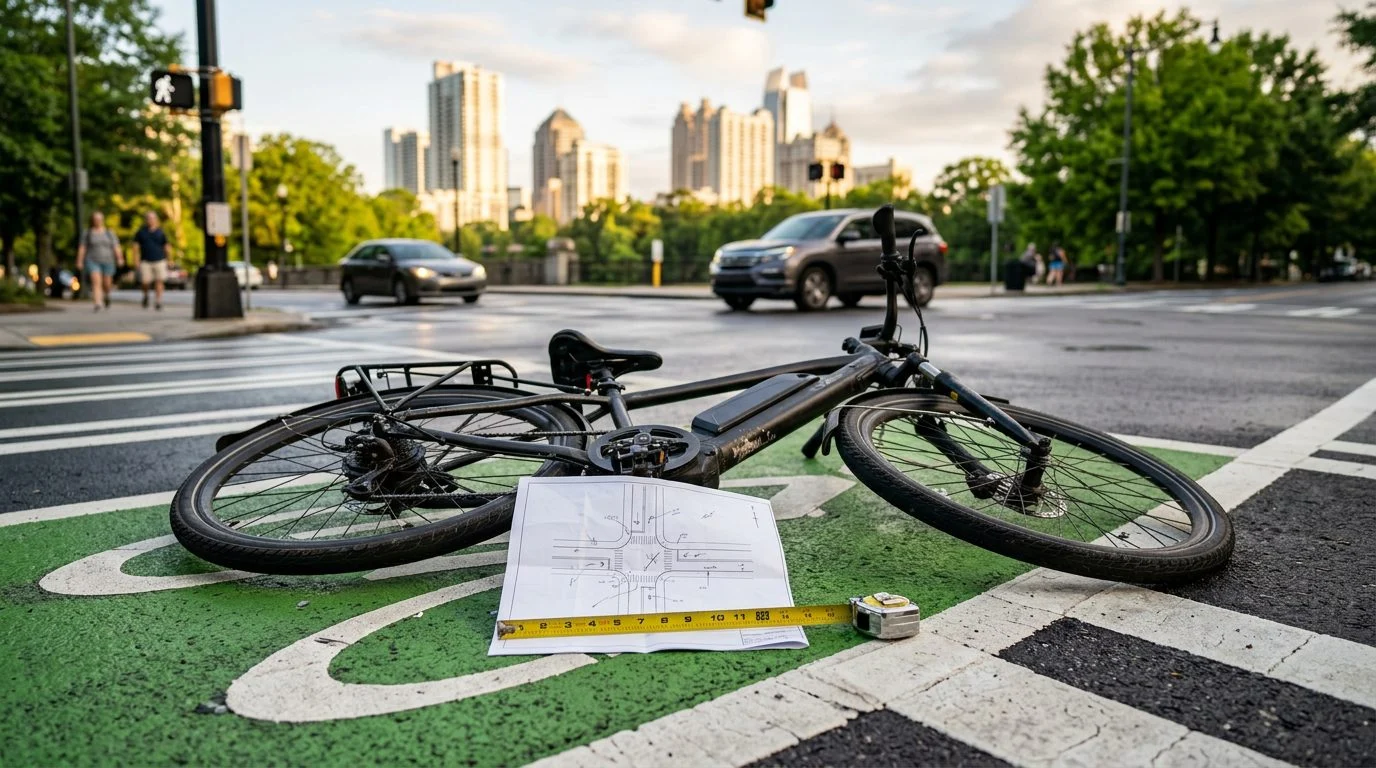
E-bike crashes in Georgia
Hurt in an e-bike crash? Protect the evidence now.
Battery data, scene photos and witness names can disappear within days. Here is what to secure first, and how the firm can help you do it.
By Terance Madden · Published November 9, 2026
After an e-bike crash, the bike is often the clearest record of what happened. Protect it, every broken part, and any video or data from the crash before anyone repairs, sells, or throws them out.
E-bike crash evidence in Georgia can disappear fast. A shop can straighten a frame in a day, and one trash pickup can take a cracked battery.
The Bike Is Evidence, Not Just Property
The bike and the scene hold the physical record of speed, impact, and what failed. Treat them as evidence from the first hour.
Scuffs on the pavement, gouges on the frame, and the spot where the bike came to rest all tell a story. They show which way the rider was moving and where the force landed. Once someone straightens a wheel or hauls the bike away, that story changes.
Repairs, sales, and trash pickup can erase proof within days. Many riders assume a bent bike is not worth keeping. Its value to a claim is not its resale price.
Your injury claim has its own clock, which we cover below.
For the full picture of e-bike claims, read our e-bike accident claims guide. The firm has offices in Jonesboro, Atlanta, Decatur, Macon, and Augusta.
If your e-bike crash was someone else's fault and the bike is still in a garage or shop, we can talk through what to protect next. Talk it through with our team — the first consultation is free, confidential, and carries no obligation.
Protect the Bike and Its Parts
Do not repair, sell, or throw away the bike or any broken part until it has been documented and examined.
Take photos of every side of the bike, every broken part, and the model label. Keep receipts, service records, and any older photos that show the bike’s condition before the crash. Store broken parts somewhere dry, labeled with the date.
Brakes matter most in a brake failure crash. Pad wear, a cut or kinked cable or hydraulic line, and rotor condition can show whether stopping power was there.
Tires and wheels tell their own story. Tread wear, bead damage, and flat or blowout marks can point to maintenance problems or a defect.
The battery, controller, motor, and frame show damage patterns. The battery management system (the chip that tracks charge and faults) may hold a record of what happened. An engineer can read the damage and separate crash marks from a part that failed first.
Liability means legal responsibility for harm. A repair shop, a parts maker, or a seller may share it. Under O.C.G.A. § 51-12-33, the jury or judge weighs the fault of everyone who contributed to the injury, even a party who was never sued. More responsible parties can mean more insurance available to pay the claim, but each party is liable only for its own percentage of fault share; that share is not a joint liability among the persons liable and is not subject to any right of contribution.
Digital Traces That Vanish Fast
Phone data, video, and vehicle memory can be overwritten, so ask for preservation early. Preservation means keeping the evidence exactly as it is.
Some e-bikes store ride or battery data in a display or companion app. Not every bike does. Do not reset, update, or pair the bike with a new phone until someone has checked what it stores.
Your phone is evidence too. Keep the photos and video you took at the scene, along with any ride-tracking app data. Delete nothing, even blurry shots.
Security cameras from homes and businesses near the crash can record over old footage quickly. A written request to preserve that footage is a step the firm can take fast.
If a car or truck was involved, its event data recorder (a built-in memory of speed, braking, and impact) may show what the driver was doing. Trucks add an electronic control module (ECM, the vehicle’s main computer), a black box, and driver logs. These records must be requested quickly.
Write down who has the bike, the phone, and the video, and when they got it. That chain of custody (a record of who held evidence and when) keeps the proof usable.
Why an Engineer Reads the Physics of the Crash
An engineer can turn scene marks and vehicle data into measurements instead of guesses.
Scene measurements matter. Skid marks, the debris field, and where the bike and vehicle came to rest show the path and speed. Each mark can be checked against physics, not memory.
Delta-V (the change in a vehicle’s speed during impact) helps show the force a rider’s body took. That force bears on the injuries claimed, and on whether they match the crash.
Terance Madden holds an engineering degree, and that training helps him read bike data, scene marks, and vehicle logs.
The “low impact” argument is common. Big Insurance often says a crash was too minor to cause real harm. Scene physics can answer that argument with measurements, which is harder to brush off than a guess.
What Big Insurance Does With Weak Evidence
Big Insurance is not on your side, and its first offer is rarely what your claim is worth.
Expect an early low offer and a request for a recorded statement before your injuries are known. Expect delays, disputes over your treatment, and the “low impact” or “rider at fault” argument.
The response is to document everything, keep every piece of evidence, and pursue every coverage layer.
Georgia requires auto liability policies to include a promise to pay the insured for injuries caused by an uninsured motor vehicle, under O.C.G.A. § 33-7-11.
If a car was involved, Georgia sets rules for written settlement offers. Under O.C.G.A. § 9-11-67.1, for a written offer to settle a motor vehicle injury claim that is prepared by or with an attorney and made from the time a cause of action accrues until the named defendant files an answer or, if there are multiple named defendants, until all named defendants have filed their initial answers or been found in default, the payment date must be at least 40 days after the offer is received.
Georgia also cuts recovery for shared fault. Under O.C.G.A. § 51-12-33, a rider found 50 percent or more responsible cannot recover any damages.
Damages are what a claim seeks. Under O.C.G.A. § 51-12-2, general damages are those the law presumes to flow from the wrong, and they need no proof of an amount. Special damages actually flow from the wrong and must be proved. Lifetime damages can include future care and lost earning ability. The firm prepares every case as if it will go to trial.
A Plan for the Person Managing the Recovery
Start with a short weekly checklist: protect the bike, save every photo, and write down every insurer call.
- Photograph the bike, the scene, and every broken part.
- Write down witness names and phone numbers.
- Save medical visit papers, bills, and work notes.
- Log each insurer call with the date, the caller’s name, and what was asked.
Keep a simple log of symptoms, appointments, and missed work. Those notes show the daily cost of the injury, which is part of what a claim measures.
Georgia generally gives two years for injury claims, and the statute has exceptions. Under O.C.G.A. § 9-3-33, actions for injuries to the person must be brought within two years after the right of action accrues, except for actions involving loss of consortium, which must be brought within four years, meaning the date the claim arises.
If the crash happened in Clayton County, the firm’s Jonesboro office is in that county. Our Clayton County e-bike page covers local riders.
Terance Madden is the responsible lawyer for this page. The firm works on a no-fee-unless-we-win basis, but you may still be responsible for court costs and case expenses.
If your e-bike crash was someone else’s fault and the bike is still in a garage or shop, start with a free first consultation. It is confidential and carries no obligation to continue. Reach out through the firm’s contact page.
Not sure what your next step is?
Talk it through with our team — the first consultation is free, confidential, and carries no obligation.
Frequently Asked Questions
What evidence matters most after an e-bike crash in Georgia?
Photos of the scene, the bike, your injuries, and any road hazard are the most useful early evidence. Also write down witness names and the police report number while the details are fresh.
Can the e-bike’s battery or controller prove what happened?
They can. The controller and battery management system may store speed, power, and fault data. Keep the bike and battery as they are, and do not repair or sell them before a lawyer reviews them. Terance Madden’s engineering training helps him read this kind of data.
Do video and phone records matter in an e-bike crash case?
They can. Security cameras, dashcams, and phone GPS or app data may show speed, timing, and who had the right of way. Ask the owner of any nearby camera to save the footage now, because many systems overwrite old video.
How long do you have to file an e-bike crash lawsuit in Georgia?
In most Georgia injury cases, the statute of limitations, which is the legal deadline to file a lawsuit, is two years from the date of the crash. Evidence disappears over time, so a free first consultation with T. Madden & Associates, P.C. is a good place to start.