

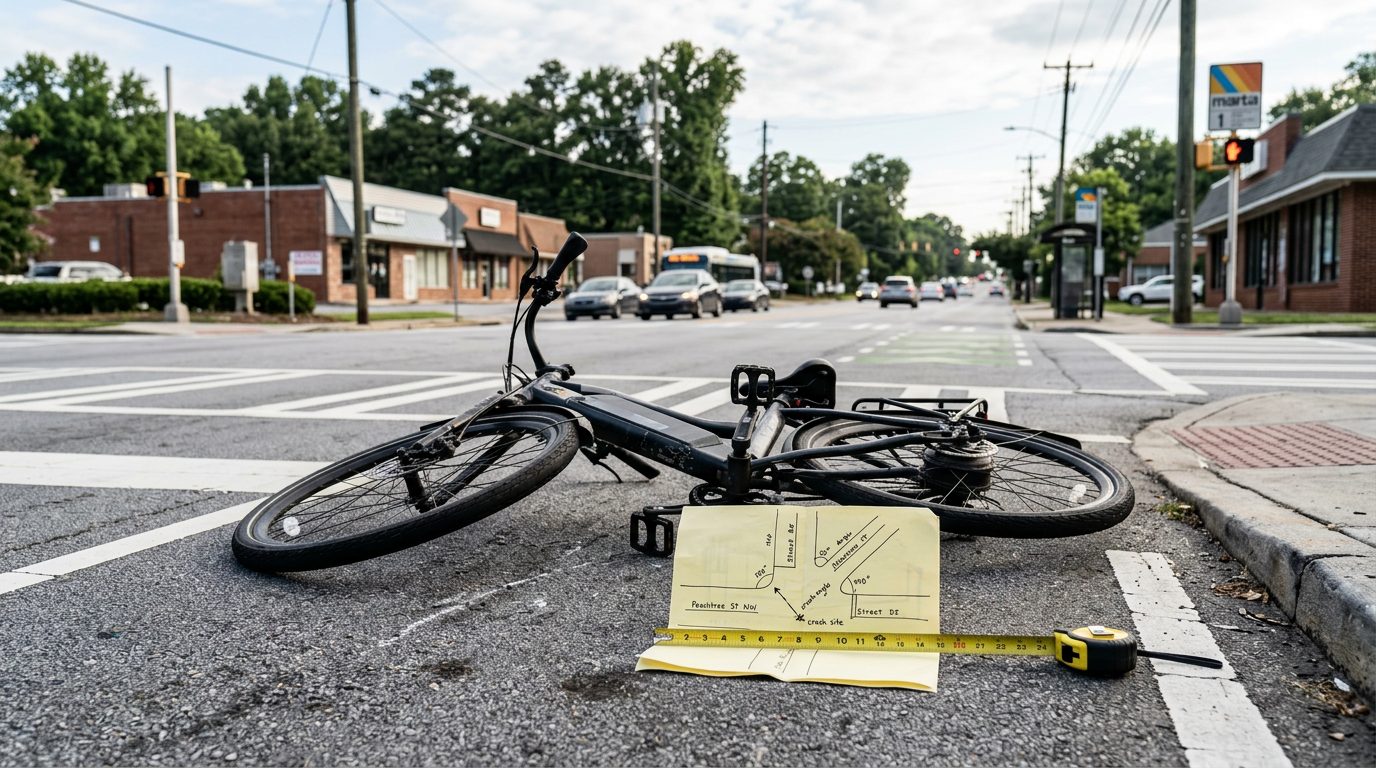
E-Bike Crash Lawyer · Georgia
Hurt on a rented e-bike? Talk with a Georgia crash lawyer today.
A rental unit can fail in ways the rider never sees, and several parties may be involved. We look closely at the device, the paperwork and the scene before anyone decides what comes next.
T. Madden & Associates, P.C.
1999
Year the firm began practice
5
Georgia offices
24/7
Call us any time
By Terance Madden · Published November 15, 2026
If you were hurt on a rented or shared e-bike, you may be asking who has to pay. Often, more than one party does.
The rental company, a battery or parts maker, a repair shop, another driver or a city can each carry a share, depending on what failed and why.
Who Can Be Liable When a Rented or Shared E-Bike Crashes in Georgia
More than one party can be liable when a rented or shared e-bike fails or a crash follows. The answer turns on three things: what failed, who controlled the bike, and who was on the road.
Most of these claims rest on negligence. Under O.C.G.A. § 51-1-2, negligence is the absence of the care an ordinarily prudent person would use in the same circumstances. A defective battery or part can support a product claim instead, or in addition.
Every party has its own role. The sections below show how responsibility usually breaks down, and why the facts of each case still matter.
If a rented or shared e-bike failed and left you or someone you love hurt, you may have a claim, and our team can review who may be responsible. Talk it through with our team — the first consultation is free, confidential, and carries no obligation.

Who May Be Liable, Party by Party
Responsibility can fall on several parties at once. Here is who usually comes up.
- The rental or share company. It often controls inspection, repair, charging and safety checks. Duties it takes on, or ignores, can make it responsible.
- The battery or product maker. Lithium-ion battery defects, overheating, and off-brand or counterfeit chargers and parts can lead to a fire or explosion.
- Repair and maintenance vendors. Brakes, tires, controllers and wiring that were done wrong, or never done, can be the real failure.
- Another driver or rider. A car or truck that cut across the path, ran a signal or hit the e-bike can be responsible.
- A city, county or property owner. Broken pavement, missing signs or a dangerous path design can be the cause. Claims against a city have a short clock: a written claim to the governing authority within six months (O.C.G.A. § 36-33-5).
A company that only puts its name on a product made by someone else is a product seller, not a manufacturer, for strict liability purposes (O.C.G.A. § 51-1-11.1).
Your own choices count too. Georgia reduces damages by the injured person’s share of fault, and a share of 50 percent or more bars recovery (O.C.G.A. § 51-12-33). Each liable party then pays its own percentage, not a joint share. Under the statute, the fault of a nonparty is considered only if the plaintiff settled with that nonparty, or if a defending party gives notice at least 120 days before trial that the nonparty was at fault (O.C.G.A. § 51-12-33).
What an E-Bike Share or Rental Crash Case Can Cover
A claim can cover the money you lost and the harm you live with. Georgia splits damages into two kinds. Special damages are actual costs you must prove, like bills and lost pay. General damages are harms the law presumes from the wrong (O.C.G.A. § 51-12-2).
- Medical bills. Recovery is limited to the reasonable value of medically necessary care (O.C.G.A. § 51-12-1.1). That can include emergency care, surgery, imaging, rehab and future care, if it is medically necessary; the trier of fact determines the amount, and either side may challenge the reasonableness of the expenses or the medical necessity of any treatment.
- Lost wages and earning ability. This covers time off work and any change in the work you can do.
- Pain, suffering and loss of enjoyment of life. Jurors weigh these harms from the evidence.
- Property. The e-bike, helmet, phone and clothing, plus rides while you heal.
- Catastrophic injuries. Long-term medical, care and income losses can continue for years. A claim should count all of them.
- Wrongful death. A surviving spouse, or children if there is no spouse, may recover the full value of a spouse’s or parent’s life, as the evidence shows; where there is a surviving spouse, the recovery is equally divided, share and share alike, among the spouse and children per capita, and the spouse receives no less than one-third of it (O.C.G.A. § 51-4-2).
What the Evidence Shows, and Why Engineering Training Matters Here
The evidence often decides who pays. Some of it can disappear fast, so it has to be saved early.
- The battery, its serial number, and the charger and cord
- Brake pads, cables and tire condition
- The controller, wiring and any burned or melted parts
- App data: unlock and trip times, the GPS path, speed and battery readings, and maintenance logs
Terance Madden trained as an electrical engineer before law school. He starts a case by asking what the evidence shows and how the failure happened. On a battery fire, that means looking at the cells, charging circuits, certification marks and the origin-and-cause work that traces where the fire began. A preservation letter asks the companies to keep the bike, battery and app data before anything is repaired or erased.
How Big Insurance Handles an E-Bike Crash Claim, and How the Firm Responds
Big Insurance is not on your side. An insurer’s first offer is rarely what your claim is worth.
Expect these tactics:
- A quick, low offer made before the medical picture is clear.
- Recorded statements taken early, while you are still in pain.
- Delays in paying or answering, while bills pile up.
- Disputes over whether your treatment was needed.
- “Low impact” or “it was only a bike” arguments that shrink the harm.
The response is to pursue every coverage layer that applies: the responsible party’s liability policy, the rental or share company’s commercial policy, your own uninsured or underinsured motorist coverage (UM/UIM) where it applies, umbrella and excess policies, and corporate coverage. The firm counts the full lifetime cost of the injury, not the first number on the table.
How the Process Works, Step by Step
After the first consultation, the work moves through evidence, records and a demand to each insurer.
- Free first consultation. The firm reviews what happened and who may be responsible. The first consultation is free, confidential and carries no obligation to continue.
- Preservation letters. The rental or share company, battery maker and repair vendors are asked to keep the bike, battery and records.
- Investigation. The firm reviews the bike, app data, medical records and the scene, including any claim against a city or county.
- Damages review. Medical bills, future care and lost earnings are documented.
- Demand and negotiation. Each insurer receives a demand covering every applicable layer.
- Suit and trial preparation. If a fair resolution is not reached, the firm files suit and prepares for trial. The firm works on a no-fee-unless-we-win basis, but you may still owe court costs and case expenses. Timelines vary with each case.
Not sure what your next step is?
Talk it through with our team — the first consultation is free, confidential, and carries no obligation.
For the Family Managing the Recovery
If you are the spouse, parent or adult daughter handling appointments, medicine, paperwork and calls, you are carrying a lot. This checklist keeps the claim moving.
- Keep every bill, receipt and discharge paper in one folder.
- Photograph the bike, battery and charger before anyone moves them.
- Write down the date, time and place of the crash, and who was there.
- Save texts, photos and app screens, plus any witness names.
- Track missed work and the trips to appointments.
Medical payments coverage (Med-Pay) may help with bills while a claim is pending, if your own policy includes it.
Common Questions About E-Bike Share and Rental Crash Claims in Georgia
How long do I have to file?
Georgia generally allows two years for a personal injury suit (O.C.G.A. § 9-3-33). Claims against a city first need written notice within six months (O.C.G.A. § 36-33-5).
Can I recover if I was partly at fault?
Possibly. Georgia reduces your damages by your share of fault, and a share of 50 percent or more bars recovery (O.C.G.A. § 51-12-33 (Quynn v. Hulsey (2020))(g)).
Do I need a police report?
A report helps document the crash, but it is not the only proof. Photos, witness names and app data matter too.
Does a rental agreement stop a claim?
Rental terms can affect which parties are involved, so they are reviewed early.
Hurt on a Rented or Shared E-Bike? Start Your Free Case Evaluation
If a rented or shared e-bike failed, its brakes gave out, or a driver or road condition caused a crash that left you or someone you love hurt, someone may be responsible. You don’t have to sort out the parties alone. Start your free case evaluation with the firm, or call any hour of the day or night.