

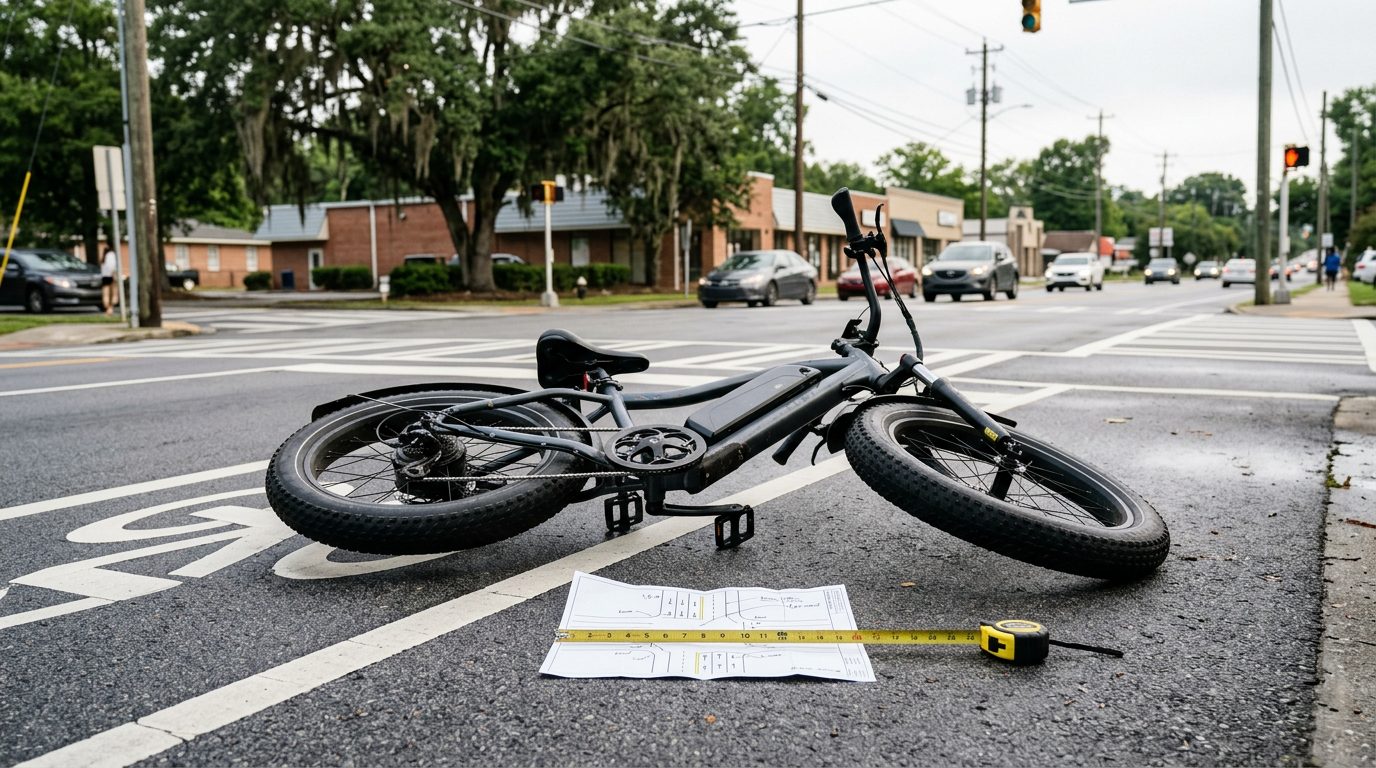
E-Bike Falls | Georgia
Hurt in an e-bike fall? Start by telling us what happened.
Battery faults, sudden power loss and road hazards can throw a rider off balance in seconds. We help you sort out the cause.
Firm at a glance
1999
Practicing law since
5
Georgia offices
24/7
Phone line open
By Terance Madden · Published November 13, 2026
Hurt on an e-bike with no car or truck involved? You may still have a claim.
If a road defect, a failed battery or a faulty part caused your fall, someone else may share the blame. An e-bike rider who fell in Georgia can pursue that claim.
Can You Still Bring a Claim If No Car Was Involved?
Yes. A single-vehicle e-bike crash can still support a claim when someone else’s negligence or a defect caused the fall. Negligence means failing to use the care a prudent person would use in the same situation. O.C.G.A. § 51-1-2 defines ordinary negligence that way.
A single-vehicle crash means you lost control or fell without hitting another vehicle. Riders often blame themselves first. But a pothole, a battery that shuts off mid-ride or a brake that fails is a cause. The cause is what matters.
This page is for the injured rider and the family member handling appointments, bills and paperwork. It focuses on serious injuries, such as broken bones, head injuries, spinal injuries and long recoveries. Minor scrapes are not the focus here.
Whether your claim can move forward depends on the facts: what caused the fall, who controlled that cause, and how badly you were hurt.
If a bad road, a failed battery or a defective part hurt you on your e-bike, you may have a claim, and our team can review it in a free first consultation. Talk it through with our team — the first consultation is free, confidential, and carries no obligation.
What Causes a Fall With No Other Vehicle?
Most single-vehicle falls trace back to the road, the bike’s equipment, or how the bike was built or kept up.
- Road and path conditions: potholes, broken pavement, loose debris, missing or wrong signs, and poorly kept bike lanes and trails.
- Equipment failure: a battery that overheats or shuts off, a throttle that sticks, brakes that fail, a controller or wiring fault, or a frame or fork that breaks.
- Defects: a bike, battery or part that is defective in its design or how it was made. Warnings and instructions can also be part of a claim.
The physical evidence shows what failed and when. The bike, battery, charger, broken parts, photos, and any app or controller data that logs speed and power all matter. Terance Madden trained as an electrical engineer, so he starts a case by asking what the evidence shows and how the crash happened. He reads how a battery, controller and brake system work, so he ties the cause to the evidence. Those records must be preserved early, before they are repaired, sold or overwritten.
Who Else Can Be Held Responsible Besides the Rider?
More than one party can share the blame, and each one may have coverage to pursue.
- The manufacturer, distributor, importer or retailer of a defective bike, battery or part.
- A repair or maintenance shop that worked on the bike.
- A rental or share company that owns, maintains and checks its bikes.
- A city, county or property owner responsible for a dangerous road, path or premises.
Georgia law makes an owner or occupier of land liable to people invited onto the property for injuries caused by failing to use ordinary care to keep the premises and approaches safe.
So the other parties who share responsibility can be important sources of coverage.
How Georgia’s Fault and Deadline Rules Affect Your Claim
Georgia reduces your recovery by your share of fault, and it bars recovery if you are 50 percent or more at fault (O.C.G.A. § 51-12-33; Quynn v. Hulsey (2020)).
Under O.C.G.A. § 51-12-33, a jury assigns a percentage of fault to each person who contributed to the injury. Your damages drop by your own percentage. At 50 percent or more, you recover nothing. Each person found at fault pays only its own share, and those shares are not joint liability.
Now the clocks:
- Injury lawsuits: generally two years, but loss of consortium actions by family members must be brought within four years after the right of action accrues. O.C.G.A. § 9-3-33 requires actions for injuries to the person within two years after the right of action accrues, except for actions for injuries to the person involving loss of consortium, which shall be brought within four years after the right of action accrues.
- Personal property, like your bike: four years under O.C.G.A. § 9-3-31.
- Claims against a city: a written claim to the governing authority within six months. O.C.G.A. § 36-33-5
- O.C.G.A. § 36-11-1
- O.C.G.A. § 50-21-26
Government notice deadlines can run far sooner than a lawsuit deadline. Evidence has a clock too. Bikes get repaired, batteries get swapped, and app data gets overwritten. Act early.
What a Claim Can Cover for the Injured Rider
A claim can seek your medical bills, lost income and the harm to your daily life.
O.C.G.A. § 51-12-2 separates general damages, which the law presumes from a wrongful act, from special damages, which you must prove. Bills and lost wages are special damages, so keep the records.
A claim can include:
- Medical costs: ER care, surgery, hospital stays, therapy, medications and future care your doctors document.
- Lost income: missed work now and lower earning ability later.
- Pain, suffering and loss of enjoyment of life.
- Property: the e-bike, helmet and gear damaged in the fall.
For catastrophic injuries like brain injury, spinal injury or amputation, future costs can run for years. The claim has to account for that lifetime impact.
If you are the spouse, mother or adult daughter keeping this together, you carry a lot. Start a simple log: appointment dates, bills, mileage to visits, and who you spoke with. That log becomes evidence. We keep the person managing the recovery informed in plain English at every step.
How Big Insurance Handles These Claims and How We Respond
Big Insurance is not on your side, and its first offer is rarely what your claim is worth.
Expect these common tactics:
- A fast, low offer made before your medical picture is clear.
- A recorded statement taken early, before you know the full extent of your injuries.
- Delays that pressure you to take less just to get money moving.
- Disputes over whether your treatment was needed or caused by the fall.
- “Low impact” arguments, or claims that you were going too fast.
Our response is to pursue every layer of coverage: the at-fault party’s liability policy, uninsured and underinsured motorist coverage where it applies, umbrella and excess policies, and corporate or commercial coverage. We value the full lifetime cost of the injury and prepare each case as if it will go to trial.
Terance Madden’s engineering training matters here. When an insurer offers its own story of the fall, he tests it against the bike, the battery data and the scene. He asks whether a battery, controller or brake could have failed the way that story says.
Not sure what your next step is?
Talk it through with our team — the first consultation is free, confidential, and carries no obligation.
How the Process Works From First Call to Resolution
The process starts with a free first consultation and moves on to evidence, investigation and negotiation.
- Free first consultation. Free, confidential and with no obligation to continue. We review what happened, your injuries and any paperwork you have.
- Evidence preservation. We send letters asking that the bike, battery, charger, parts and device data be kept. Our crash guide for e-bike riders covers what to save.
- Investigation and engineering review. We examine the equipment and the scene.
- Medical documentation. Once treatment is far enough along to value your injuries, we build a demand package.
- Negotiation, then suit if needed. We negotiate with each available insurer. If no fair resolution comes, we file suit before the deadline.
We work on a no-fee-unless-we-win basis, but you may still be responsible for court costs and case expenses.
Simple cases can take months. Cases with serious injuries and several liable parties often take longer.

Who Handles Your Case and Your Common Questions
Terance Madden is the responsible lawyer for this page, and the firm has been in practice since 1999.
Before law school, Terance Madden trained as an electrical engineer, and he leads T. Madden & Associates, P.C., which has been in practice since 1999. The firm’s lawyers include Terance Madden and Shenia Madden, and our team of assistants and office staff supports every case. The firm has offices in Jonesboro, Atlanta, Decatur, Macon and Augusta. The Terance Madden Foundation supports community work.
Can I still bring a claim if no car hit me?
Yes. A fall with no other vehicle can still support a claim when road conditions, equipment failure or another party’s negligence caused it.
Who pays if the battery caught fire or shut off?
More than one party may share responsibility, including the maker, seller or repair shop. Each at-fault party pays only its own share.
Does a rental company have responsibility?
It may, if its maintenance or checks of the bike fell short of ordinary care.
Should I give an insurer a recorded statement?
Slow down first. Insurers may ask early, before your injuries are clear, and your words can be used to dispute your claim.
Hurt in a fall that a bad road, a failed battery or a defective part may have caused? You may have a claim, and you don’t have to sort it out alone. Start your free case evaluation through our contact page, or call us any time, 24/7.