

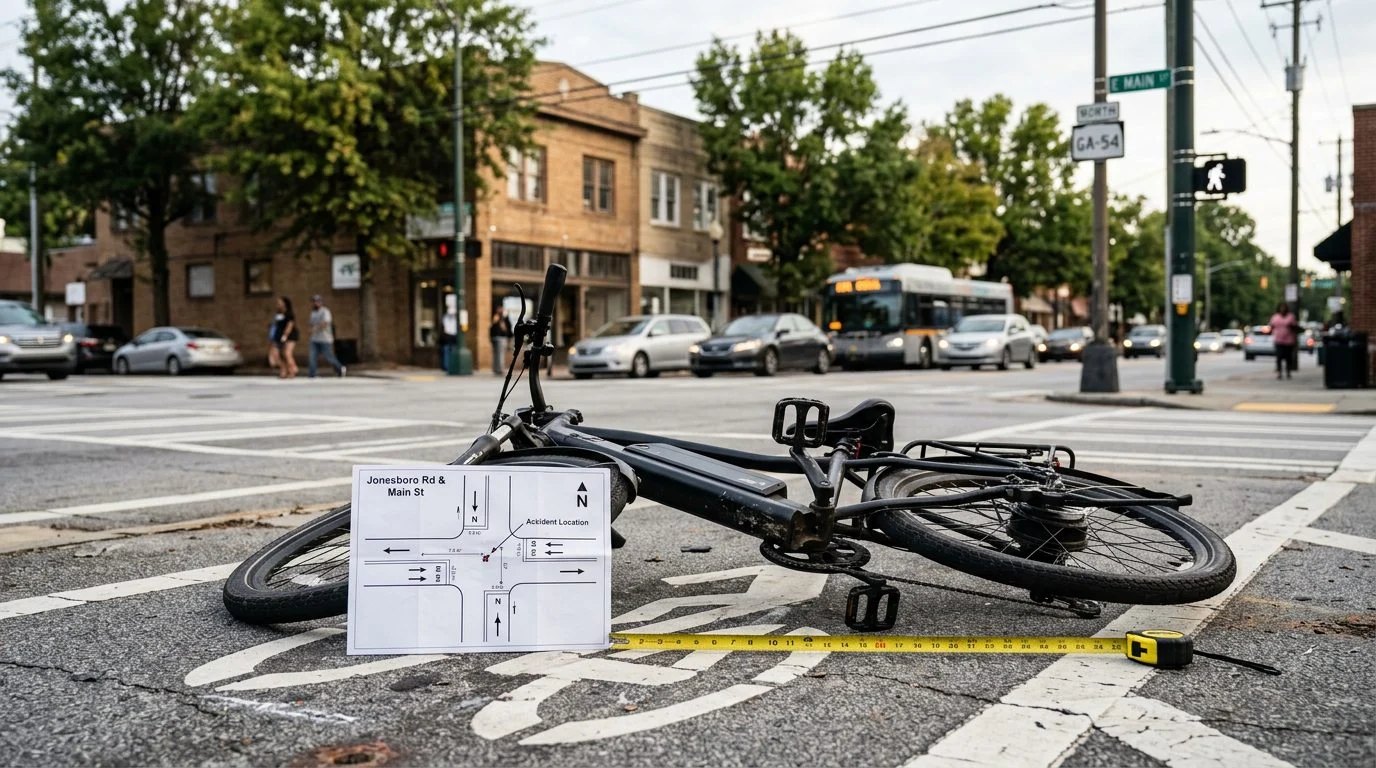
E-bike accident lawyer | Georgia
What Is Your E-Bike Crash Claim Worth?
Medical bills, lost pay, and pain all shape a claim's value. Here is how we look at each one, and where to start.
T. Madden & Associates, P.C.
1999
Practicing law for injured Georgians since
5
Georgia offices: Jonesboro, Atlanta, Decatur, Macon and Augusta
24/7
Phone line open for calls about a recent crash
By Terance Madden · Published November 13, 2026
You were hurt riding your e-bike, and the bills are already stacking up. If an e-bike crash left you hurt, you likely have questions about what your claim is worth in Georgia. The honest answer is that no one can name a fair number until the medical picture is complete.
This page explains what drives that value, how Georgia’s fault rule can cut a recovery, which insurance may pay, and what the person managing your recovery should do now.
The Short Answer: No One Can Honestly Name a Number Yet
A fair value cannot be set until the full cost of the injury is known. E-bike injuries often change over weeks or months. A wrist that looks like a sprain on day one can need surgery later. A head injury can show symptoms days after the crash.
Early numbers are guesses. A guess made before treatment is finished can cost you money.
Think of a repair estimate. A mechanic can’t price the job until he opens the engine. Your claim works the same way. Value depends on the records, the bills and the work history that come after the first week.
Four things decide the value: the medical picture, lost income, how the fault is split between the people involved, and which insurance policies can pay. Big Insurance often wants a number early. That is a reason to slow down, not speed up.
Hurt in an e-bike crash that someone else caused? Our team can walk you through your medical bills, your missed work and the insurance calls you're getting right now. Talk it through with our team — the first consultation is free, confidential, and carries no obligation.
Why the First Offer Is Rarely What the Claim Is Worth
An insurer’s first offer is rarely what a claim is worth. Big Insurance is not on your side. Its job is to pay less, and it often starts low before you know what treatment will cost.
Expect a few common tactics:
- A fast, low offer made before the medical picture is clear.
- A request for a recorded statement, asked for while you are still in pain or on medication.
- Delays in decisions that leave bills unpaid and stress high.
- Disputes over whether your treatment was needed or reasonable.
- A “low impact” argument that says a slow e-bike crash could not have caused real harm.
Each tactic has a response. The firm reviews every coverage layer that may apply and documents lifetime damages, including future care.
What Drives the Value of an E-Bike Crash Claim
Value comes from the real costs the crash caused: medical care, lost income, future needs and the change to daily life.
Special damages are losses you can prove with bills and pay records. They must be proved, under O.C.G.A. § 51-12-2. General damages are losses the law presumes flow from the crash. They can be recovered without proof of an exact amount.
Medical bills get special handling. Under O.C.G.A. § 51-12-1.1, medical expenses are limited to the reasonable value of medically necessary care, and the jury decides that amount.
Some providers treat patients under a letter of protection (a promise to be paid from any settlement or verdict). Those arrangements can create liens (claims against your recovery) that must be paid from the money. The law makes those charges open to examination.
Future losses get adjusted to today’s value. Under O.C.G.A. § 51-12-13, a jury may discount future medical costs and lost wages using a 5 percent rate or another rate it finds right.
For harm to your peace, happiness or feelings, Georgia sets no fixed formula. Under O.C.G.A. § 51-12-6, the amount is left to “the enlightened consciences of impartial jurors.”
How Georgia’s Fault Rule Can Reduce Your Recovery
Georgia uses modified comparative negligence (a rule that shrinks your award by your share of fault) (O.C.G.A. § 51-12-33; Quynn v. Hulsey (2020)). You can still recover if you were partly at fault. You lose everything if your share is 50 percent or more.
Under O.C.G.A. § 51-12-33, the judge reduces your damages in proportion to your percentage of fault. If you are 50 percent or more responsible, you may not receive any damages.
Each liable person pays only the share the jury assigns to that person. The statute says those shares are not joint liability. The jury must also weigh the fault of everyone who contributed, even people never named in the suit.
Expect the other side to look hard at the rider. They will ask about speed, lane position, lights and whether you were in a bike lane or mixing with traffic. Those are fair questions. The answers come from the facts.
Your choices get weighed against the other driver’s choices. A driver who pulls out without looking, or a road layout that drops riders into fast traffic, is a choice or a failure that belongs in that weighing too, but only if you settled with that nonparty or a defending party gives notice not later than 120 days prior to the date of trial that the nonparty was wholly or partially at fault.
Which Insurance Layers May Pay
Several insurance layers may pay an e-bike claim, and the firm checks each one.
- Liability coverage. This is the at-fault driver’s policy. It can also be a property owner’s or business’s policy when that party’s conduct contributed.
- Uninsured and underinsured motorist coverage (UM and UIM). UM covers you when the at-fault party has no insurance. Whether it applies to your crash depends on the policy and the facts.
- Umbrella and excess policies. These sit above a primary policy’s limits.
- Business or employer coverage. Under O.C.G.A. § 51-2-2, a person is liable for torts a worker commits within the scope of the business. A delivery or rental operator may be drawn into the claim this way.
- Other liable parties. A parts maker or repair shop whose work failed can add another policy.
Policy limits set the most a policy will pay. They are not the value of your claim. The firm reads the actual policy language and pursues every layer that applies.
What the Evidence Shows and How an Engineer Reads It
E-bike evidence can show how fast the bike was moving, how the crash unfolded and whether a part failed.
Before law school, Terance Madden trained as an electrical engineer. He starts a case by asking what the evidence shows, how the crash happened, and which records exist and must be preserved. On an e-bike case, that means looking at battery and controller data where it exists, brake condition, tire wear, lighting and phone records from the time of the crash.
Crash physics is simple at its core. Speed and stopping distance decide how much force reaches a rider’s body. A “low impact” label from the other side does not end that analysis. The question is how the forces moved through the bike and the rider.
Preserve the evidence early. Keep the e-bike as it is, take photos of the damage and the scene, and get witness names and contact details. Parts get repaired, sold or thrown away, and the evidence goes with them.
Not sure what your next step is?
Talk it through with our team — the first consultation is free, confidential, and carries no obligation.
The Person Managing the Recovery
The person managing the recovery usually holds the paperwork, so that person needs a simple system. If that is you, you’re doing the hardest job in the family.
Start a daily log. Write down pain levels, what you could not do and any missed activity. Save every bill, receipt, pharmacy slip and mileage record for trips to appointments.
Keep pay stubs. Ask the employer for a letter that shows missed time and reduced hours. These records prove lost income later.
Route insurance calls through one person in the family. Write down the adjuster’s questions and the time of each call. A recorded statement given too early can be used to shrink the claim, so hold off until the facts are reviewed with you.
Your family has taken care of each other for years, and this is no different. That care is part of the story of the claim, and it deserves the same respect as the bills.
Frequently Asked Questions
How much of a $100,000 settlement will I get?
Your share depends on your fee agreement, case expenses, liens and any other claims against the money. The firm works on a no-fee-unless-we-win basis, but the client may still be responsible for court costs and case expenses.
Can I sue a rental scooter or e-bike company after a crash?
Possibly, depending on who was at fault. A rental company can be part of a claim when its own conduct or its worker’s conduct contributed to the crash.
What if the rider had no insurance?
If the other party was uninsured, your own policy’s uninsured motorist coverage may apply. Whether it does depends on the policy and the facts.
Does Georgia’s fault rule mean I get nothing if I was partly at fault?
No. Under O.C.G.A. § 51-12-33, your damages are reduced by your share of fault, and you lose them only if you are 50 percent or more responsible.
Hurt in a Crash That Was Someone Else’s Fault?
If someone else’s choices left you hurt on your e-bike, you do not have to deal with Big Insurance alone.
Maybe you’re juggling appointments, a stack of bills, missed shifts and an adjuster who wants a quick answer on a settlement. The decision in front of you is whether to give a recorded statement or accept a first offer. Those choices matter, and they are easier with the facts laid out.
T. Madden & Associates, P.C. offers a free first consultation. It is confidential and carries no obligation to continue. You can start with a free case evaluation. The firm has offices in Jonesboro, Atlanta, Decatur, Macon and Augusta and has been in practice since 1999.