

Georgia crash claims
No police report?
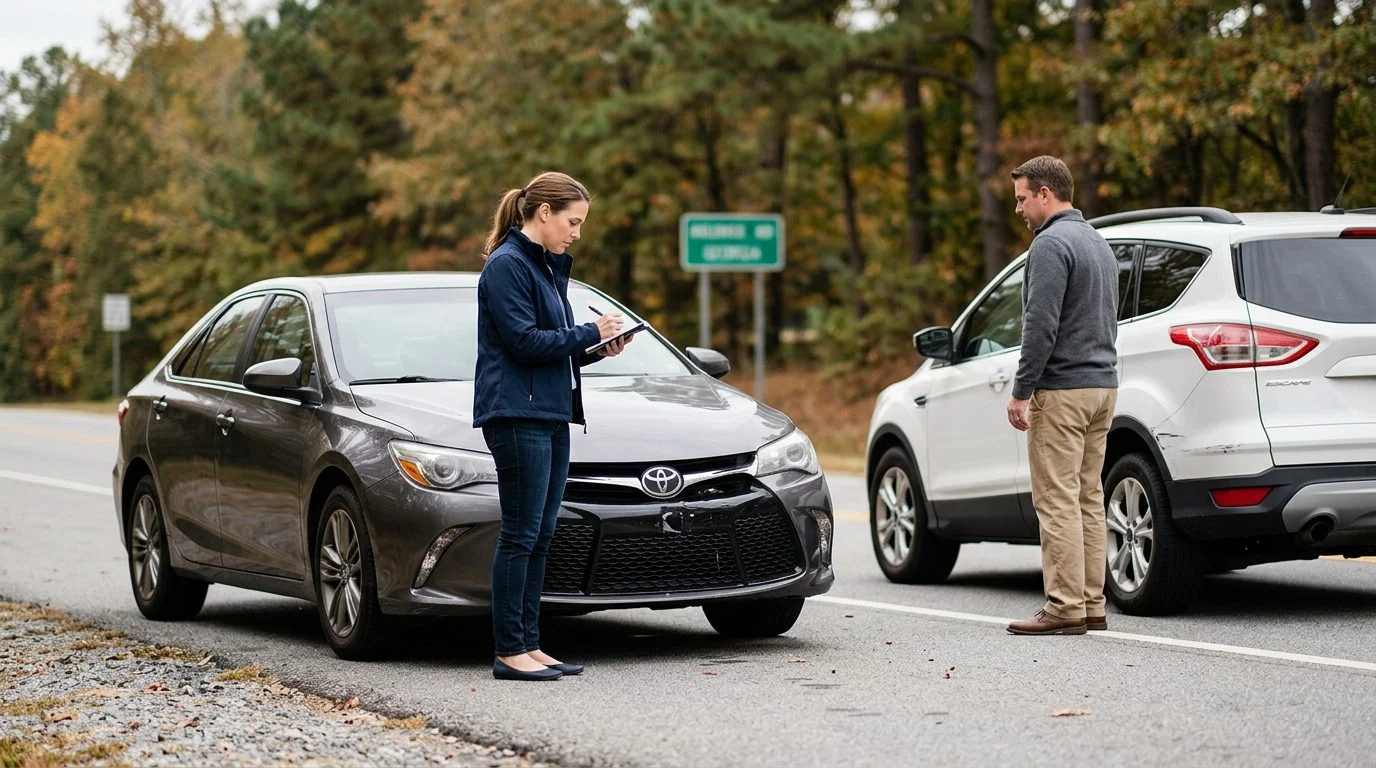
Police do not always respond to the scene, and a crash can still be documented well. Here is how to protect your record and your options.
T. Madden & Associates, P.C.
1999
In practice since
5
Georgia offices
24/7
Phone line available
By Terance Madden · Published November 6, 2026
You can report an accident without a police report in Georgia, and a missing report does not end a claim by itself. You notify your insurer, document the scene and your injuries, and build a clear written record. Here is how that works, step by step.
Can You Still Pursue a Claim Without a Police Report?
Yes. A police report is useful evidence, but it is not the only proof a Georgia claim can rely on. Insurers and courts look at the whole record of what happened.
An officer’s report records what the officer saw and heard at the scene. It does not settle who was at fault. Photos, witness statements, medical records, and repair estimates can fill that gap.
Fault still matters. Under Georgia law, when a plaintiff is to some degree responsible for the injury or damages claimed, the judge reduces the damages awarded in proportion to the plaintiff’s percentage of fault, and the plaintiff is not entitled to receive any damages if the plaintiff is 50 percent or more responsible (§ 51-12-33 on fault). That is why an early, accurate record matters so much.
For a broader look at e-bike and other crash claims, read our e-bike accident guide.
If you were hurt and no police report exists yet, you don't have to sort out your options alone. Talk through your crash with us in a free, confidential first consultation. Talk it through with our team — the first consultation is free, confidential, and carries no obligation.
How Long Do You Have to File a Car Accident Lawsuit in Georgia?
Mixing up these two timelines can cost you time.
Under § 9-3-33, Georgia generally requires a personal injury lawsuit to be filed within two years after the right of action accrues, except that loss of consortium claims must be brought within four years (Georgia Court of Appeals opinion).
For you, the practical rule is simple: notify your insurer as soon as you can, while the details are fresh. Timing depends on the facts of each crash.
For the filing deadline after an e-bike crash, see our e-bike crash filing deadline page.
Will Insurance Pay Without a Police Report?
Many insurers will open a claim without a police report when the crash is documented another way. Each insurer and policy sets its own requirements, so ask what your policy needs.
Insurers commonly look for the other driver’s name, phone number, insurance company, and policy number. They also want the date, time, and location, photos of the vehicles and scene, witness names, and medical treatment records.
Without a report, the other driver may deny fault. A clear written account made on the day of the crash becomes your starting point, and it sits next to the physical evidence.
Georgia’s avoidance rule adds another check. If you could have avoided the consequences caused by the defendant’s negligence with ordinary care, you cannot recover for them (§ 51-11-7). In other cases, the at-fault driver is not relieved just because you contributed in some way. For how shared fault can change what you recover, see our partial-fault e-bike crash guide.
Can I Report an Accident to My Insurer Without Filing a Claim?
Yes. Giving your insurer notice of an accident is different from asking it to pay you. Notice opens a file, while a claim asks for payment.
A first notice usually covers the date, the location, the people involved, and a short description of what happened. You can give notice now and decide later whether to pursue compensation.
Keep a written record of every contact. Note the date, the adjuster’s name, any claim number, and what was said. Send key details in writing when you can, and save copies. If the insurer asks for a recorded statement, note the request and the date before you agree to anything.
How to Document an Accident Yourself When No Officer Comes
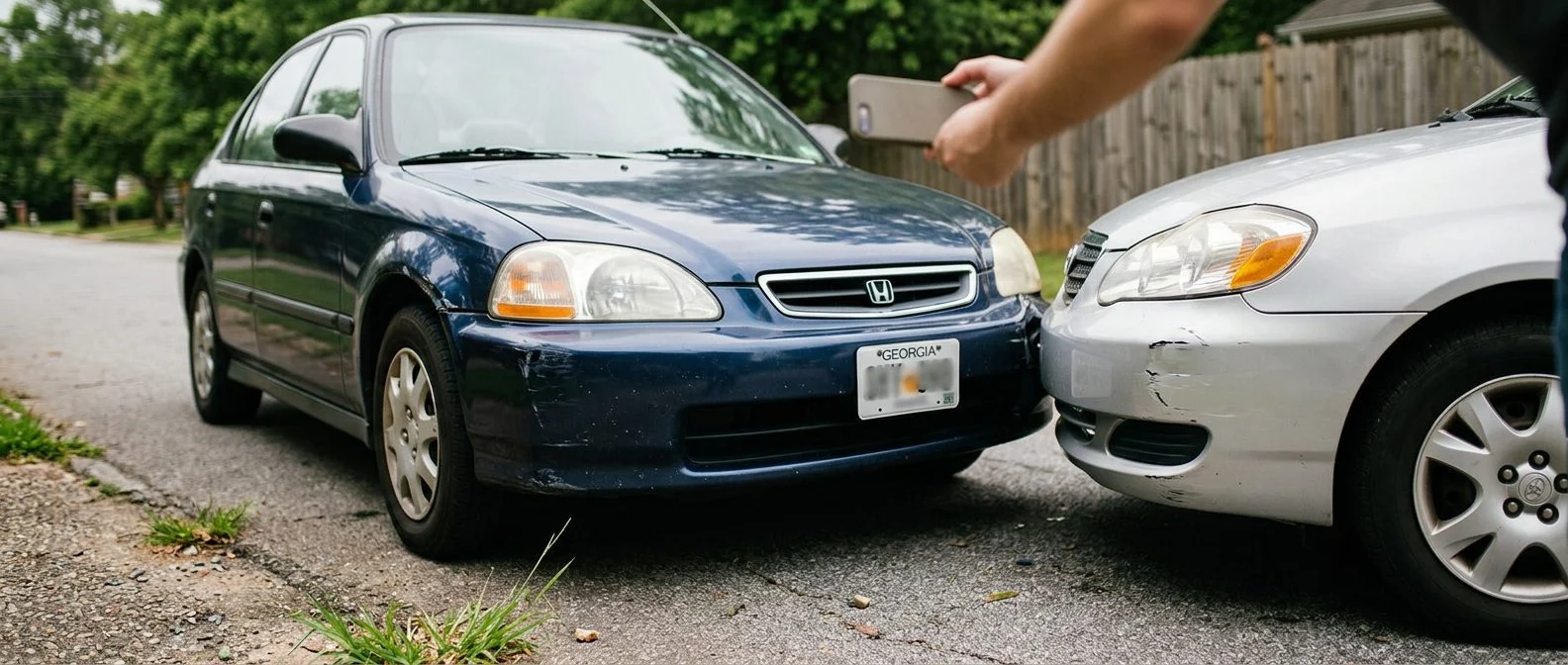
Start with safety, then document the scene, the other party, and your injuries. Call 911 if anyone needs medical help.
- Move to safety if you can, and check yourself and others for injuries.
- Photograph both vehicles, the road, traffic signs, skid marks, lighting, and all visible damage.
- Get the other driver’s name, phone number, insurance company, policy number, and license plate. Ask for witness contact details.
- For an e-bike or motorcycle, photograph the bike, damaged parts, debris, and your helmet. Note the make, model, and battery or motor condition if visible.
- Write a detailed account the same day. Include the sequence of events, the weather, road conditions, and what each person said.
- Keep every medical bill, appointment note, prescription receipt, and missed-work record.
Medical bills are special damages, which must be proved before they can be recovered (§ 51-12-2). Georgia also treats necessary expenses from an injury as a legitimate part of the damages estimate (§ 51-12-7). Your records are how you prove both.
Can You File a Police Report After the Accident?
You may be able to contact the local police department after a crash to ask about making a report. The department decides what it can document, so ask what it can take.
A report made after the fact may carry less weight than one written at the scene. Pair it with the photos, witness names, and records described above. Contacting police promptly is still the better practice when someone has been hurt.
Not sure what your next step is?
Talk it through with our team — the first consultation is free, confidential, and carries no obligation.
Hit-and-Run and Uninsured Driver Situations
If the other driver fled or had no insurance, your own uninsured motorist coverage may be the route to payment. Under O.C.G.A. § 33-7-11, an automobile liability policy issued in Georgia must contain an endorsement or provisions undertaking to pay the insured damages for bodily injury, loss of consortium or death, or for injury to or destruction of property, sustained from the owner or operator of an uninsured motor vehicle, with limits set at the insured’s option within the choices the statute lists (§ 33-7-11).
Georgia law also sets a penalty for bad-faith refusal. If an insurer refuses a covered loss within 60 days after a demand, and a bad-faith finding is made, the insurer can owe up to 25 percent of the recovery or $25,000, whichever is greater, plus reasonable attorney’s fees. That question is decided in a separate action after a judgment against the uninsured motorist (§ 33-7-11).
Read your policy’s uninsured motorist section and any notice terms. The policy’s own wording controls the steps you must take. If the crash happened on a public road, the Georgia DOT crash reporting system covers crash data and how to get police crash reports.
Talk Through Your Crash With a Georgia Injury Lawyer
Learning how to report an accident without a police report is a good first step, but it is rarely the whole picture. You may be dealing with injuries, a damaged vehicle or bike, an insurer asking questions, and no report to point to.
You may also face decisions you did not expect. Should you give a recorded statement? How should you answer a fault dispute? Is your documentation enough to move forward? These are facts-based questions, and they are easier to think through with someone who reviews your specific crash.
Please reach out to T. Madden & Associates, P.C. through our contact page to talk through your crash. Our first consultation is free, confidential, and carries no obligation to continue.
The firm has been in practice since 1999, with offices in Jonesboro, Atlanta, Decatur, Macon, and Augusta.
Common Questions
A missing report does not end a claim by itself. Insurers and courts also weigh photos, witness statements, and medical records.
How long do I have to sue after a crash in Georgia?
Georgia generally requires a personal injury lawsuit within two years. That deadline runs separately from reporting to police or your insurer.
Does a late police report still help?
It may. It can carry less weight than a report made at the scene, so pair it with your own documentation.
What if the other driver left the scene?
Check your uninsured motorist coverage and its notice terms as soon as possible. Georgia law generally requires auto liability policies to include that protection, unless the insured rejects it in writing.
Disclaimer: This page is published by T. Madden & Associates, P.C. The responsible lawyer for this page is Terance Madden. Contact the firm at https://www.tmaddenlaw.com/contact/. This information is general and is not a promise of any result.
Related practice areas
- Georgia E-Bike Accident Laws: Rider Guide
- Truck Accident Lawyer Riverdale GA
- Truck Driver Hours of Service Crash Georgia Lawyer