

Negligent Security Lawyer | Georgia
Hurt on Property That Was Not Kept Safe?
Owners and managers owe certain duties to the people they invite in. Here is how the firm looks at what went wrong and what it may mean for you.
The firm at a glance
1999
Year the firm began practice
5
Offices in Jonesboro, Atlanta, Decatur, Macon and Augusta
24/7
Call us any time
By Terance Madden · Published November 18, 2026
You’re reading this because someone you love was hurt in a crime on property they didn’t control. Now you keep hearing the words “negligent security.” Let’s cut through it.
What does negligent security mean in Georgia? The attacker is a separate wrongdoer. The claim goes after the property’s own failure. This guide walks through the pieces in order, using Georgia’s statutes.
What Negligent Security Means, in Plain Words
Negligent security is a type of premises liability. That is the body of law covering injuries on property someone controls. Georgia defines negligent security as a claim against an owner or occupier, or a security contractor, that seeks damages for bodily injury or wrongful death. The claim arises from a failure to keep the property safe from the wrongful conduct of third persons (O.C.G.A. § 51-3-50).
Negligence means failing to do what a reasonably careful person or business would do in the same situation. A “third person” is any person other than an owner or occupier or a security contractor or a person under the direction, control, or supervision of an owner or occupier or security contractor, such as the one who committed the assault, robbery or shooting. The claim does not excuse that person. It asks why the property’s protections failed.
Wrongful conduct is broad. It covers any violation of a Georgia law or local ordinance punishable as a felony or misdemeanor, and any other conduct that amounts to an intentional, or willful and wanton, tort. It counts even when there was no arrest, citation or conviction (O.C.G.A. § 51-3-50).
If your loved one was hurt in a crime on property someone else controls, you may have a claim, and our team can talk through what happened with you. Talk it through with our team — the first consultation is free, confidential, and carries no obligation.

The Duty a Property Owner Owes
The owner owes visitors ordinary care. Many people ask what a property owner should do to keep visitors safe, and the answer depends on the facts of each case. Georgia law says an owner who invites people onto the property for a lawful purpose must use ordinary care in keeping the premises and approaches safe (O.C.G.A. § 51-3-1).
Invited visitors include customers, tenants and their guests. Property owners often control areas such as parking lots, stairwells, hallways, gates and entrances.
Control matters more than the name on the deed. Georgia’s definition of owner or occupier covers anyone who owns, leases, occupies, operates, maintains or manages real property of any kind, as well as any director, officer, employee, or agent of such person (O.C.G.A. § 51-3-50). A company that runs an apartment complex or a store can carry this duty. Who holds the keys and who fixes the lights often decides who answers.
What Reasonable Security Looks Like
Reasonable security depends on the property. A jury weighs the security measures the owner used at the time of the injury. It also weighs whether more were needed, whether they were practical, and whether they would have prevented the harm (O.C.G.A. § 51-3-55). The owner does not have to act as the police. The law does not require it to take on the government’s law enforcement role.
Common measures include working lights, locks that lock, controlled gates, cameras that record, security staff and repairs after complaints. Each one is judged against the property’s size, location and history.
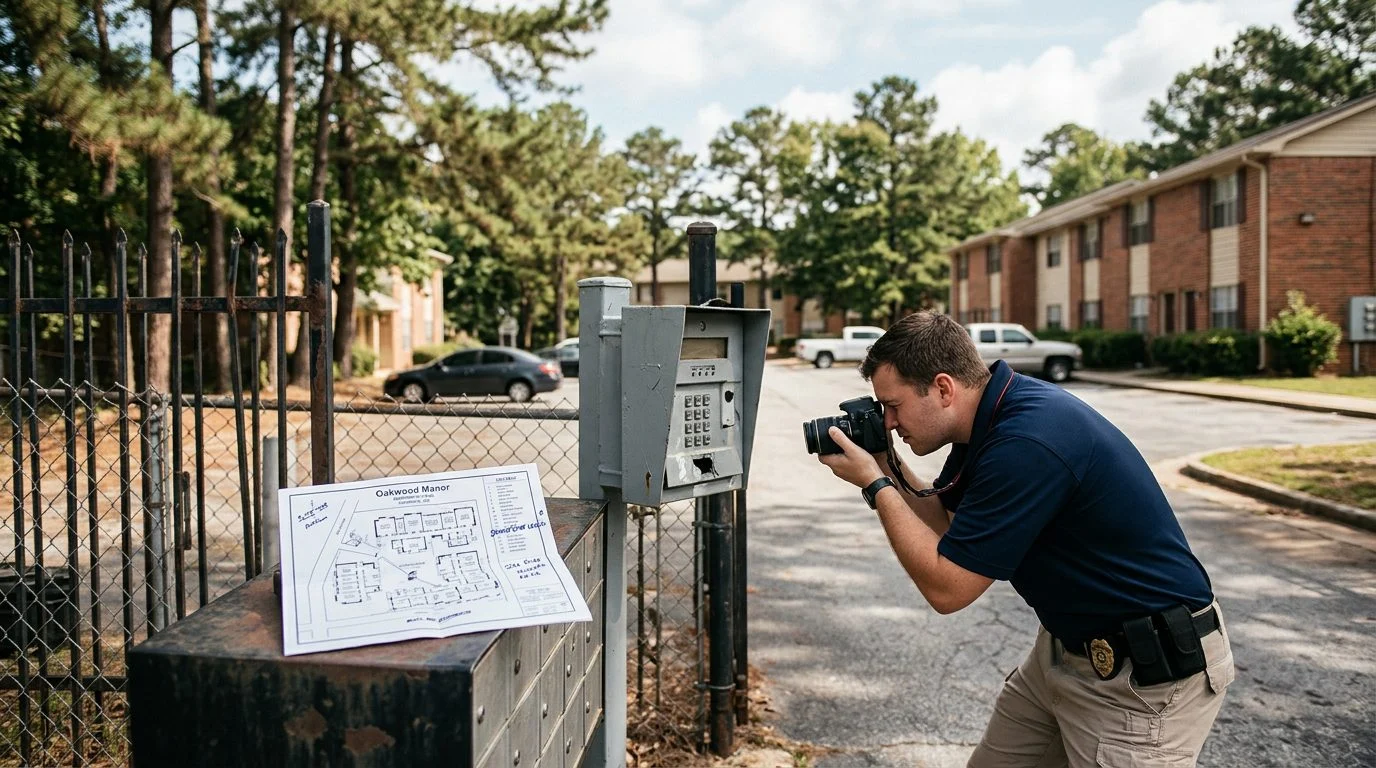
Small details often carry the case. A gate that stayed propped open, a light that was out for weeks, or a camera that wasn’t recording can become evidence. Work orders, maintenance logs and video show what the owner knew and when.
Before law school, Terance Madden trained as an electrical engineer, so he starts a case by asking what the evidence shows and how the crash happened. He starts by asking how the lighting, access controls and cameras actually worked that night. He also asks which records must be saved before they are overwritten. That approach helps him read physical evidence in plain terms.
What Counts as a Security Incident and Why Prior Crimes Matter
A security incident is an earlier crime or dangerous event that warned the owner of a risk. Prior crimes often sit at the center of a negligent security claim.
Georgia law spells out how foreseeability can be shown. The owner may have had a particularized warning: information actually known to the owner and deemed credible by the owner, which caused the owner to consciously understand that a third person is likely to imminently engage in wrongful conduct on the premises that poses a clear danger to the safety of persons upon the premises, and which is specific as to the third person’s identity, the nature and character of the conduct, its degree of dangerousness, and the location, time, and circumstances. The owner may also have had actual knowledge of prior, substantially similar wrongful conduct on the property (O.C.G.A. § 51-3-51). Earlier substantially similar wrongful conduct on adjoining property, or otherwise occurring within 500 yards of the premises, can also support foreseeability, but only if the owner actually knew about it. Earlier substantially similar conduct by the same person can also support foreseeability, if the owner knew or should have known, by clear and convincing evidence, that the person was or would be on the premises, and the owner had actual knowledge of those earlier occurrences.
Police calls, incident reports, resident complaints and texts with management are the records that show what the owner knew. General crime data for an area does not, by itself, show what an owner actually knew, because O.C.G.A. § 51-3-51 looks to prior occurrences of substantially similar wrongful conduct of which the owner or occupier had actual knowledge. A one-time event that looks nothing like the later crime is harder to tie in.
What a Negligent Security Claim Has to Prove
The injured person has to prove several things. The owner owed a duty. The owner failed to use ordinary care. That failure caused the injury. The statute lists these steps in detail (O.C.G.A. § 51-3-51).
In plain words, the crime had to be reasonably foreseeable. The injury had to be a foreseeable result of that crime. A specific, known physical problem, like a broken gate or a dead light, had to make the crime much more likely than usual. The owner had to fail to fix that problem or protect against the crime.
Causation is the link between that failure and the harm. The key question under the statute is whether the owner’s failure to exercise ordinary care was a proximate cause of the injury sustained by the invitee (O.C.G.A. § 51-3-51). Medical bills and lost pay are special damages. Georgia law says special damages must be proved (O.C.G.A. § 51-12-2).
Start the file now. Keep photos, video, incident reports, texts with management, receipts and every medical record. Those papers do much of the proving.
Defenses, Shared Fault and Why the Attacker’s Role Matters
The owner’s usual defenses are simple. The crime wasn’t foreseeable. The security was reasonable. Or the injured person was at fault. Each defense turns on facts, so the record matters.
Fault can be divided. The jury must apportion fault among the owner, the attacker and others to whom fault should go (O.C.G.A. § 51-3-56). That is why the owner’s defense often points at the person who committed the crime. In connection with fault apportionment, no party may offer evidence or argument in the hearing of any juror about any sentence of imprisonment or probation, fine, or other punishment that has been, or could be, imposed on the attacker in a criminal prosecution (O.C.G.A. § 51-3-56). No party can argue how the split will change the award.
Comparative negligence (shared fault) also applies. Georgia reduces damages in proportion to the injured person’s share of fault. If that share is 50 percent or more, no damages are recoverable (O.C.G.A. § 51-12-33).
Not sure what your next step is?
Talk it through with our team — the first consultation is free, confidential, and carries no obligation.

How Big Insurance Responds and What Comes Next
Big Insurance is not on the injured person’s side. A first offer is rarely what the claim is worth.
Expect early low offers. Expect a recorded statement taken soon after the crime, while your family is still in shock. Expect delays in paying bills, disputes over whether treatment was needed, and arguments that the crime was “unforeseeable” or the security was “reasonable.” Each one is a tactic to lower the value.
The response is to pursue every layer of coverage. That can include the owner’s liability policy, any umbrella or excess policy, and corporate coverage. The claim should count the full cost of the injury over time, not just the first bills. Your family can call the firm with questions about the case.
Does someone have to be arrested or convicted first?
No. Georgia’s definition of wrongful conduct counts even without an arrest, citation or conviction (O.C.G.A. § 51-3-50).
How long do I have to file?
Georgia law generally requires actions for injuries to the person within two years after the right of action accrues (O.C.G.A. § 9-3-33). The clock matters early.
Can a property owner be responsible if a stranger committed the crime?
It can happen. Except as provided in Code Section 51-3-54, O.C.G.A. § 51-3-51 says an owner or occupier shall be liable for negligent security for an injury an invitee sustains upon the premises if the plaintiff proves that (1) the third person’s wrongful conduct was reasonably foreseeable for one of the reasons the statute lists, such as a particularized warning of imminent wrongful conduct or prior occurrences of substantially similar wrongful conduct of which the owner or occupier had actual knowledge; (2) the injury was a reasonably foreseeable consequence of that wrongful conduct; (3) the wrongful conduct was a reasonably foreseeable consequence of the third person exploiting a specific physical condition of the premises known to the owner or occupier, which created a reasonably foreseeable risk of wrongful conduct on the premises that was substantially greater than the general risk of wrongful conduct in the vicinity of the premises; (4) the owner or occupier failed to exercise ordinary care to remedy or mitigate that specific and known physical condition and to otherwise keep the premises safe from such wrongful conduct; and (5) that failure was a proximate cause of the injury.
You don’t have to sort out the next steps alone. Start a free case evaluation. The firm offers a free first consultation that is confidential, with no obligation to continue.