

Truck Accident Guidance | Georgia
Can You Sue a Trucking Company in Georgia?
Truck crashes can involve several parties and insurers. T.
About T. Madden & Associates, P.C.
1999
Year the firm began practicing law
5
Offices in Georgia
24/7
Phone availability
By Terance Madden · Published October 26, 2026
Can you sue a trucking company if their truck hits you?
Often, yes. In many cases, an injured person can file a claim against a trucking company. The company may be liable for its driver’s conduct or for its own decisions. Whether a specific claim is viable depends on the facts.
A truck crash can bring medical bills, lost wages, vehicle damage, and a long recovery. A claim or lawsuit seeks money for those losses. It can’t undo the harm, but it can address its cost.
The question has two parts. First, who can be named as a defendant. Second, whether the facts show that someone was at fault. The sections below cover both, then Georgia’s deadline and fault rules.
If a truck just hit you or someone you love, our team can talk through the facts of the crash with you, and you don't have to sort it out alone. Talk it through with our team — the first consultation is free, confidential, and carries no obligation.
Who can be named in a lawsuit after a truck crash
The truck driver can be named as an individual defendant. The driver made the choices behind the wheel, so the driver is usually part of the analysis.
The motor carrier, meaning the company that employs or dispatches the driver, can also be named. Federal rules put duties on the carrier. One rule says it is the carrier’s duty to require drivers to observe the duties and prohibitions placed on them (49 C.F.R. § 390.11).
The owner of the truck or trailer may be a separate company from the carrier. Maintenance contractors, repair shops, and companies that loaded the cargo can be named when their work contributed to the crash.
Some drivers are labeled “independent contractors.” That label on paper doesn’t settle the question. Georgia law says an employer generally isn’t responsible for an employee who runs an independent business and isn’t under the employer’s immediate direction and control (O.C.G.A. § 51-2-4). Under that section, an employer is generally not responsible for torts committed by an employee in an independent business who is not under the employer’s immediate direction and control; the listed cases in which an employer is liable for a contractor’s negligence are in O.C.G.A. § 51-2-5, cited below. One case is when the employer keeps the right to direct or control the time and manner of the work (O.C.G.A. § 51-2-5).
So one key question is how much control the company really had over the driver and the work, though the law lists other cases too, such as when the wrongful act violates a duty imposed by statute.
How a trucking company can be held responsible
A trucking company can be responsible for a driver’s negligence when the driver was working for it. Georgia law makes a person liable for torts committed by a servant within the scope of that person’s business (O.C.G.A. § 51-2-2). This is the usual path for a driver on a delivery run.
The company may also be responsible for its own choices. The common theories work like this:
- Hiring and supervision. The company may have failed to check a driver’s background, train the driver, or watch the driver’s work.
- Entrusting a truck. The company may have handed a truck to a driver it should not have trusted with it.
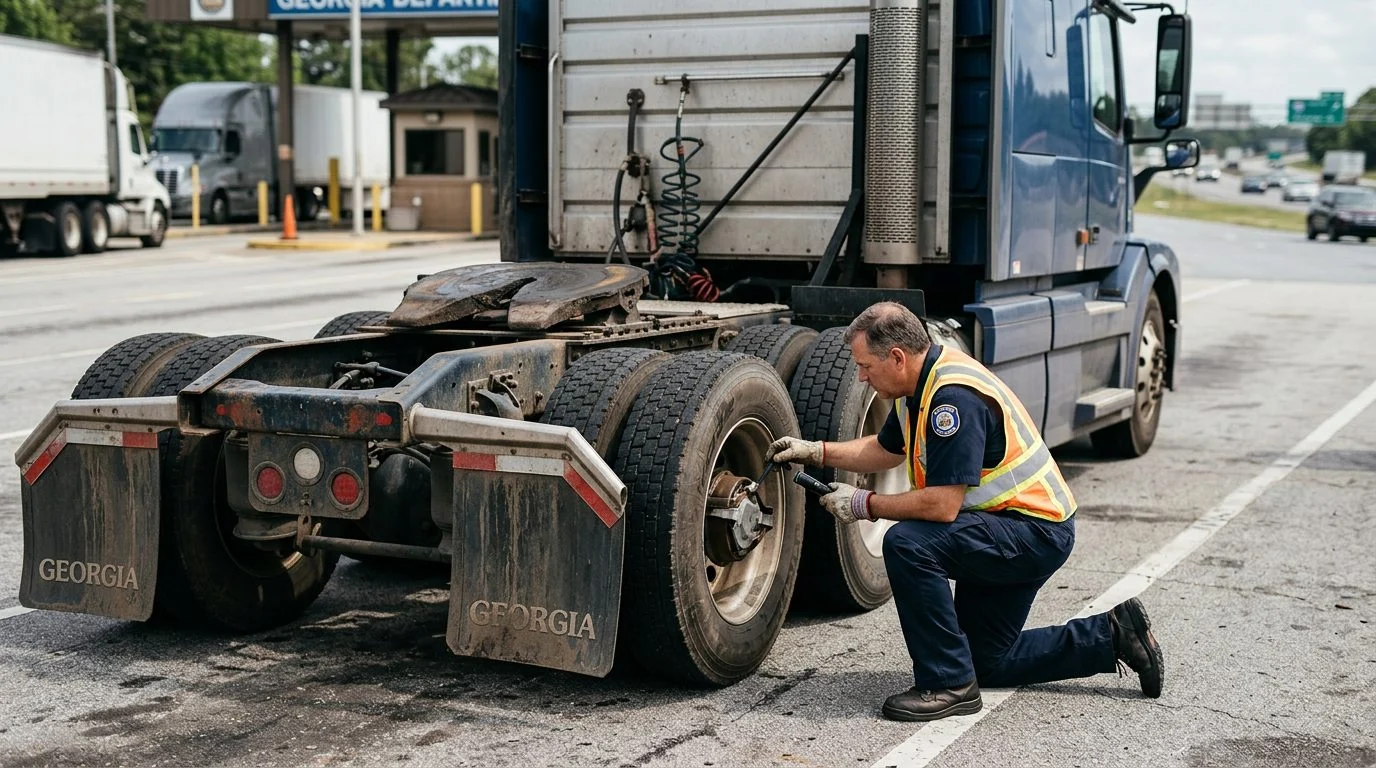
- Maintenance. The company may have failed to inspect and repair brakes, tires, lights, or steering. Federal rules require every motor carrier to systematically inspect, repair, and maintain its vehicles (49 C.F.R. § 396.3).
Driving limits matter too. A driver of a property-carrying truck generally may not drive once 14 consecutive hours have passed since coming on duty after 10 consecutive hours off (49 C.F.R. § 395.3). A driver who was rushing on a long shift may have broken that limit.
Each theory ties to a fact you may recognize. Think of a driver who seemed worn out, a truck with worn brakes, or a log that doesn’t match the trip.
What happens when a commercial truck hits you
Medical care comes first, even when injuries seem minor. Next comes the police report, which records the scene and the people involved. Then the insurers on both sides usually get involved.
Trucking companies typically have their own insurers and claims staff. Contact from them can start quickly, sometimes before you feel ready to talk. A short statement can be repeated later. Stick to facts and skip guesses about speed or fault.
Ask for the accident report early. Our Georgia accident report steps explain how to request one. Before you give any recorded statement, read our what not to say after a crash guide.
Proving that the trucking company was at fault
Fault is shown through records and witnesses. Start with the police report, photos of the scene and vehicles, witness contact details, and medical records. Those show what happened and what harm followed.
Trucking records often matter most. Federal rules require a motor carrier to keep records of duty status and supporting documents for at least six months from the date of receipt (49 C.F.R. § 395.8). Maintenance records must be kept for one year where the truck is housed, and for six months after it leaves the carrier’s control (49 C.F.R. § 396.3). Those periods are short, so ask for records early.
Some trucks also carry electronic logs, cameras, or GPS systems. Those records can show driving time and stops. Their retention periods can differ from the federal records.
Expect a counter-argument. The company may say the other driver caused the crash, or that a part failed in a way no one could have seen coming. Each case turns on its own facts and evidence.
Time limits, comparative fault, and suing the insurer
Georgia generally gives two years to file a personal injury lawsuit (O.C.G.A. § 9-3-33). The clock usually starts when the right of action accrues, which is often the date of the crash. Other rules can apply to some claims, so timing matters.
Georgia also reduces damages by the injured person’s share of fault (O.C.G.A. § 51-12-33). A driver may argue that you caused the crash, and that argument is part of the analysis. If you are 50 percent or more responsible, you cannot recover damages. Under O.C.G.A. § 51-12-33, if the plaintiff is to some degree responsible for the injury or damages claimed, the judge reduces the damages awarded in proportion to the plaintiff’s percentage of fault, and the plaintiff is not entitled to receive any damages if the plaintiff is 50 percent or more responsible. When several defendants are liable, each one pays its own apportioned share, not a joint share.
An insurance claim and a lawsuit are different steps. A claim is handled with the insurer for the company’s policyholder. A lawsuit is a court case against the defendant, with court rules and deadlines. Each path has trade-offs in time, control, and how a settlement is reached. To see how settlement questions are approached, read our settlement guide.
Can you sue a trucking company if the driver was an employee?
Often, yes. Georgia law can make a company liable for an employee’s negligence within the scope of the job.
How long do you have to sue in Georgia?
Georgia generally allows two years for a personal injury lawsuit.
Can you sue both the driver and the company?
Yes. One lawsuit can name more than one defendant.
Not sure what your next step is?
Talk it through with our team — the first consultation is free, confidential, and carries no obligation.

Talking through your situation with T. Madden & Associates, P.C.
If a truck just hit you or someone you love, the days after can feel crowded. Medical visits pile up, an insurer may call, and you may be wondering whether the trucking company can be sued at all. You don’t have to sort that out alone.
If you want to talk through the facts of your crash, reach out to T. Madden & Associates, P.C. through our contact page. The firm offers a free first consultation — confidential, with no obligation to continue.
T. Madden & Associates, P.C. has practiced since 1999. It has offices in Jonesboro (Clayton County), Atlanta, Decatur, Macon, and Augusta. For the broader topic, see our truck accident lawyer guide.
Responsible lawyer: Terance Madden, T. Madden & Associates, P.C. Contact details are on our contact page.
Parties Often Looked at in a Truck Crash Claim
The Truck Driver
The driver is the person who was operating the truck when the crash happened. Their conduct at the time of the wreck is often central to the claim.
The Trucking Company
Depending on the facts, the company that employed the driver or operated the truck may be named in a lawsuit. Georgia cases often examine the company's role and its responsibilities.
Other Responsible Parties
Maintenance providers, cargo loaders, equipment makers, or other drivers may also have played a part in some crashes. Each case depends on its own facts.
Records That Matter Early
Crash reports, photos, dashcam footage, medical records, and driver logs can disappear or be overwritten. Keeping copies of what you have is a useful first step.
What to Expect When You Contact Our Firm
Free First Consultation
Your first consultation is free, confidential, and comes with no obligation to continue.
Review of Your Situation
We look at the crash details, injuries, and insurance information to explain the questions that matter in your case.
No Fees Unless There Is a Recovery
Our fees are contingent, so there are no fees unless there is a recovery. You may still be responsible for court costs and case expenses, and we will explain those before you decide.
Support From Our Team
Terance Madden, Shenia Madden, and our team of assistants and office staff work to keep you informed throughout the process.
Act Early
Trucking companies and their insurers often begin investigating quickly after a serious crash. Waiting to speak with a lawyer can make it harder to preserve evidence, so contact us as soon as you can.
Unsure whether you have a case?
Talk with Terance Madden today. Our free, confidential first consultation has no obligation to continue, and our phones are answered 24/7.