

Truck Crash Claims | Georgia
Truck Crashes Often Involve More Than One Company. We Trace Every Link.
When a loaded rig collides with a car, the driver, the carrier, the loading crew and a parts maker can all share the blame. Terance Madden reads the evidence to show who did what.
T. Madden & Associates, P.C.
1999
In practice since
5
Offices across Georgia
24/7
Phone line available
By Terance Madden · Published November 16, 2026
The short answer: yes, Georgia divides fault among several defendants
Yes. In a Georgia truck crash case, a jury can name more than one party at fault and assign each one its own percentage. Lawyers call this apportionment, which means dividing fault by percentage among the people responsible. The main rule comes from O.C.G.A. § 51-12-33.
A truck crash often involves more than one driver. The truck driver is only one possible party. The trucking company, a company that serviced the truck, and a company that loaded the cargo may each have a role in what happened.
Apportionment also sets a hard line for the injured person. If that person is 50 percent or more responsible, the statute bars recovery (O.C.G.A. § 51-12-33; Quynn v. Hulsey (2020)). Below that line, the award is reduced by the injured person’s share.
People who search for apportionment truck crash Georgia multiple defendants usually want one answer: who pays, and how much. The answer depends on the facts. Every crash has its own evidence, so the split in one case can look very different from another.
If an 18-wheeler crash left you hurt and more than one company may share the blame, you don't have to sort out the fault alone. Reach out for a free, confidential consultation. Talk it through with our team — the first consultation is free, confidential, and carries no obligation.
What O.C.G.A. § 51-12-33 says about dividing fault
The statute works in steps. First, the jury sets the injured person’s share. Then it divides the rest among the people who are liable.
The first step is the injured person’s own percentage. The judge reduces the damages in proportion to that percentage.
The second step splits the remaining award. Each liable person pays only its own share. The statute says those shares are not joint liability and are not subject to contribution. In plain terms, one defendant usually does not cover another defendant’s share.
The jury also considers everyone who contributed to the injury, including people who were never sued. A defendant can give notice, not later than 120 days before trial, that a nonparty (someone not in the lawsuit) was at fault. That nonparty’s fault can then count.
Finally, there is the 50 percent rule. The statute says a plaintiff who is 50 percent or more responsible is not entitled to receive any damages (O.C.G.A. § 51-12-33; Quynn v. Hulsey (2020)). Under Georgia law, a plaintiff who is partly at fault may still recover damages, but the judge reduces those damages in proportion to the plaintiff’s percentage of fault (O.C.G.A. § 51-12-33).
Who can share fault in a truck crash
Several parties can share fault, and each party’s role is judged on its own.
The driver can be assigned fault for unsafe driving. A business can also answer for a worker’s negligence done within the scope of its work, as O.C.G.A. § 51-2-2 describes. That is why the trucking company is often part of the case.
The company can also face its own claims. Under Quynn v. Hulsey, an employer that admits it is responsible for its employee’s conduct can still be sued for its own negligent hiring, retention, supervision, training or entrustment. These claims focus on the company’s own choices.
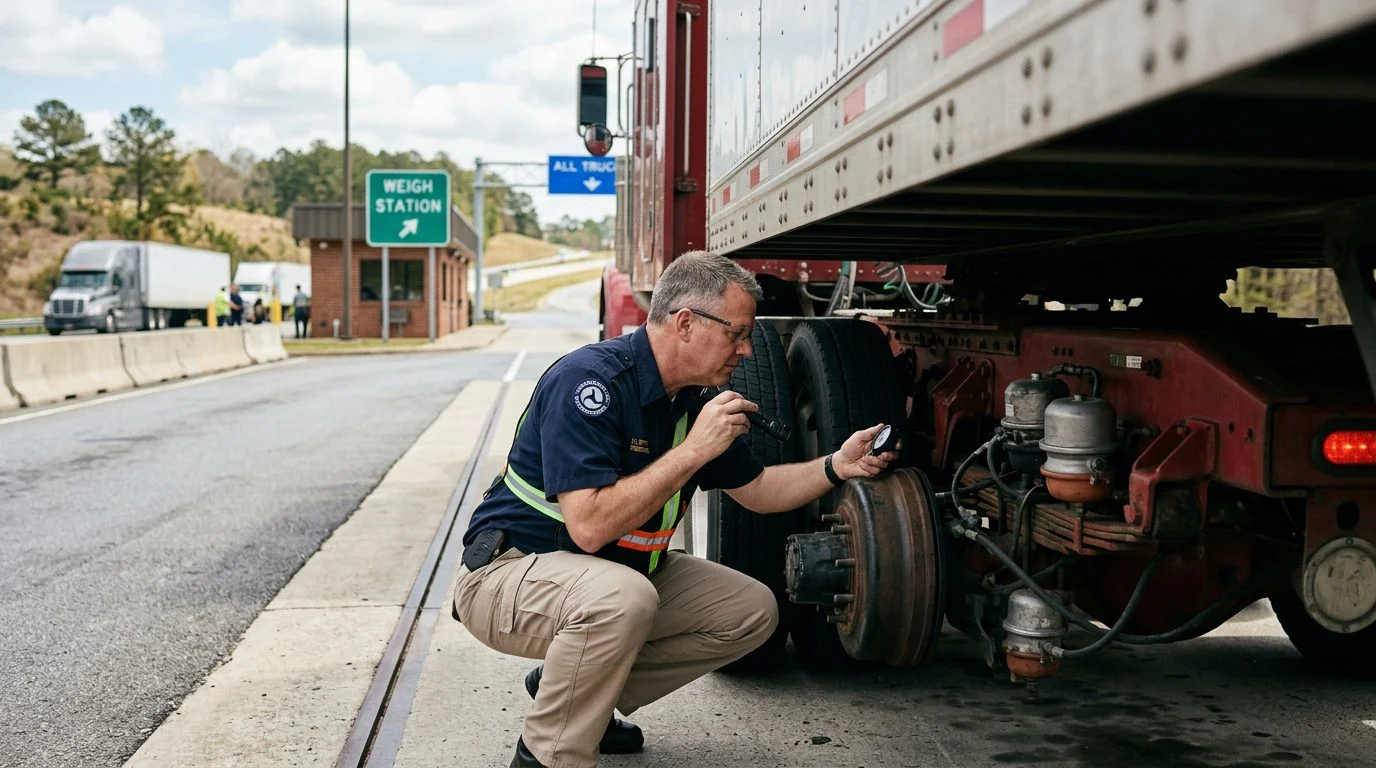
Federal trucking rules put duties on the motor carrier. 49 C.F.R. § 390.11 requires the carrier to make sure drivers follow the driver rules. 49 C.F.R. § 396.3 requires every motor carrier to systematically inspect, repair and maintain its vehicles. Whether a repair shop’s work played a part is a question of proof.
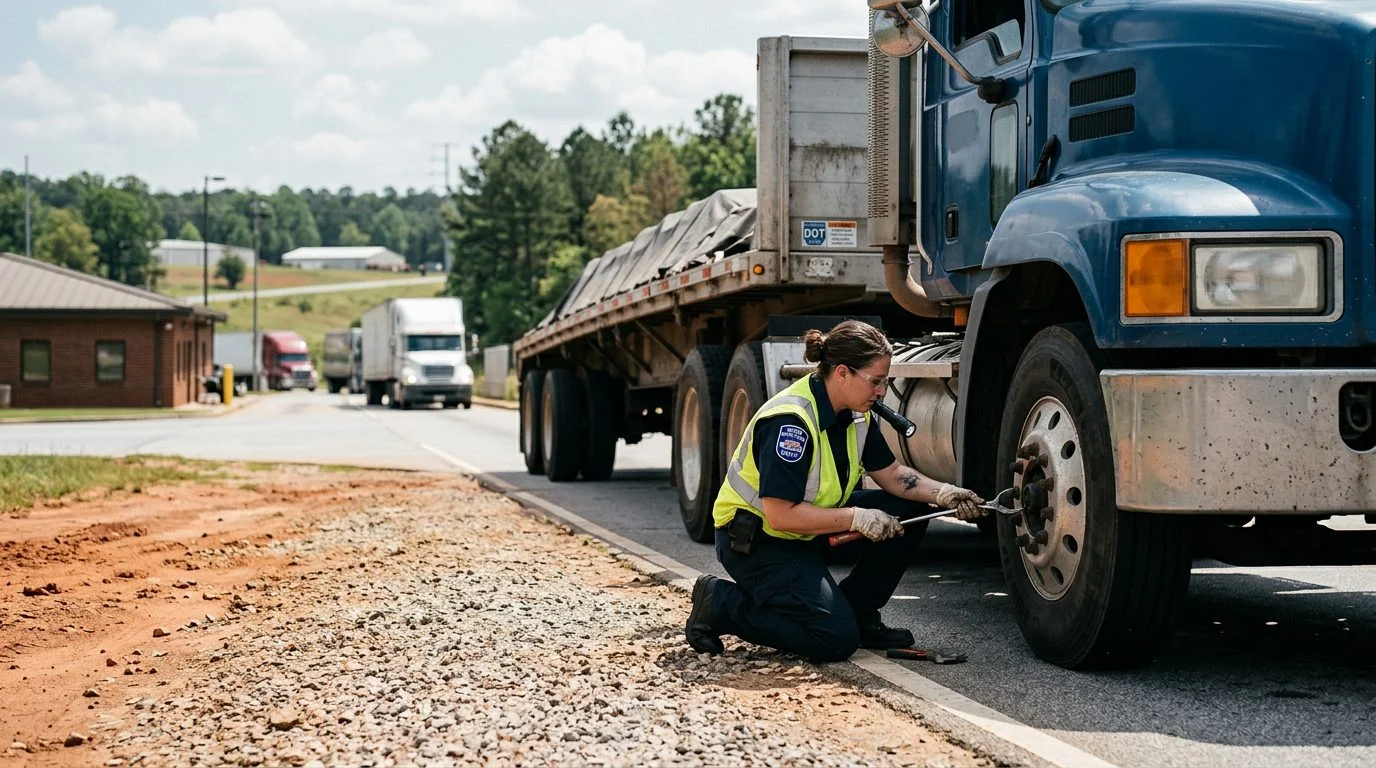
When loading or securing the cargo played a role, the people who handled the load may have a share to examine. 49 C.F.R. § 393.100, which applies to trucks, truck tractors, semitrailers, full trailers, and pole trailers, requires each commercial motor vehicle, when transporting cargo on public roads, to be loaded and equipped, and to have its cargo secured, so the cargo does not leak, spill, blow or fall, and so it does not shift upon or within the vehicle to such an extent that the vehicle’s stability or maneuverability is adversely affected.
How a jury assigns percentages in a multi-defendant truck case
Driver records come first. Federal rules require a motor carrier to have drivers record their duty status for each 24-hour period, as 49 C.F.R. § 395.8 explains. These logs can show when a driver was on duty, driving and resting.
State officials also list common causes. The Georgia Department of Public Safety fact sheet names driver error, inadequate rest, defective brakes and defective steering components as contributing factors in commercial-truck crashes. Some of these point to the driver. Others point to the vehicle’s maintenance.
Maintenance and inspection records show whether the truck was kept in safe condition. Cargo papers show how the load was secured. Witness statements and the crash report fill in the timeline.
Each party’s conduct is weighed against the others. The percentages reflect the share the jury assigns to each party. Records can be lost or overwritten after a crash, so early requests for them matter.
Why the injured person’s own fault matters too
Your own fault can cut your recovery. At 50 percent or more, you are not entitled to receive any damages (O.C.G.A. § 51-12-33; Quynn v. Hulsey (2020)).
Georgia also has a separate avoidance rule. Under O.C.G.A. § 51-11-7, if the injured person could have avoided the harm by ordinary care, that person cannot recover. In other cases, the defendant is not relieved just because the injured person contributed to the injury. This rule is separate from the percentage reduction, so both can matter in one case.
Small shifts matter. Under O.C.G.A. § 51-12-33, a plaintiff who is 50 percent or more responsible for the injury or damages claimed cannot receive any damages. That is why people who were partly at fault should not assume a small share is harmless.
Many injured people make the same early mistakes. They give recorded statements to an insurer before they understand how fault might be argued. They also post about the crash on social media, where photos and comments can be used to argue about fault.
Questions to answer early in a Georgia truck crash case
Early on, the key facts are the crash report, the driver’s logs, the maintenance file, the cargo paperwork and witness statements.
- The crash report and scene photos
- The driver’s duty-status records
- Inspection, repair and maintenance records
- Loading and cargo-securement papers
- Names and statements of witnesses
Some of these records have set retention periods, so asking early helps. Preserving evidence early helps show how fault divides among the parties.
Insurance works differently than many people expect. https://www.legis.ga.gov/api/document/docs/default-source/joint-features-document-library/t40-ch1-5-(v28a)-2024-pdf.pdfOne example is when a related carrier is insolvent or bankrupt.
T. Madden & Associates, P.C. has offices in Jonesboro, in Clayton County, as well as in Atlanta, Decatur, Macon and Augusta.
Frequently asked questions
What is the 50 percent rule in Georgia?
Under the statute, a plaintiff who is 50 percent or more responsible cannot receive damages (O.C.G.A. § 51-12-33; Quynn v. Hulsey (2020)). Below 50 percent, the award is reduced by that share.
Not sure what your next step is?
Talk it through with our team — the first consultation is free, confidential, and carries no obligation.

Talk with the firm’s lawyers about your truck crash
If you were hurt in an 18-wheeler crash, and the driver, the trucking company, a repair vendor or a load owner may each share responsibility, you need to know how fault may split. Our lawyers, Terance Madden and Shenia Madden, can review the crash facts with you and explain how fault may be divided. Start a free case evaluation with T. Madden & Associates, P.C.
Terance Madden has been in practice since 1999. It works on a no-fee-unless-we-win basis, but you may still be responsible for court costs and case expenses. The first consultation is free, confidential and without obligation.
Disclaimer: This page gives general information, not legal advice. Terance Madden is the responsible lawyer for this page at T. Madden & Associates, P.C., with offices in Jonesboro, Atlanta, Decatur, Macon and Augusta. Contact the firm through the contact page.