

Motorcycle Crashes | Georgia
Commercial Truck Evidence in a Georgia Motorcycle Crash Case
Trucking companies keep detailed records that can disappear quickly. Here is what to look for and how a Georgia injury lawyer at T. Madden & Associates, P.C. can help preserve it.
About T. Madden & Associates, P.C.
Since 1999
Representing injured Georgians
5
Offices across Georgia
24/7
Call us any time
By Terance Madden · Published October 20, 2026
Proving fault in a motorcycle crash with a commercial truck often depends on records the trucking company controls. This guide covers the main motorcycle crash commercial truck evidence, why some of it can disappear fast, and how Georgia’s fault rules shape what must be shown. It is general information about how these records are used in a claim.
What evidence is needed to prove fault in a motorcycle crash with a commercial truck, such as trucking logs, black box data, dashcam footage, and police reports?
Proving fault usually means showing what the truck driver and the trucking company did, or failed to do, before the crash. The strongest cases use the truck’s own records together with the police report, the scene, and the motorcyclist’s account.
The main evidence types are:
- Trucking logs that show the driver’s hours and duty status.
- Engine control module data, often called black box data, that records how the truck was moving.
- Dashcam or other camera footage from the truck or nearby vehicles.
- The police crash report.
- Photographs, measurements, and witness statements.
No single item decides the case. A log entry means little until it is checked against video, vehicle damage, and what witnesses saw. The right mix changes with each crash, so this list is not complete.
Not sure what your next step is?
Talk it through with our team — the first consultation is free, confidential, and carries no obligation.

Why truck crash evidence can disappear quickly
Truck crash evidence can disappear quickly because each record has its own retention clock. Federal rules set those clocks: driver qualification files are generally kept while the driver is employed and for three years after (49 C.F.R. § 391.51(c)), and the six-month period for certain records runs from the date of receipt (49 C.F.R. § 395.8(k)(1)).
- Electronic duty-status records and supporting documents must be kept for six months, according to the Federal Motor Carrier Safety Administration.
- Driver vehicle inspection reports must be kept for three months from the date they were prepared, under 49 C.F.R. § 396.11.
- Periodic inspection reports must be kept for fourteen months, under 49 C.F.R. § 396.21.
- Driver qualification files are kept while the driver works for the carrier and for three years after, except that certain records may be removed from the file three years after the date of execution, under 49 C.F.R. § 391.51.
After the required period ends, the rules let a company’s management decide whether to destroy a record, under 49 C.F.R. § 379.3, but this does not excuse compliance with longer retention periods required by any other governmental body.
Trucks also get repaired. Federal rules require a carrier, except a private motor carrier of passengers (nonbusiness), a driveaway-towaway operation, or any motor carrier operating only one commercial motor vehicle, to repair listed defects that would be likely to affect the safety of operation before the truck runs again, under 49 C.F.R. § 396.11. That repair can change the physical evidence. A written preservation request sent early asks the carrier to keep crash records.
How trucking logs and hours-of-service records show what happened before the crash
Trucking logs show whether the driver was driving, on duty, or resting in the hours before the crash. Federal rules require a motor carrier, except a private motor carrier of passengers (nonbusiness), to make each driver record duty status for each 24-hour period, under 49 C.F.R. § 395.8.
Electronic logging devices record much of this on their own. Under 49 C.F.R. § 395.26(b), the device records the date, time, truck location, engine hours, vehicle miles, driver and vehicle identification, and motor carrier identification. When the truck is moving and no duty status change or other intermediate recording has happened in the past hour, it records an intermediate entry, under 49 C.F.R. § 395.26(d)(1).
See 49 C.F.R. § 395.8(e).
Logs alone do not prove fault. Investigators often compare them with fuel receipts, dispatch messages, GPS data, and delivery schedules. A log that shows the driver resting, while another record places the truck on the road, raises a question that needs an answer.
How black box, dashcam, and police report evidence fit together
Black box data, dashcam video, and the police report each show a different part of the crash. They are most useful when read against one another.
Engine control module data can record speed, braking, and throttle use in the moments before impact. That data only helps if the module survived the crash and was not reset.
Dashcam footage from the truck or nearby vehicles can show lane position, signals, and traffic. It can also show timing that a log cannot.
Police reports document the scene, road and weather conditions, any citations, and early statements. An officer’s conclusion about fault is a starting point, not the final word. The report’s facts are checked against the logs, data, and video.
What motorcycle-side evidence shows about how the crash happened
Evidence from the road and the motorcycle shows where each vehicle was and how it moved. Skid marks, debris fields, and final rest positions can show the path of each vehicle. Photos and measurements record lane lines, sightlines, and lighting.
Damage to the motorcycle and the truck can show the angle of impact and where the two vehicles made contact.
Helmets are a separate issue. Georgia requires riders to wear protective headgear that meets state standards, under O.C.G.A. § 40-6-315(a). Helmet use can come up in a claim, and how it matters turns on the specific facts.
Under O.C.G.A. § 51-12-33(a), the judge reduces the amount of damages awarded to the plaintiff in proportion to the plaintiff’s percentage of fault, and under § 51-12-33(g), the plaintiff is not entitled to receive any damages if the plaintiff is 50 percent or more responsible for the injury or damages claimed. So evidence about the rider’s own conduct counts as much as evidence about the driver.
How carrier records help show negligence beyond the driver
Carrier records can show whether the trucking company met its own safety duties. A driver’s mistake is only part of the picture when the company’s rules were not followed.
Federal law lets regulators set requirements for a motor carrier’s driver qualifications, hours, and the safety of its operation and equipment, under 49 U.S.C. § 31502(b). Interstate carriers must also obtain a USDOT number and follow federal safety rules, according to the Federal Motor Carrier Safety Administration.
Records that often matter include:
- Driver qualification files, which hold the driver’s application and motor vehicle records.
- Periodic inspection reports for the truck.
- Driver vehicle inspection reports on brakes, tires, lights, and other parts.
- Load records showing weight, securement, or distribution.
A related claim is that a company hired an unsafe carrier.
Not sure what your next step is?
Talk it through with our team — the first consultation is free, confidential, and carries no obligation.

Talk with our team about what to preserve after a motorcycle crash with a truck
If someone you love was hurt in a motorcycle crash with a truck, the records that prove fault may be the first thing to fade. You may be gathering facts for a family member or friend who is still recovering.
T. Madden & Associates, P.C. has practiced in Georgia since 1999. The firm has offices in Jonesboro (Clayton County), Atlanta, Decatur, Macon, and Augusta. Terance Madden is the responsible lawyer for this page. Our team works with the firm’s lawyers, Terance Madden and Shenia Madden, on injury claims.
Frequently asked questions
How long do I have to sue in Georgia?
Georgia generally gives two years to sue for injuries to the person, under O.C.G.A. § 9-3-33 (Cameron v. JMP Pizza, Inc. (2026)).
Does a police report decide who is at fault?
No. It is one source, and its conclusions are checked against the other records.
Can a motorcyclist be partly at fault?
Yes. Georgia reduces damages by the rider’s share of fault and bars recovery at 50 percent or more, under O.C.G.A. § 51-12-33.
If you’re trying to keep the records from a crash that hurt someone you care about from disappearing, a free, confidential initial consultation with no obligation to continue can show you what to ask for next. Contact T. Madden & Associates to start that conversation.
How we approach commercial truck evidence
Early preservation requests
Trucking companies are not always required to keep every record indefinitely. We focus on sending preservation requests early so key data is not lost.
Records the driver never sees
Electronic logs, maintenance files, and dispatch communications can tell a different story than the police report. We work to identify and review them.
Careful witness work
Independent witnesses and nearby drivers often remember details that matter. Our team works to locate and document their accounts while memories are fresh.
Clear communication
Our lawyers explain each step, what evidence we are gathering, and what it may mean for your case, in plain language.
Act quickly to protect the evidence
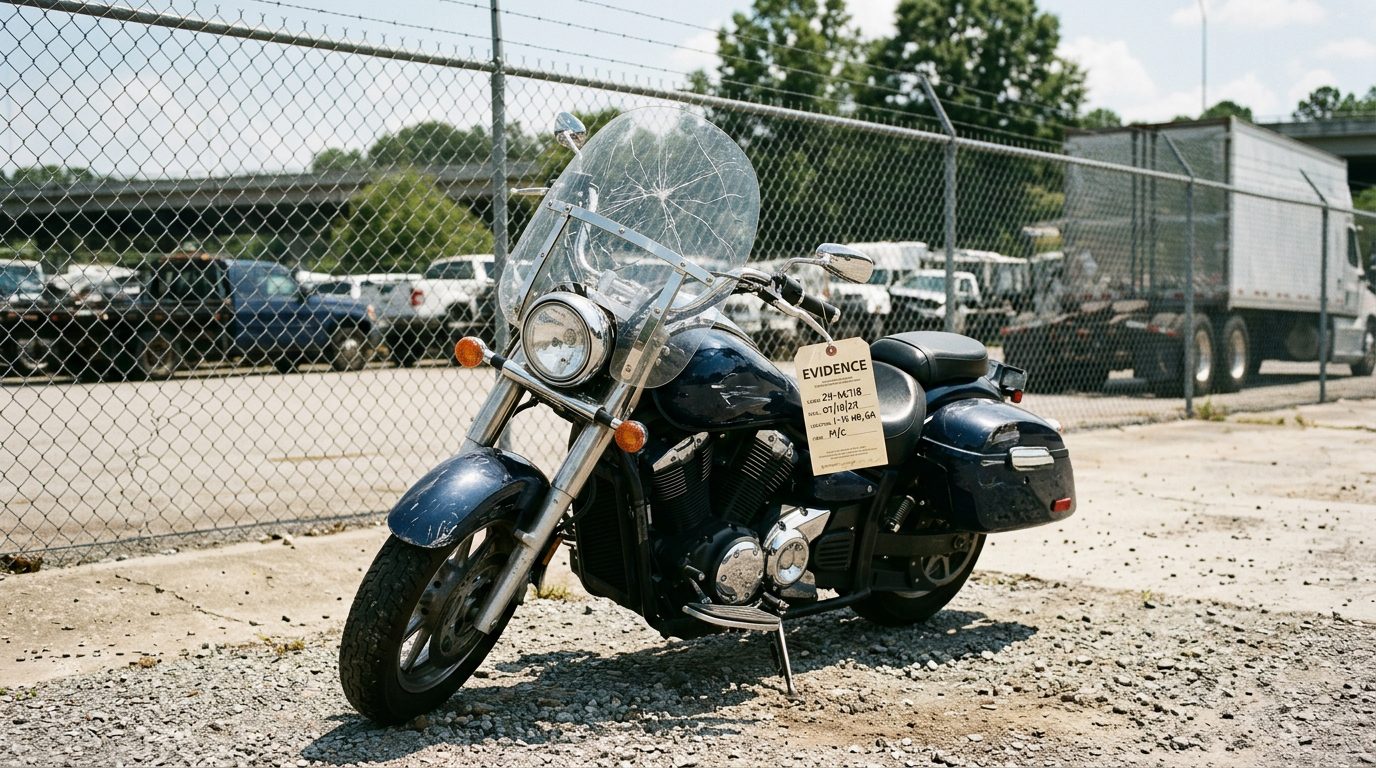
Save photos, videos, and messages from the scene. Keep your helmet, riding gear, and damaged bike. Avoid giving recorded statements to any insurance company before speaking with a lawyer.
Evidence that can matter in a truck and motorcycle case
Electronic logging device data
Driving hours and speed data can show whether a driver was following required schedules at the time of the crash.
Dashcam and onboard video
Footage from the truck or nearby vehicles can capture lane position, signals, and the moments leading up to impact.
Maintenance and inspection records
Brake, tire, and lighting repairs or inspection gaps can be relevant to how the crash happened.
Your scene and medical records
Photos, crash reports, and treatment records help connect your injuries to the collision.