

Motorcycle & Truck Crashes | Georgia
Who caused the crash? The evidence usually tells the story.
Police reports, scene photos, vehicle damage, and truck data can show what happened. Learn which proof matters most and how it gets collected.
Why people call T. Madden & Associates, P.C.
1999
Year the firm began practice
5
Offices in Georgia
No fee
Unless there is a recovery; court costs and case expenses may still apply
By Terance Madden · Published November 22, 2026
Motorcycle truck crash evidence decides who is responsible. If a truck hit you or someone you love on a bike, the paperwork can feel like a second job.
The short answer: fault gets proven when several sources point the same way. Those sources are the truck company’s records, the truck’s electronic data, video, the police report, and the scene itself.
What evidence is needed to prove fault in a motorcycle crash with a commercial truck, such as trucking logs, black box data, dashcam footage, and police reports?
Proving fault takes evidence that lines up. The strongest cases match the truck company’s records, the truck’s data, video, the police report, and the physical scene against each other.
Liability means legal responsibility for harm. In a truck case, liability can reach the driver, the trucking company, and other companies that helped cause the crash.
No single item settles the question alone. A log can show a driver was worn out. Engine data can show a hard brake. Video can show the lane. Each piece gets stronger when it matches the others.
A federal board may also review a serious crash. The National Transportation Safety Board looks for probable causes and safety fixes. It does not decide fault or liability.
The sections below cover each source, why it must be requested fast, and how Big Insurance may use it.
If a truck hit you or someone you love on a motorcycle, the evidence can feel overwhelming, and you don't have to sort it out alone. Talk it through with our team — the first consultation is free, confidential, and carries no obligation.

Trucking logs and driver records show what the driver was doing before the crash
Trucking logs show how long the driver had been working and driving before impact.
Most carriers must track driver hours with an electronic logging device (ELD), a device that records a driver’s time on duty and on the road. Under 49 C.F.R. § 395.8, carriers must install ELDs and require drivers to use them.
Hours limits set the boundaries. Under 49 C.F.R. § 395.3, a driver of a property-carrying commercial motor vehicle may not drive without first taking 10 consecutive hours off duty, except as otherwise provided in § 395.1. Under 49 C.F.R. § 395.3(a)(3)(ii), driving is not permitted after more than 8 hours of driving time without a 30-minute interruption in driving status, except for drivers who qualify for the short-haul exceptions in § 395.1(e)(1) or (2).
Logs can also show a schedule that pushed a driver to hurry. 49 C.F.R. § 392.6
Check the logs against everything else. Dispatch messages, bills of lading, fuel receipts, and phone records can confirm or contradict what the driver says. Federal rules also bar any false report about duty status.
Time matters here. Carriers must keep these records for at least six months from the date of receipt. That is the minimum, so send your request early.
After certain crashes, the employer must test the surviving driver for alcohol as soon as practicable. If that test is not given within two hours, the employer must keep a record of why. 49 C.F.R. § 382.303
Black box data from the truck’s engine control module shows speed, braking, and throttle in the seconds before impact
The engine control module (ECM) is the truck’s onboard computer. Many trucks log speed, brake use, and throttle position in the seconds before impact. People often call this data the black box.
Think of it as a flight recorder for a big rig. A sudden drop in speed can point to hard braking. Throttle data can show whether the driver was on the gas during a lane change. Cruise control status can show whether the driver was steering through traffic or holding a set speed.
Before law school, Terance Madden trained as an electrical engineer. He trained as an engineer before law school, so he reads this kind of data himself. He lines the engine timing up against the video and the scene, then asks what the numbers mean for the crash.
The data must be pulled correctly. Data can be lost when a truck goes back into service. Federal rules let carriers keep records with any technology that accurately reflects the information and stays readable. Data stored in a truck can be lost when the truck is repaired or sold, so it helps to act early. Contact the firm as soon as possible to talk through what should be preserved.
Dashcam and surveillance video can show the lane, the signals, and the timing of the crash
Video shows where each vehicle was, and when. Forward-facing dashcams, driver-facing cameras, and nearby business or traffic cameras can each catch part of the crash.
Video is fragile. Many systems record over old footage on a set schedule. Send a written preservation request, which asks the holder to keep the footage, early. Name the cameras, the location, and the time window.
Matching video to truck data builds a timeline. If a frame shows the truck crossing into the rider’s lane at the same moment the engine data shows braking, the sequence is tight. If the times don’t line up, that gap is worth chasing.
Video also shows the rider’s lane position and speed. Big Insurance often argues the rider was speeding or weaving. Footage can answer that claim in both directions. Don’t assume the rider was at fault. Let the frames show what happened.
Police reports and physical scene evidence record the facts while the scene is fresh
A police report records what the officer saw, heard, and measured. It usually includes a diagram, witness statements, any citations, and the officer’s notes.
The report is a starting point. An officer arrives after the crash and works from what is visible and what people say at that moment. An officer’s opinion on fault can be challenged with other evidence, such as the truck data and the video.
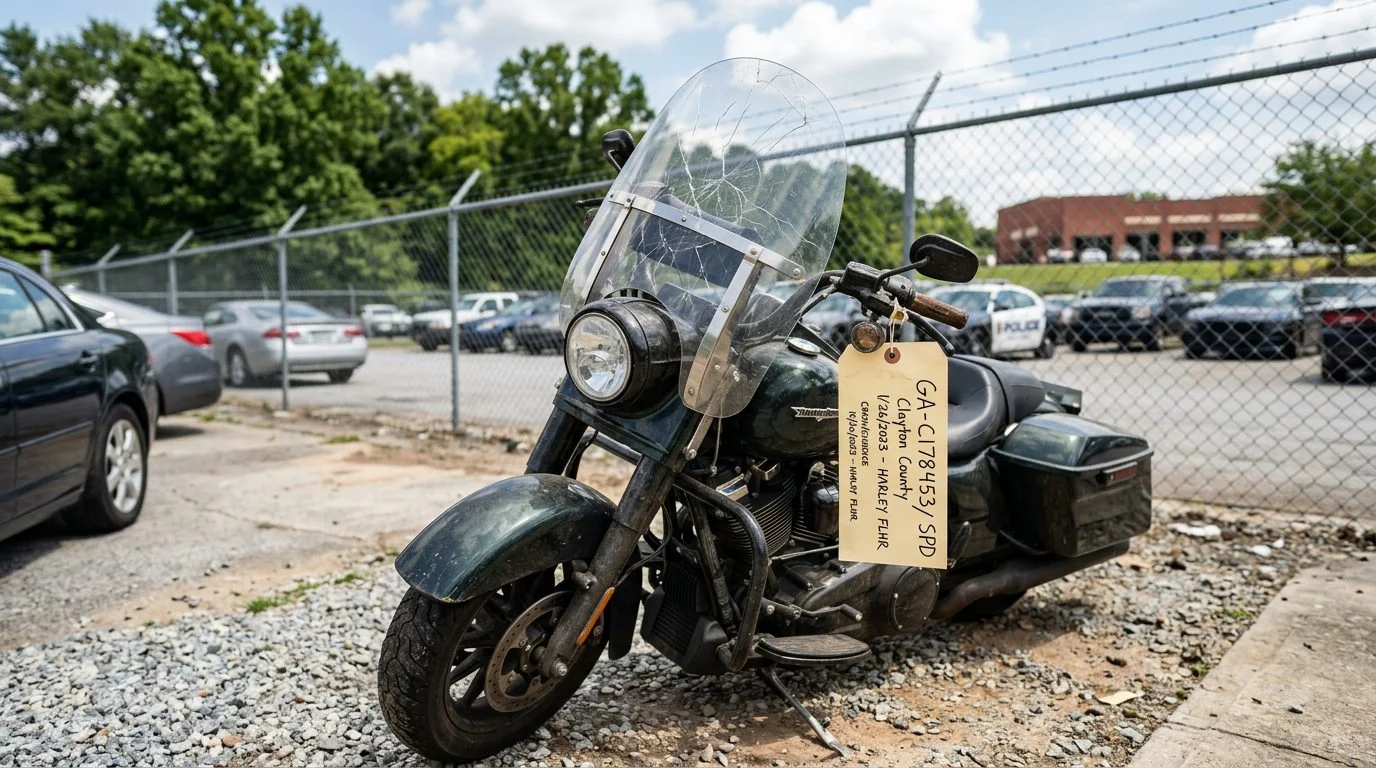
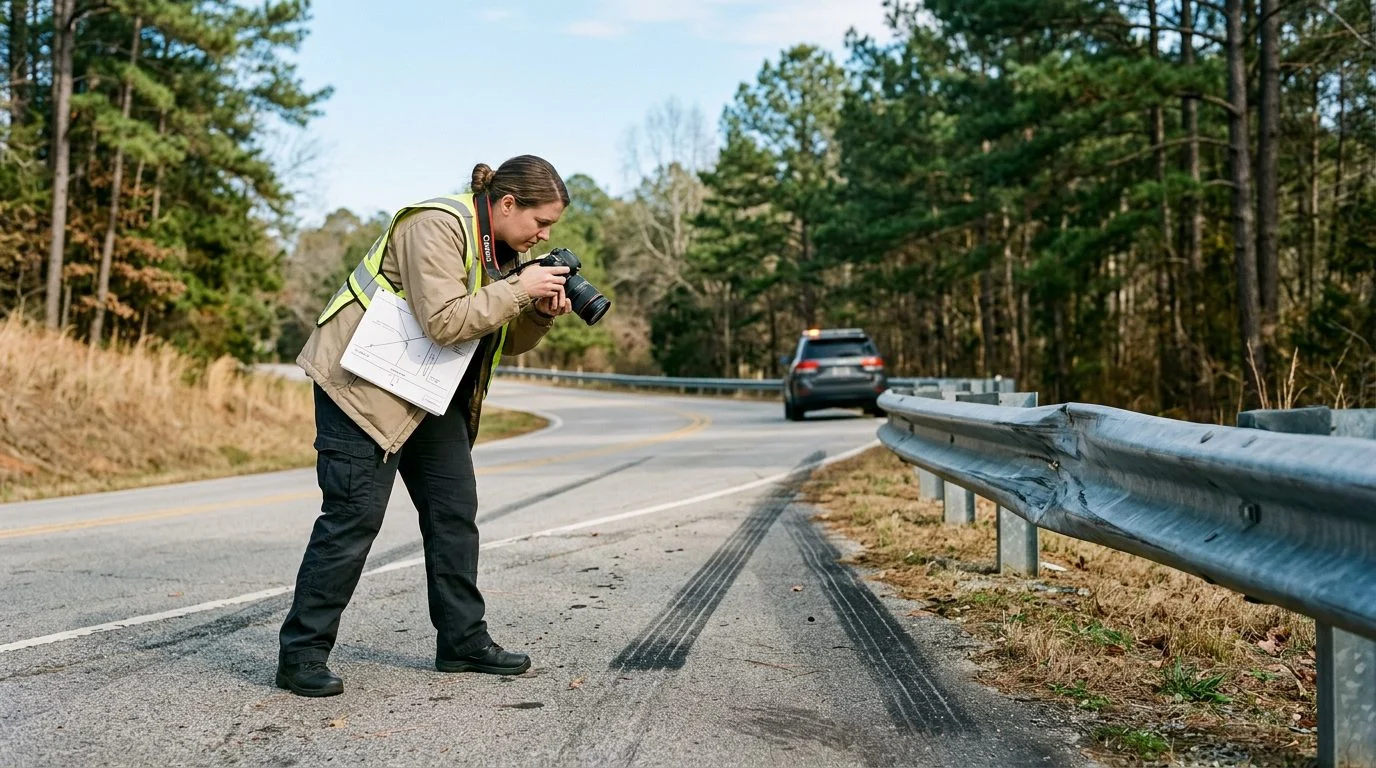
Physical evidence changes fast. Tire marks wash out, and roads get reopened. Look for final rest positions, skid or scuff marks, debris, and damage patterns on both vehicles. The motorcycle is evidence too. Keep it, along with the helmet and gear, if you still have them.
Crash physics ties the pieces together. Delta-V is the change in speed a vehicle goes through during impact. Where each vehicle was struck, and how far each moved, can show how fast it was going and how much time the driver had to react. Terance Madden’s engineering training helps him run those numbers and explain them in plain words.
Employer negligence and other liable parties can add more evidence and more insurance
A trucking company can answer for its own choices, not only the driver’s. The firm calls five of these choices The Negligent Five. Each one below is stated as the Georgia cases and statutes state it.
- Hiring: An employer must use ordinary care not to hire someone it knew or should have known posed a risk of harm to others. Munroe v. Universal Health Services, Inc.
- Training: An injured party may bring a claim against a company for negligently training an employee. Beasley v. A Better Gas Co.
- Entrustment: Negligent entrustment (lending a vehicle to someone known to be unfit) rests on actual knowledge that the person is incompetent or habitually reckless. Zaldivar v. Prickett Showing the company should have known is not enough. Western Industries, Inc. v. Poole
- Retention: An employer must use ordinary care not to keep an employee after learning of incompetency. O.C.G.A. § 34-7-20
- Supervision: A claim needs enough evidence that the employer reasonably knew or should have known of the employee’s tendencies tied to the injuries. Novare Group, Inc. v. Sarif
An employer can also answer for a worker’s wrongs done within the scope of the job. O.C.G.A. § 51-2-2 makes a person liable for torts committed by his servant by his command or in the prosecution and within the scope of his business. In Quynn v. Hulsey, the Georgia Supreme Court held that an employer’s admission of that responsibility does not end the company’s own claims. Quynn v. Hulsey
Other companies can share the blame. Brake, tire, and maintenance vendors, and cargo loaders, can all be at fault. Each at-fault party answers for its own share, and that share is not joint. Each party may carry its own insurance.
Georgia also cuts damages by the injured person’s share of fault. A plaintiff who is 50 percent or more responsible may not receive any damages (O.C.G.A. § 51-12-33; Quynn v. Hulsey (2020)).
Not sure what your next step is?
Talk it through with our team — the first consultation is free, confidential, and carries no obligation.
Big Insurance uses these same records to argue fault and push a low offer, and the firm responds with every coverage layer
Big Insurance is not on your side. An insurer’s first offer is rarely what a claim is worth. The same records that prove fault can be used to shrink a claim, so expect pushback.
Common tactics include:
- An early recorded statement, taken before the family knows what the records show.
- A quick, low offer meant to close the file.
- Claims that the rider was speeding or lane-splitting.
- Delays, incomplete records, and fights over what the truck data shows.
- “Low impact” arguments that downplay the force of the crash.
- Disputes over medical treatment and bills.
The firm’s response is to pursue every coverage layer. That means the at-fault driver’s liability coverage, the trucking company’s coverage, umbrella and excess policies, corporate coverage, and uninsured motorist (UM) and underinsured motorist (UIM) coverage.
The firm also counts the full cost of the injury over a lifetime. That includes future care, lost income, and the daily help a family provides.
If you are the person holding the paperwork, here is what to protect first, and how to reach the firm
If you’re the one holding the paperwork, you’re carrying a lot. You may be taking calls, paying bills, and checking the mail after a long shift. That’s a hard week, and the decisions ahead are heavy.
Start by protecting the evidence you already have. Keep these items together:
- Photos of the scene, the bike, and the truck, if you have them
- Medical bills, discharge papers, and appointment notes
- Pay records for missed work
- The damaged helmet and gear
- The motorcycle, if it is still available
- Names and phone numbers of anyone who saw the crash
Two rules help. Don’t give a recorded statement to the truck company or Big Insurance before you talk with a lawyer. And don’t sign anything you haven’t read.
If your family member was hurt in a crash that someone else’s fault caused, you don’t have to sort the evidence alone. Start a free case evaluation at T. Madden & Associates, P.C.. The firm offers a free first consultation that is confidential, with no obligation to continue. Terance Madden is the responsible lawyer, and the firm has offices in Jonesboro, Atlanta, Decatur, Macon and Augusta.
Frequently Asked Questions
What evidence shows who was at fault in a motorcycle and truck crash?
Police reports, photos of the scene, vehicle damage, witness statements, and traffic camera or dash cam video can all show how the crash happened. In a truck crash, the truck’s electronic data and driver logs often add key facts about speed, braking, and hours on the road.
Can the truck’s black box data prove the driver was at fault?
The truck’s engine control module (ECM) records speed, throttle, and braking, and it can show whether the driver reacted in time. Driver logs can show whether the driver was over the legal hours of service. This data can be lost if it is not preserved quickly, so it matters to act early.
Can I still recover damages if I was partly at fault for the crash?
Georgia uses a rule called modified comparative fault. Georgia uses a modified comparative fault rule (O.C.G.A. § 51-12-33). That means your award is reduced by your percentage of fault, and if you are found 50 percent or more responsible, you recover nothing. If you are 50 percent or more at fault, you cannot recover damages under Georgia law.
Can someone other than the truck driver be liable in a motorcycle and truck crash?
Yes. The trucking company may share responsibility for how it hired, trained, supervised, and maintained the truck and its driver. A cargo loader, brake or tire vendor, or repair shop may also share fault if their work contributed to the crash, and each one may bring another source of insurance into the claim.