

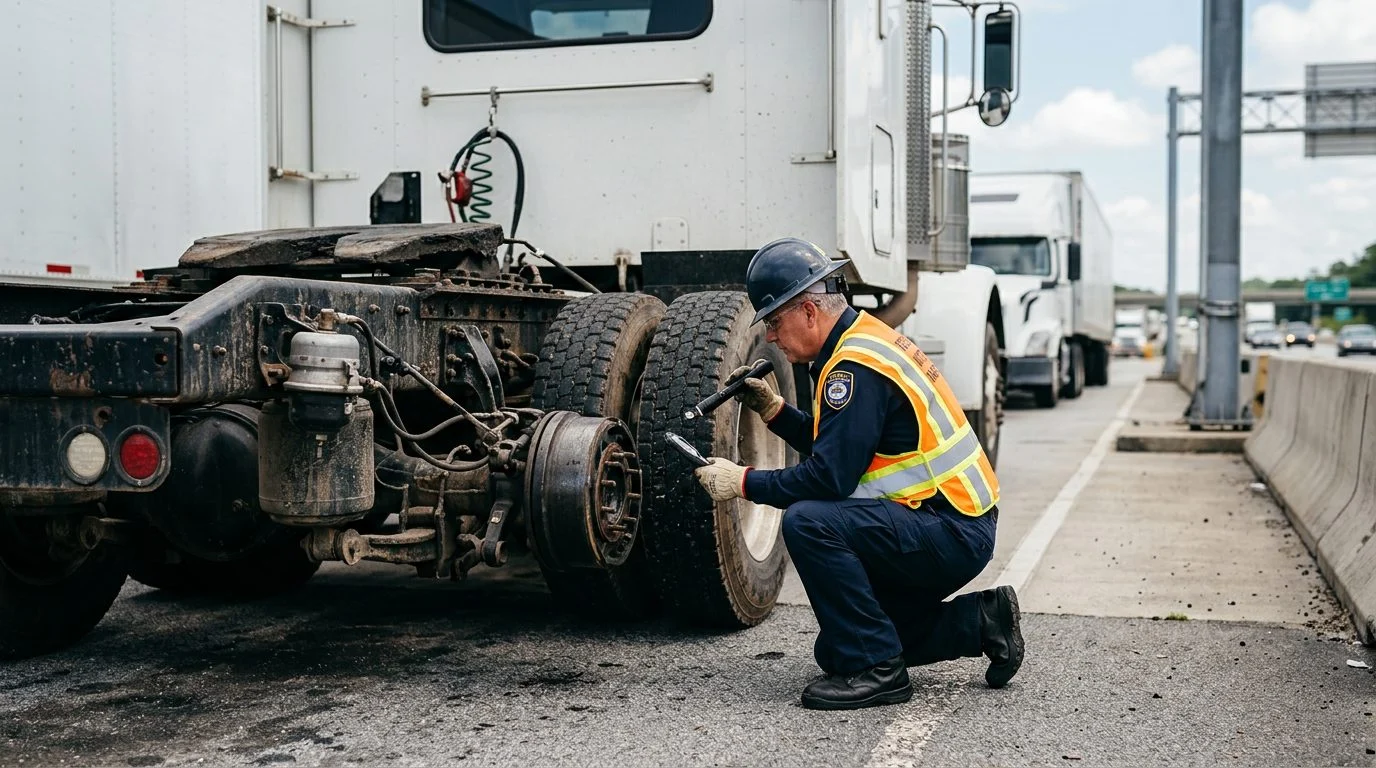
Owner-Operator Truck Crash: Who Is Liable in Georgia
By Terance Madden · Published October 17, 2026
Yes, in many Georgia truck crashes you can pursue more than one party. The label on a contract is only one piece. Courts also look at who owned the truck, who controlled the trip, and who got paid.
If you’re reading this after a crash, you may be hurt, dealing with bills, and trying to figure out who should answer for what happened. That’s a lot to carry. This page explains the legal questions that usually come up, so you know what to gather and why it matters.
Why the Contractor Label Changes Who You Can Sue
A driver’s job title doesn’t settle who can be sued. Your options depend on how the driver, the truck’s owner, and the company whose freight was being hauled were connected. That connection shows up in the paperwork, and it also shows up in daily practice.
A driver labeled as a contractor can still create liability for that driver personally. If the driver ran a red light or drove while exhausted, the driver’s own negligence still matters. The label doesn’t erase it.
This page answers three questions. Who can be named in a lawsuit? When can a company answer for a contractor’s crash? What proof and deadlines matter most?
This Georgia personal injury firm, led by attorney Terance Madden, has been in practice since 1999. Attorney Terance Madden leads the firm, and our team can explain how these rules apply to a specific crash.

Employee, Owner-Operator, and Contractor: What the Labels Mean
An employee drives for a company that puts him on its payroll. An owner-operator owns the truck and drives it, often under a lease with a carrier. A contractor drives under a service agreement with a company that hires the work done.
These labels matter because they point to the relationship. They aren’t the whole answer. Courts and insurers look at how the work was actually run. Who assigned the loads? Who set the schedule? Whose name was on the truck? Who paid the driver, and who carried the insurance?
A company can sometimes answer for a driver it doesn’t directly employ. This can happen when the company held the truck out as its own, or when it controlled the trip. Georgia courts decide these questions by looking at the facts of each relationship. This page keeps the discussion general, so it won’t predict how any single label will be treated.
Can You Sue the Driver or the Owner-Operator Personally?
Yes.
Common examples in truck crashes include speeding, following too closely, and distracted driving. If the driver made one of these mistakes, the driver may be a direct defendant.
An owner-operator often fits this picture. The owner-operator is the driver, and often the person who owns and insures the truck. That can make the owner-operator a direct defendant, not only a witness to someone else’s decisions.
An individual’s personal assets and insurance can look very different from a larger carrier’s coverage. That difference matters when deciding who to name and what coverage is available. For the broader picture of truck crash claims, read our truck accident lawyer guide for Georgia.
When the Trucking Company Can Be Held Responsible
A trucking company can be held responsible even when the driver is a contractor. The route depends on the lease, the company’s own conduct, and what it knew.
Federal rules set requirements for leased trucks. The written lease must be made between the carrier and the equipment owner, and signed by the parties or their representatives. The pay must be clearly stated in the lease or an addendum before any trip begins, under federal truck lease rules.
Federal law also lets the Secretary of Transportation require a carrier that uses trucks it doesn’t own to put the arrangement in writing. It can also require the carrier to inspect the trucks, carry liability insurance, and operate them as if it owned them. See the federal leased-vehicle statute.
A company can also face claims for its own conduct. These are often called direct negligence claims. They can include negligent selection, hiring, supervision, retention, and entrustment. With limited exceptions, a motor carrier must, within 30 days after a driver’s employment begins, ask each state licensing authority that issued that driver a license or permit during the preceding 3 years for the driver’s motor vehicle record covering that 3-year period. Each motor carrier must also investigate the driver’s safety performance history with Department of Transportation regulated employers during the preceding three years, as set out in the federal driver qualification rules.
In Quynn v. Hulsey, the Georgia Supreme Court held that fault apportionment applies to direct negligence claims against an employer that admits respondeat superior. Whether these claims apply depends on the facts of the crash and the relationship.
Proving the Relationship: Documents and Crash Data to Gather
The strongest proof is paperwork that shows who controlled the truck, who gave orders, and who got paid. Start with these items:
- The lease or service agreement, including any addendum about pay.
- Bills of lading, which show who hired the load and where it was headed.
- Dispatch records and messages that show who sent the driver on the trip.
- Markings on the truck, including the USDOT number.
- Registration and insurance papers.
Each item answers a question. Who owned the truck? Who assigned the load? Whose name was on the insurance? Together they can show the real relationship, even when the contract uses a different label.
Driver logs matter too. Federal rules require a carrier to make each driver record duty status for each 24-hour period. Carriers must keep those records for at least six months from receipt, under federal driver log rules.
Because that retention period is only a minimum, it’s a practical reason to act early. Ask for electronic logs, GPS data, and dash-camera footage before they’re gone. Our page on preserving crash data in Georgia explains what to request. For how driver hours can bear on fault, see hours of service and crash fault.
Insurance Layers and What Coverage Means for Recovery
One crash can involve more than one insurance policy. The driver, the owner-operator, and the carrier may each carry coverage.
Federal rules set minimum insurance for some interstate carriers. For for-hire carriage of nonhazardous property in interstate or foreign commerce, the minimum is $750,000 for trucks rated at 10,001 pounds or more, under federal insurance minimums. A minimum is a floor, not a measure of what any claim is worth.
Whether a trucking company’s insurer can be named as a defendant in the same case depends on which statute covers that carrier. O.C.G.A. § 40-1-112 addresses the motor carriers governed by that article, while O.C.G.A. § 40-2-140 contains a parallel provision for interstate carriers, and each sets its own conditions. Under Georgia motor carrier insurance law, O.C.G.A. § 40-1-112(c), joinder is generally allowed only when a related carrier is insolvent or bankrupt, or when personal service can’t be made on the driver or carrier after reasonable diligence.
Coverage questions need a review of the actual policies, not just the minimums. For how minimum coverage fits a claim, read our semi-truck minimum insurance guide.
Georgia Deadlines and Fault Rules That Affect the Claim
Georgia generally gives two years to file a personal injury lawsuit. Under O.C.G.A. § 9-3-33, injury actions generally must be brought within two years after the right of action accrues. Loss of consortium claims have a four-year period.
Georgia also uses a comparative fault rule. Under O.C.G.A. § 51-12-33, if you share some blame, the judge reduces your damages by your percentage of fault. If you are 50 percent or more responsible, you cannot receive any damages.
The same statute divides fault among everyone who contributed. Each liable party generally pays its own apportioned share, and the damages are generally not joint liability, though exceptions apply, including where a carrier is vicariously liable for its driver and the two are treated as one share.
Early evidence matters for both fault and deadlines. Witness names, photos, and a prompt review of company records help show who was at fault. Waiting can make that proof harder to find.
Talk With Terance Madden About Your Crash
If you’re weighing who to pursue after a truck crash, a free first consultation can help you see how these rules fit your facts. You may still be recovering. The truck’s paperwork may name a contractor or an owner-operator. You may be deciding whether to act, and how quickly.
Common Questions
Can I sue a trucking company if the driver was a contractor?
Often, yes. A company can face claims through its lease, its own hiring or supervision, or other facts showing control.
Is an owner-operator personally liable?
An owner-operator who drove the truck can be named as the driver, and often as its owner.
How long do I have to file?
Georgia generally allows two years for personal injury claims, under the statute linked above.
Our team can review the lease, the dispatch records, and the crash facts with you. Contact our team through our contact page for a free, confidential first consultation with no obligation to continue. The firm works on a no-fee-unless-we-win basis, but you may still be responsible for court costs and case expenses. You can call 24/7.
This page is general information, not legal advice. Responsible lawyer: Terance Madden. Offices in Jonesboro, Atlanta, Decatur, Macon, and Augusta. Contact: https://www.tmaddenlaw.com/contact/