

Truck Accident Lawyer | Jonesboro, Atlanta, Decatur, Macon & Augusta
Hurt by a Truck Driver Who Was Texting? Talk to a Georgia Truck Crash Lawyer
T. Madden & Associates, P.C. has represented injured Georgians since 1999. We help people hurt in crashes involving distracted commercial drivers, including texting, and we explain your options in a free, confidential consultation.
About T. Madden & Associates, P.C.
Since 1999
Representing injured people in Georgia
5
Offices: Jonesboro, Atlanta, Decatur, Macon, Augusta
Free
Confidential first consultation
By Terance Madden · Published October 24, 2026
A texting truck crash can leave you hurt, out of work, and fielding calls from insurers. A truck driver texting crash lawyer in Georgia can help sort out the phone rules, the proof, and the deadlines. This guide explains how these claims work in plain terms.
What a Texting Truck Driver Crash Claim Covers
A texting truck driver crash claim asks for payment after a commercial truck driver’s phone use helped cause an injury or death. Each case depends on its own facts, and the evidence is reviewed individually.
Who these claims are for:
- Drivers and passengers hurt in a crash with a truck.
- Pedestrians and cyclists struck by a truck.
- Families of a person killed in a crash involving a truck.
Crash patterns where distraction can play a role include:
- Rear-end collisions into slowed or stopped traffic.
- Lane changes that move into another vehicle.
- Failing to stop for a signal or stop sign.
- Run-off-road crashes.
T. Madden & Associates, P.C. handles truck accident cases, including cases where phone use is part of the story.
If a truck driver's phone use may have caused the crash that hurt you or someone you love, you don't have to face it alone. Our team can talk it through with you. Talk it through with our team — the first consultation is free, confidential, and carries no obligation.

Georgia and Federal Phone Rules for Truck Drivers
Federal rules bar commercial truck drivers from texting while driving and from using a hand-held phone while driving a commercial motor vehicle, though hand-held use is permitted when necessary to communicate with law enforcement officials or other emergency services.
Under 49 C.F.R. § 392.80, no driver may text while driving, and no motor carrier may allow or require it. “Driving” includes a truck that is temporarily stopped in traffic or at a signal, with the motor running.
Under 49 C.F.R. § 392.82, no driver may use a hand-held mobile telephone while driving, and no motor carrier may allow or require it. Both rules allow an exception for communicating with law enforcement or other emergency services.
Under 49 C.F.R. § 390.11, the motor carrier must require its drivers to observe these duties and prohibitions. The company carries its own duty, not just the driver.
Georgia also has its own rules on phone use by drivers.
Why this matters: Georgia calls the failure to use ordinary care “ordinary negligence,” under O.C.G.A. § 51-1-2. Proof that a driver broke a phone rule can help show that lack of care. How much weight it carries depends on the crash’s facts.
How Phone Use Is Proven After a Truck Crash
Phone use is proven by combining several kinds of evidence. No single record usually settles the question.
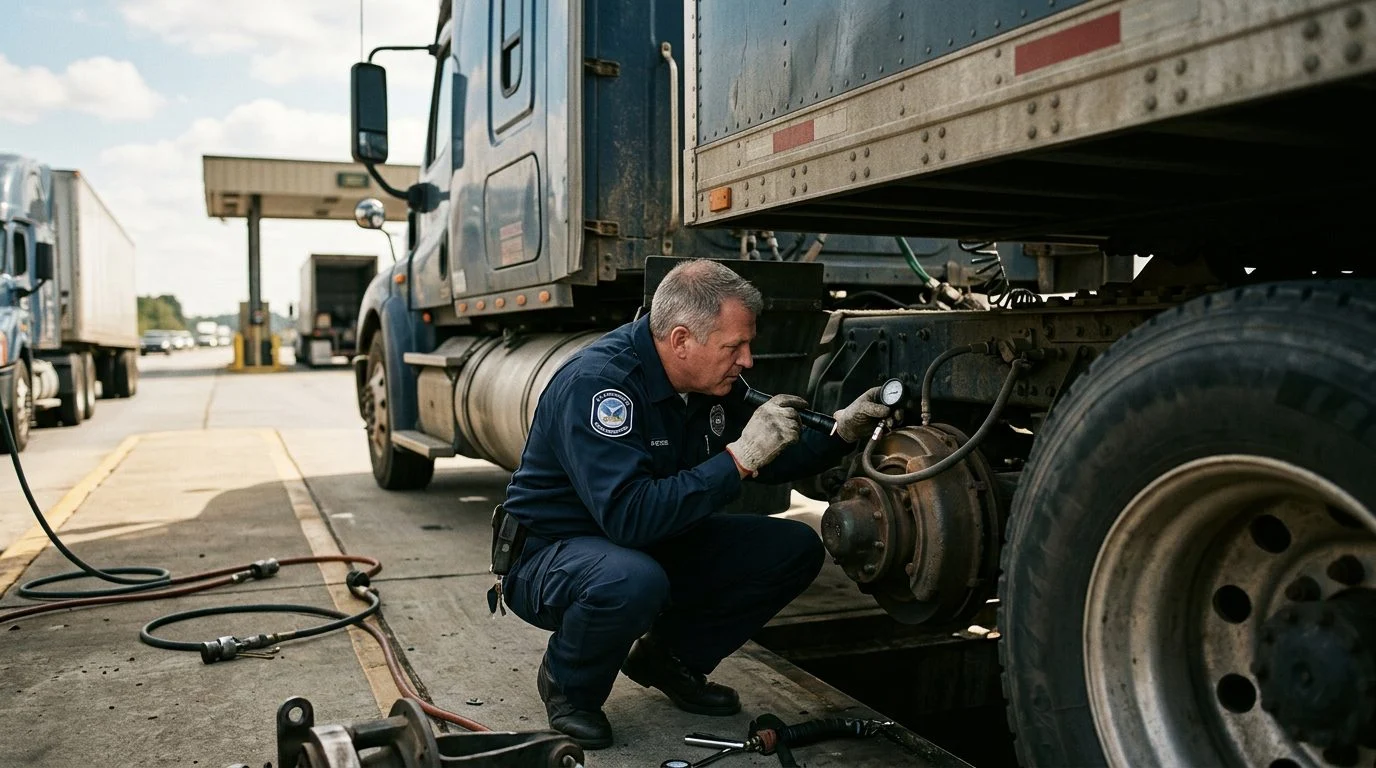
- Electronic logging data. An electronic logging device automatically records the date, time, truck location, engine hours, and vehicle miles, under 49 C.F.R. § 395.26. When the truck is moving and no other entry is made for an hour, the device records an intermediate entry.
- Phone records. Carrier records and the driver’s device can show texts, calls, or app use near the crash time. Getting them usually takes formal legal steps.
- Crash scene evidence. Police reports, skid marks, vehicle damage, witness statements, and nearby camera footage show how the crash happened.
- Short retention windows. The Federal Motor Carrier Safety Administration explains that motor carriers must keep drivers’ electronic duty-status records and supporting documents for six months.
A preservation letter is a written demand that the trucking company keep logs, phone data, camera footage, and maintenance records. Under 49 C.F.R. § 379.7, records may be kept with any technology that accurately reflects the information and stays accessible. Sending that letter early matters, because records must remain accessible in a form that can be accurately reproduced later for reference.
Who Can Be Held Liable in a Texting Truck Crash
The truck driver and the trucking company can both be liable, depending on the facts.
The driver is responsible for his or her own negligence, such as texting at the wheel.
The company can also be responsible for the driver’s work. Under O.C.G.A. § 51-2-2, a person is liable for torts committed by a servant “by his command or in the prosecution and within the scope of his business.” This scope-of-business rule is often called respondeat superior.
Some claims also look at the company’s own choices. These can include how it hired, trained, supervised, or kept the driver. Whether those claims apply depends on the facts.
Other parties, such as a maintenance contractor or an equipment owner, may share responsibility in some crashes.
Comparative Fault, Deadlines, and Damages
Georgia cuts your recovery by your share of fault. At 50 percent or more, you recover nothing (O.C.G.A. § 51-12-33 (Quynn v. Hulsey (2020))(g)).
Under O.C.G.A. § 51-12-33, the judge reduces the damages in proportion to the plaintiff’s fault. A plaintiff who is 50 percent or more responsible for the injury cannot receive damages. Each liable person pays its own share, not a joint amount.
Georgia’s injury deadline is generally two years. Under O.C.G.A. § 9-3-33, actions for injuries to the person must be brought within two years after the right of action accrues, except for actions for injuries to the person involving loss of consortium, which must be brought within four years after the right of action accrues.
Families of a person killed should act early. Under O.C.G.A. § 51-4-5, when death results from criminal or other negligence, the personal representative may recover funeral, medical, and other necessary expenses.
Under O.C.G.A. § 51-12-2, general damages are those which the law presumes to flow from any tortious act, and they may be recovered without proof of any amount; special damages are those which actually flow from a tortious act, and they must be proved in order to be recovered. General damages are presumed and need no proof of amount. Special damages, such as medical bills, must be proved.
What to Expect After You Contact a Lawyer
After you contact a lawyer, the work usually moves through five steps. The timeline depends on the facts of your case.
- Intake. The lawyer reviews the crash facts, your injuries, and any police report or citation.
- Preservation. Letters go to the trucking company and insurers asking them to keep phone, log, and camera data.
- Investigation. The team requests records, interviews witnesses, and, when needed, arranges reconstruction work.
- Insurance contact. The firm can handle adjuster calls, so you aren’t pushed into a recorded statement without advice.
- Negotiation or lawsuit. Claims can be negotiated or, if needed, filed in court.
Several mistakes can hurt a claim. Avoid giving a recorded statement without advice, posting about the crash online, admitting fault at the scene, and delaying medical care.
Not sure what your next step is?
Talk it through with our team — the first consultation is free, confidential, and carries no obligation.
Why Work With T. Madden & Associates, P.C.
T. Madden & Associates, P.C. has practiced personal injury law in Georgia since 1999. Terance Madden is the responsible lawyer for this page. The firm’s lawyers include Terance Madden and Shenia Madden.
The firm has offices in Jonesboro (Clayton County), Atlanta, Decatur, Macon, and Augusta. Clients can call 24/7 to talk about a crash.
The first consultation is free, confidential, and carries no obligation to continue. The firm works on a no-fee-unless-we-win basis, but you may still be responsible for court costs and case expenses. Ask about those before you sign anything.
The firm’s practice covers car, truck, motorcycle, e-bike, slip and fall, medical malpractice, nursing home abuse, negligent security, wrongful death, and catastrophic injury cases.

Frequently Asked Questions About Texting Truck Crash Claims
Short answers to common questions are below.
Can you sue a trucking company if its truck hits you?
In many cases, yes. The company may be responsible for its driver’s negligence within the scope of the driver’s work.
How can I prove a truck driver was texting?
Phone records, electronic logging data, camera footage, witness accounts, and the police report can all help build that proof.
How long do I have to file?
Georgia’s injury deadline is generally two years under O.C.G.A. § 9-3-33. Families of a person killed should contact T. Madden & Associates, P.C. early for a free, confidential first consultation with no obligation to continue.
What if I was partly at fault?
Georgia reduces your recovery by your share of fault. At 50 percent or more, you recover nothing under O.C.G.A. § 51-12-33.
If a truck driver’s phone use may have caused a crash that hurt you or someone you love, you don’t have to sort out the rules, proof, and deadlines alone. Our team at T. Madden & Associates, P.C. can review your situation. Start a free case evaluation today.
Evidence That Can Show a Driver Was Texting
Phone Records
Call, text, and data logs from the driver's phone can show activity at the time of the crash.
Electronic Logging Data
Trucks often carry electronic systems that record speed, braking, and driving patterns before a collision.
Camera Footage
Dash cams, onboard cameras, and nearby business or traffic cameras may capture what happened.
Police and Witness Reports
Officer observations, statements from witnesses, and the crash report help build the timeline.
How Our Team Can Help
Investigation
We work to gather phone records, trucking company files, and crash evidence while it is still available.
Advocacy
We fight for fair compensation for medical bills, lost income, and the impact of your injuries.
Clear Communication
Our lawyers, Terance Madden and Shenia Madden, and our team keep you informed at every step.
Fees
There are no fees unless there is a recovery. Court costs and case expenses may still be your responsibility.
Act Early to Protect Evidence
Phone data, electronic logs, and camera footage can be overwritten or lost. Contacting a lawyer soon after a crash gives your case the best chance to request that this evidence be preserved.