

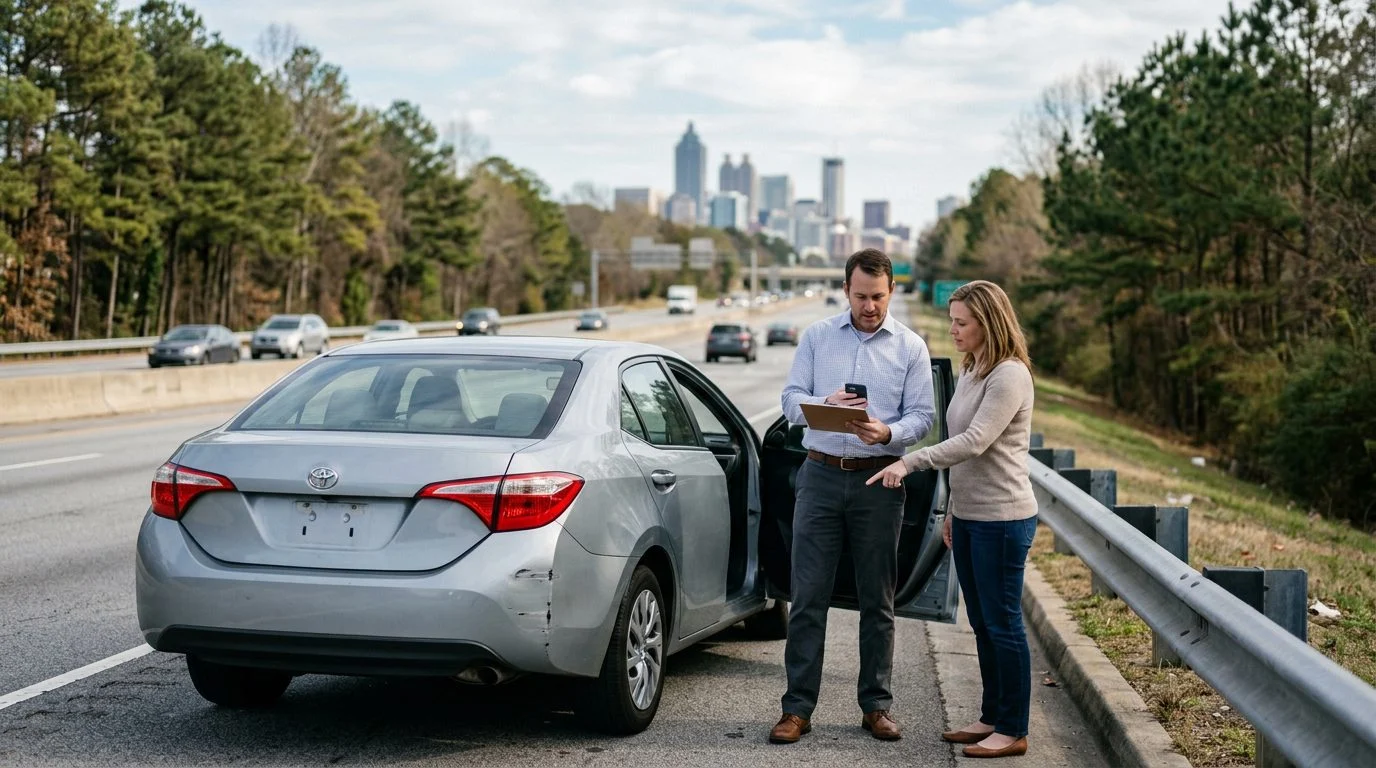
Car Accidents · Georgia
What Does "No-Fault State" Mean? A Georgia Guide
Learn how insurance and fault work after a crash in Georgia, and when it makes sense to talk with a personal injury lawyer.
T. Madden & Associates, P.C.
1999
Year the firm began practice
5
Offices: Jonesboro, Atlanta, Decatur, Macon and Augusta
Free
Confidential first consultation with no obligation
By Terance Madden · Published October 30, 2026
What does “no-fault state” mean?
The term describes how the insurance pays. It does not mean that nobody was at fault.
Most no-fault systems rely on Personal Injury Protection (PIP) coverage. PIP is the part of an auto policy that pays certain medical bills and related losses after a crash. The details differ from state to state, so the same phrase can mean slightly different things in different places.
When you see “no-fault” in an insurance letter, it usually refers to this payment system. It tells you which policy is asked to pay first. It does not answer the bigger question of who owes you money for pain and other harm. That question falls under the state’s fault rules.
If a truck crash left you hurt and insurer calls have you unsure what comes next, our team can talk it through with you in a free first consultation. Talk it through with our team — the first consultation is free, confidential, and carries no obligation.

How a no-fault insurance system works
That speeds up payment for basic losses.
PIP benefits have limits. The policy and state law set how much it pays and for what. Once those limits are used up, other sources may be needed to cover the rest of your losses.
The purpose of this design is faster payment for basic losses. It also aims to reduce small claims that would otherwise clog the courts. Not every state uses it, and the rules can change over time.
What an at-fault state means
In an at-fault state, the driver who caused the crash is responsible for the other people’s losses. That driver’s liability insurance is the main source of payment for those losses. Liability coverage pays for harm the policyholder causes to others.
An injured person may bring a claim with the at-fault driver’s insurer. If the claim does not settle, the injured person may be able to file a lawsuit. Every lawsuit must be filed within the state’s deadlines, which are covered below.
Fault is decided from evidence. Common evidence includes police reports, photographs, witness statements, and the traffic rules that applied at the scene. Drivers often disagree about what happened, so the evidence often decides who bears the larger share of fault.
No-fault vs. at-fault insurance compared
Here is the short version of the main differences.
- Shared fault: Under O.C.G.A. § 51-12-33 (Quynn v. Hulsey (2020)), a plaintiff’s damages are reduced in proportion to the plaintiff’s percentage of fault, and the plaintiff cannot recover damages if the plaintiff is 50 percent or more responsible for the injury or damages claimed (O.C.G.A. § 51-12-33(a) and (g)). The Georgia section below explains how this works.
These differences matter most when you are deciding whom to file a claim against and how fast you need money for medical bills.
Which states are no-fault states?
Some states use no-fault systems, and others use at-fault systems. That is why the same crash can be handled differently depending on the state.
If you were hurt out of state, ask about the rules where the crash happened.
State laws change over time. Any list of no-fault states can fall out of date. The safest starting point is the current law of the state where the crash took place.
Insurance and fault in a Georgia crash claim
The state’s fault rules shape how much can be recovered.
Georgia applies modified comparative fault. The trier of fact determines the injured person’s percentage of fault. The judge then reduces the damages in proportion to that percentage, under O.C.G.A. § 51-12-33.
The same statute says an injured person who is 50 percent or more responsible for the harm cannot receive any damages (O.C.G.A. § 51-12-33; Quynn v. Hulsey (2020)). Below that level, the award is reduced by the injured person’s share of fault. For example, a 20 percent share of fault would reduce the award by 20 percent.
The statute also apportions damages among the people who are liable, by each person’s percentage of fault. Those shares are not joint liability.
How these rules apply to a specific crash depends on the facts of that crash.
Not sure what your next step is?
Talk it through with our team — the first consultation is free, confidential, and carries no obligation.
Why a truck crash can involve more parties
A crash with a commercial truck can involve the driver, the trucking company, and more than one insurer. That can make the claim more complicated than a typical car crash. Georgia law makes a person liable for torts committed by a servant within the scope of the person’s business, O.C.G.A. § 51-2-2.
Georgia’s joinder rule limits when a motor carrier’s insurance company can be added to a lawsuit. Under O.C.G.A. § 40-1-112, that joinder is allowed only when a related motor carrier is insolvent or bankrupt, or when personal service cannot be made after reasonable diligence on the driver or the motor carrier.
Federal rules also set insurance floors for certain trucks. For example, 49 C.F.R. § 387.9 sets a $750,000 minimum for for-hire interstate carriage of nonhazardous property in trucks rated 10,001 pounds or more. Federal hours-of-service rules state that, subject to the exceptions in the regulation, a driver may not drive without first taking 10 consecutive hours off duty, may not drive after a 14-hour period that begins after coming on duty following 10 consecutive hours off duty, may drive a total of 11 hours during that period, and may not drive once more than 8 hours of driving time have passed without at least a consecutive 30-minute interruption in driving status.
Brokers can also be part of the picture. For Clayton County readers, our trucking company insurance claim guide explains how these parties fit together.
Deadlines and reporting to know about
Georgia’s general deadline for injury claims is two years. Under O.C.G.A. § 9-3-33, an action for injuries to the person must be brought within two years after the right of action accrues. Some other claims have different deadlines. Loss of consortium claims, for example, have a four-year period under the same statute.
Georgia also has accident reporting rules. Our Georgia accident report guide explains when a report may be needed. Our reporting deadline guide covers what happens when a report is late.
Deadlines can run from different dates in different situations. Keep track of the date of the crash and the dates of every letter you receive. Writing these dates down early makes them easier to work with later.
Before you give a recorded statement to an insurer
Insurers often ask for a recorded statement early in a claim. Anything you say can be used when fault and injuries are evaluated. Stay with facts you saw and heard.
Describe what happened without guessing at speed, distance, or who was at fault. Avoid estimating how hurt you are before a medical evaluation. Early guesses can be used against you later, even when they were made in good faith.
Keep copies of every letter, bill, and receipt. Medical bills matter in a claim. Georgia law limits special damages for medical expenses to the reasonable value of medically necessary care, under O.C.G.A. § 51-12-1.1.
You do not have to answer every question on the spot. You can ask for time to review the request before you respond.

Talk with a Georgia accident lawyer about your situation
You may be dealing with injuries from a truck crash, calls from an insurer, and a term in a letter you don’t fully understand. You may be doing this while helping a family member who was hurt. That is a lot to carry at once.
The decision in front of you is practical. You need to know whether the crash falls under Georgia’s at-fault rules, and how a claim against a trucking company’s insurer should be handled. Those answers depend on your facts, and they affect the steps you take next.
T. Madden & Associates, P.C. has been in practice since 1999. The firm represents people hurt in car and truck wrecks, motorcycle and e-bike crashes, slip and falls, and other injury matters. Responsible lawyer: Terance Madden. The firm’s Jonesboro office is in Clayton County.
Is Georgia a no-fault state?
Can I recover if I am partly at fault?
Georgia reduces damages by your percentage of fault. Under O.C.G.A. § 51-12-33, you cannot recover if you are 50 percent or more responsible.
How long do I have to file an injury lawsuit in Georgia?
Georgia’s general deadline for injury claims is two years from when the right of action accrues, under O.C.G.A. § 9-3-33.
If a truck crash left you hurt and insurer calls have you unsure what comes next, you don’t have to sort out Georgia’s rules alone. Contact T. Madden & Associates, P.C. for a free first consultation, which is confidential and carries no obligation to continue. Responsible lawyer: Terance Madden, T. Madden & Associates, P.C., Jonesboro, Clayton County, Georgia.
How We Can Help
Free First Consultation
Your first consultation is confidential and comes with no obligation to continue.
No Fees Unless There Is a Recovery
Our fee comes only from a recovery. You may still be responsible for court costs and case expenses.
Available 24/7
Call us any time to talk about a recent crash, even outside business hours.
Lawyers and Staff Who Listen
Terance Madden and Shenia Madden work with our team to explain your options in plain language.
Don't Give a Statement Without Advice
Insurance adjusters may ask you for a recorded statement soon after a crash. Before you speak with them, talk with our team about your situation.
Key Terms to Know
Fault-Based System
Under a fault-based system, the driver who caused a crash is generally the one whose insurer pays for injuries and damage.
Injury Claims
A personal injury claim seeks compensation from the party responsible for the harm, and the details of each claim matter.