

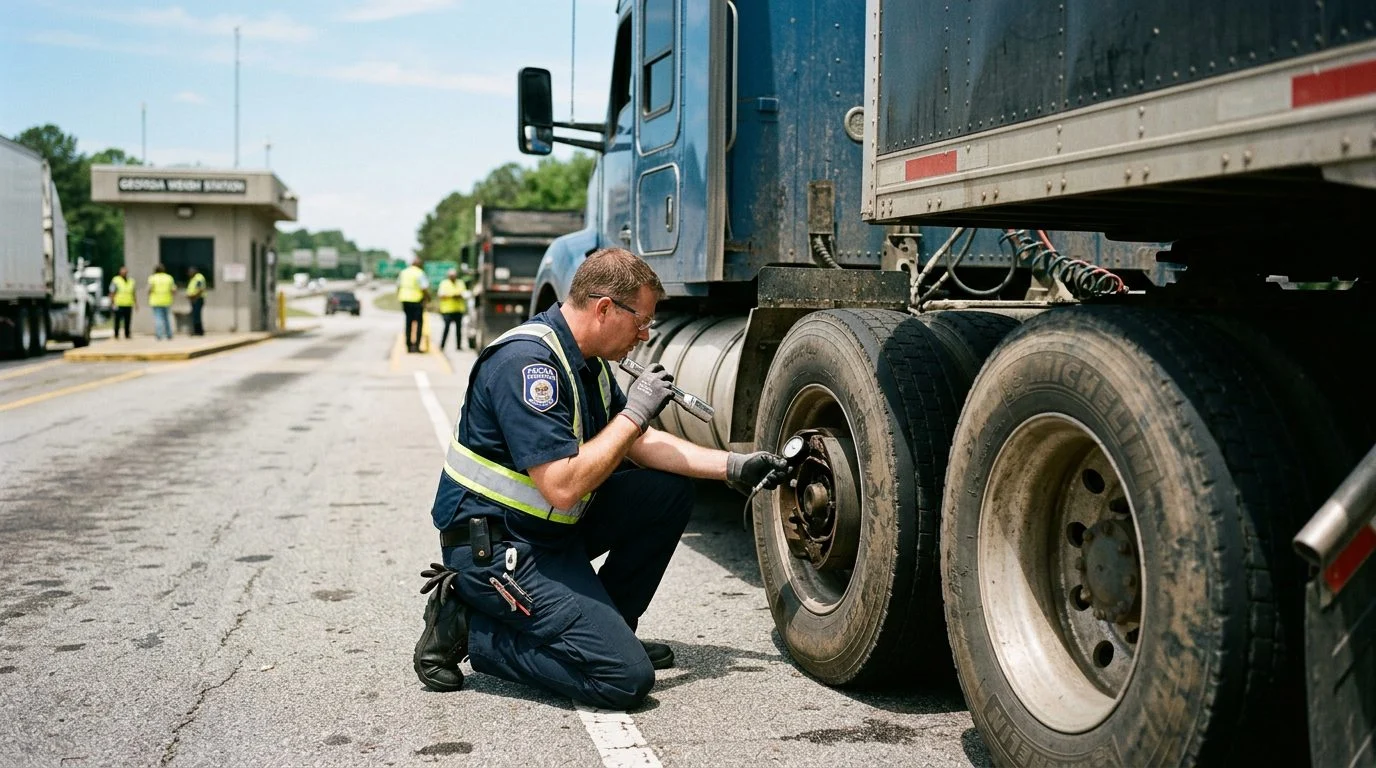
Truck Accidents | Georgia
Truck Logbooks and Black Box Data Can Disappear. Act Early.
T. Madden & Associates, P.C. has represented people injured in Georgia crashes since 1999. We help families ask for the trucking records that can show what happened on the road.
About the Firm
1999
Year the firm began practicing law
5
Georgia offices: Jonesboro, Atlanta, Decatur, Macon and Augusta
24/7
Phone availability to call us
By Terance Madden · Published October 26, 2026
If you were hurt in a truck crash in Georgia, the truck’s black box and the driver’s logbook may hold some of the clearest records of what happened. The black box can show speed and braking in the seconds before impact. The logbook can show when the driver was driving, resting, or on duty. Both can be lost if no one asks for them in time.
This page explains what truck driver logbook and black box data after a crash in Georgia can show, why it can disappear, and what to do now. It is general information, not advice about your specific case.
If you’re reading this, you may be injured, or you may be helping a family member who was. The truck may already be back on the road. The records you need may sit with a company you never dealt with.
What Is the Black Box and What Is the Driver Logbook?
The black box is the truck’s event data recorder, and the driver logbook is its record of duty status. These are two different sources, and different parties may hold each one.
An event data recorder stores information from the truck’s onboard systems when a sudden event happens, such as hard braking or an impact. It keeps a short window of data. What it captures depends on the device and the event.
The logbook is different. Federal rules require a motor carrier operating commercial motor vehicles to make each driver record duty status.
An ELD automatically records the date, time, truck location, engine hours, vehicle miles, driver and vehicle identification, and motor carrier identification data, among other information. The details are set out in 49 C.F.R. § 395.26. Those automatic entries are why the logbook matters after a crash. Ask early which company holds which record.
If a truck crash hurt you or someone you love, you don't have to sort out these records alone. Contact us for a free, confidential first consultation. Talk it through with our team — the first consultation is free, confidential, and carries no obligation.

What Can This Data Show About the Moments Before a Crash?
Black box data can show how fast the truck was moving and whether the brakes or throttle were used before impact. It only shows what the device recorded, and it may not capture every detail.
Investigators use these readings to rebuild the sequence of events. They line up speed and braking data with the time of impact, the police report, and what witnesses describe. Small timing gaps can matter.
Timestamps are the key. If a witness says the truck was slowing and the data shows it was accelerating, the two accounts can’t both be right. The data doesn’t decide fault alone, but it gives a fixed reference point that memory often can’t.
A common mistake is assuming the black box shows everything. It doesn’t. It shows the data the device saved, and that data has to be pulled and read correctly.
How Can ELD Records Point to Driver Fatigue?
ELD and paper log entries can show whether a driver had enough rest before a crash. They show driving time, off-duty time, and sleeper berth time, which can point toward fatigue.
Federal hours-of-service rules set firm limits. See 49 C.F.R. § 395.3.
Driving is also not permitted after more than 8 hours of driving time without at least a 30-minute break, with limited exceptions for some short-haul drivers. The same section sets weekly on-duty limits.
Separate federal rules bar driving when a driver’s alertness is impaired by fatigue, illness, or another cause. See 49 C.F.R. § 392.3.
Compare the logbook with the GPS location and engine hours. If the entries don’t match the truck’s movements, that gap is worth investigating.
Why Truck Data Can Be Lost or Overwritten
Truck data can be lost because devices replace old records, trucks get repaired or sold, and companies follow their own retention schedules. Each step can change where the data sits.
Federal rules require a motor carrier to keep records of duty status and supporting documents for not less than 6 months from the date of receipt, under 49 C.F.R. § 395.8(k). Under the federal record-retention rule, how long to keep any record that its appendix A schedule does not list is left to the management of each company. See 49 C.F.R. § 379.13.
Federal rules also protect original ELD data. A motor carrier must not alter or erase the original hours-of-service information, the source data streams, or information in any ELD that uses that original information. See 49 C.F.R. § 395.30.
That rule is strong. It still doesn’t mean the records stay forever, or that they are handed over without a written request. A truck may be repaired, sold, or put back into service after a crash.
The risk is real and time-sensitive. This page does not predict what any company has done with its records.
Why a Written Preservation Request Matters Right Away
A written preservation request, sometimes called a spoliation letter, asks the trucking company and its insurer to keep records tied to the crash. It should go out early, and it is separate from filing a lawsuit.
A useful request names the records. Common examples include logs and ELD files, event data, dispatch messages, GPS data, maintenance records, driver qualification files, and photos of the truck.
A written request makes it harder to claim the company did not know records mattered.
How Is the Data Retrieved and What If the Company Disputes It?
Event data is usually pulled from the truck’s module by a technician using a download tool. The download should follow a documented process, with a record of who did it, when, and how.
A company may question the data. Evidence such as the black box readings, the logbook, GPS records, photos, the police report, and witness accounts can be compared with one another. A complete set of records makes that comparison more reliable.
Logs can change after a crash, so watch for edits. The driver or support staff must annotate each change or addition to an ELD record. See 49 C.F.R. § 395.30.
A motor carrier may not coerce a driver into a false certification of the driver’s record of duty status. Also, under 49 C.F.R. § 395.8(e)(2), no driver or motor carrier may tamper with an ELD so that it does not accurately record and retain required data. See 49 C.F.R. § 395.8.
Not sure what your next step is?
Talk it through with our team — the first consultation is free, confidential, and carries no obligation.
What to Gather Now If You Were Involved or Are Helping Someone Who Was
Start a file now, while memories and records are fresh. Write down what you can about the truck and the company.
Record the name of the motor carrier for which work is performed, the truck or tractor and trailer number, or the number assigned by the motor carrier or the license number and licensing State of each commercial motor vehicle. Keep the police report number, photos of the scene and vehicles, and the names and phone numbers of witnesses.
Keep medical records, bills, and a dated list of symptoms and missed work. Notes made close to the crash are easier to rely on later.
Be careful about what you post online about the crash. Before giving a recorded statement to an insurer, understand what you are agreeing to.
Frequently Asked Questions
Does the black box record every trip?
No. It records specific events, and what it saves depends on the device and the event. A complete trip record may not exist.
Can a family member send a preservation request?
The request should name the records and be sent in writing as early as possible.
How long do I have to file a lawsuit in Georgia?
Georgia law generally requires that actions for injuries to the person be brought within two years after the right of action accrues, but actions for injuries to the person involving loss of consortium must be brought within four years and actions for injuries to the reputation within one year, under O.C.G.A. § 9-3-33. Waiting can make records harder to recover.
Can the trucking company be responsible for its driver?
Georgia law makes a person liable for torts committed by a servant in the prosecution and within the scope of the person’s business, under O.C.G.A. § 51-2-2. Fault is still decided on the facts of each crash.

Talk With T. Madden & Associates, P.C. About Your Crash
If a truck crash has left you hurt, or has taken someone you love, you may be facing medical bills, missed work, and hard questions about who is responsible. Meanwhile, the records that matter may already be moving.
Our team can review the specifics of your crash with you. We offer a free, confidential first consultation with no obligation to continue. We handle these cases on a no-fee-unless-we-win basis, but you may still be responsible for court costs and case expenses.
T. Madden & Associates, P.C. has practiced since 1999, with offices in Jonesboro, Atlanta, Decatur, Macon and Augusta. The responsible lawyer for this page is Terance Madden. Firm contact information is on the contact page.
Why Timing Matters
Electronic records are overwritten
Many truck systems store data for a limited time or overwrite it during normal operation, so early preservation matters.
Paper logs and files get lost
Logbooks, dispatch notes, and maintenance records can be misplaced once a company learns of a claim.
Written requests help
A written request that names the specific records gives a clearer record of what was asked for and when.
Our team can help family members act
Spouses and adult children often need to act quickly while the injured person is recovering.
Do Not Wait to Protect the Evidence
The sooner the trucking company is asked to keep its logbooks, black box data, and dispatch records, the less chance they are lost. Do not assume the company will keep records on its own.
Records That Can Matter in a Truck Crash
Driver logbooks
Hours-of-service logs and electronic logging device data can show when the driver was on duty and driving.
Black box data
Engine control and event data recorders may save speed, braking, and throttle information around a crash, depending on the device.
Dispatch and GPS records
Dispatch messages, route data, and GPS tracking can show the timeline and the company's communications.
Maintenance and inspection files
Repair, inspection, and equipment records can help show the condition of the truck before the crash.