

E-Bike Crash Claims | Georgia
Hurt on an E-Bike? Find Out Which Insurance Can Help Pay
The answer often depends on policies you may already own, plus the at-fault driver's coverage. Here is how to sort through them.
Why people call T. Madden & Associates, P.C.
1999
In practice since
5
Georgia offices: Jonesboro, Atlanta, Decatur, Macon, Augusta
Free
Confidential first consultation, no obligation
24/7
Call us any time
By Terance Madden · Published November 9, 2026
Hurt on an e-bike and not sure which insurance pays? The answer is more specific than most people expect.
An auto insurance policy can pay after an e-bike crash in Georgia. The money may come from the at-fault driver’s liability policy, your own auto policy, or a policy held by someone in your household. Which one applies depends on whose policy it is and how the crash happened.
Which Insurance Can Pay After an E-Bike Crash?
Three sources can pay: the at-fault driver’s liability policy, your own auto policy, and a policy belonging to a household member.
If you’re the one making the calls, paying the bills and keeping the paperwork, this list is your starting point. Spouses, mothers and adult daughters often carry this job. Start with the declarations page (the summary sheet that lists your coverages and limits) from every auto policy in the house.
Don’t wait for the other side to tell you what coverage exists. Find it yourself first. Each source works differently, so you need the full list before anyone asks for a statement. Write down the policy numbers, the insurer’s name and the coverage dates. You’ll need them to match each policy to the crash.
Hurt in an e-bike crash that someone else caused? Our team can help you sort out which insurance may pay, so you can focus on your recovery. Talk it through with our team — the first consultation is free, confidential, and carries no obligation.
What Each Coverage Layer Means
Liability coverage pays for harm the at-fault driver causes. Uninsured, underinsured and medical payments coverage can work on your own policy.
Liability coverage is the insurance the at-fault driver carries to pay people they injure. It is usually the first place a claim goes.
Uninsured motorist (UM) coverage is an add-on to your own auto policy. Under Georgia law, auto policies must include uninsured motorist coverage unless the insured rejects it in writing, and the insured may choose uninsured motorist limits lower than the liability limits. O.C.G.A. § 33-7-11 O.C.G.A. § 33-7-11
Underinsured motorist (UIM) coverage works on your own policy when the at-fault driver has insurance, but not enough to cover your losses. Your policy’s wording controls how it applies.
Medical payments (MedPay) coverage pays certain medical bills from your own policy when the policy includes it. Check the declarations page for a MedPay line.
A household member’s policy may also apply, depending on who lives in the home and who is named on the policy.
The firm pursues every coverage layer that applies. That includes umbrella coverage (extra liability limits above a policy’s base limits) and corporate coverage where a business or commercial vehicle is involved.
How the At-Fault Driver’s Insurer Handles Your Claim
You bring a liability claim against the at-fault driver’s insurer. A claim usually turns on who caused the crash and what your injuries cost.
Georgia’s fault rules decide how much you recover. A judge reduces your damages in proportion to your share of fault. O.C.G.A. § 51-12-33 If you are 50 percent or more responsible, you recover nothing.
Georgia also counts the fault of everyone who contributed to the crash, even people who were never sued, regardless of whether they were or could have been named as a party; a nonparty’s fault is considered if the plaintiff settled with that person or a defending party gives notice not later than 120 days prior to the date of trial that the person was wholly or partially at fault. A brake maker or a repair shop can carry a share. Each liable party pays its own share, not a joint amount.
Expect Big Insurance to argue you were partly at fault. O.C.G.A. § 51-11-7 addresses how a plaintiff’s own ordinary care can affect recovery.
Big Insurance usually moves fast. Expect an early call, a request for a recorded statement (a taped or written account the insurer can use later), and a first offer. An insurer’s first offer is rarely what a claim is worth.
Georgia also sets rules for some settlement offers in motor vehicle injury claims. Certain written offers must set a payment date at least 40 days after receipt. O.C.G.A. § 9-11-67.1 sets rules for written settlement offers on motor vehicle collision claims.
When Your Own Policy Is the Source of Payment
Your own UM or UIM coverage becomes the source of payment when the at-fault driver is uninsured or carries too little insurance. Then your own insurer sits across the table from you.
Expect the same tactics. Big Insurance often opens with a low offer, asks for recorded statements, delays decisions, disputes your treatment, and argues the crash was too minor to cause real harm. The “low impact” argument says a slow crash could not hurt you. A low-speed crash can still cause serious injury, and the evidence decides it.
General damages (pain, suffering and loss of enjoyment of life) are presumed to flow from the injury and need no dollar proof. Special damages (medical bills and lost wages) must be proved. O.C.G.A. § 51-12-2
Georgia limits medical expense claims to the reasonable value of medically necessary care. If you have health insurance, the evidence can include both the amounts charged and the amounts the insurance contract requires. O.C.G.A. § 51-12-1.1
Our response is to pursue every coverage layer, value the full lifetime cost of a serious or permanent injury, and prepare each claim as if it will go to trial.
How Engineering Evidence Shapes Which Policy Pays
Physical evidence can show who was at fault and which parties share the blame. That decides which policies are in play.
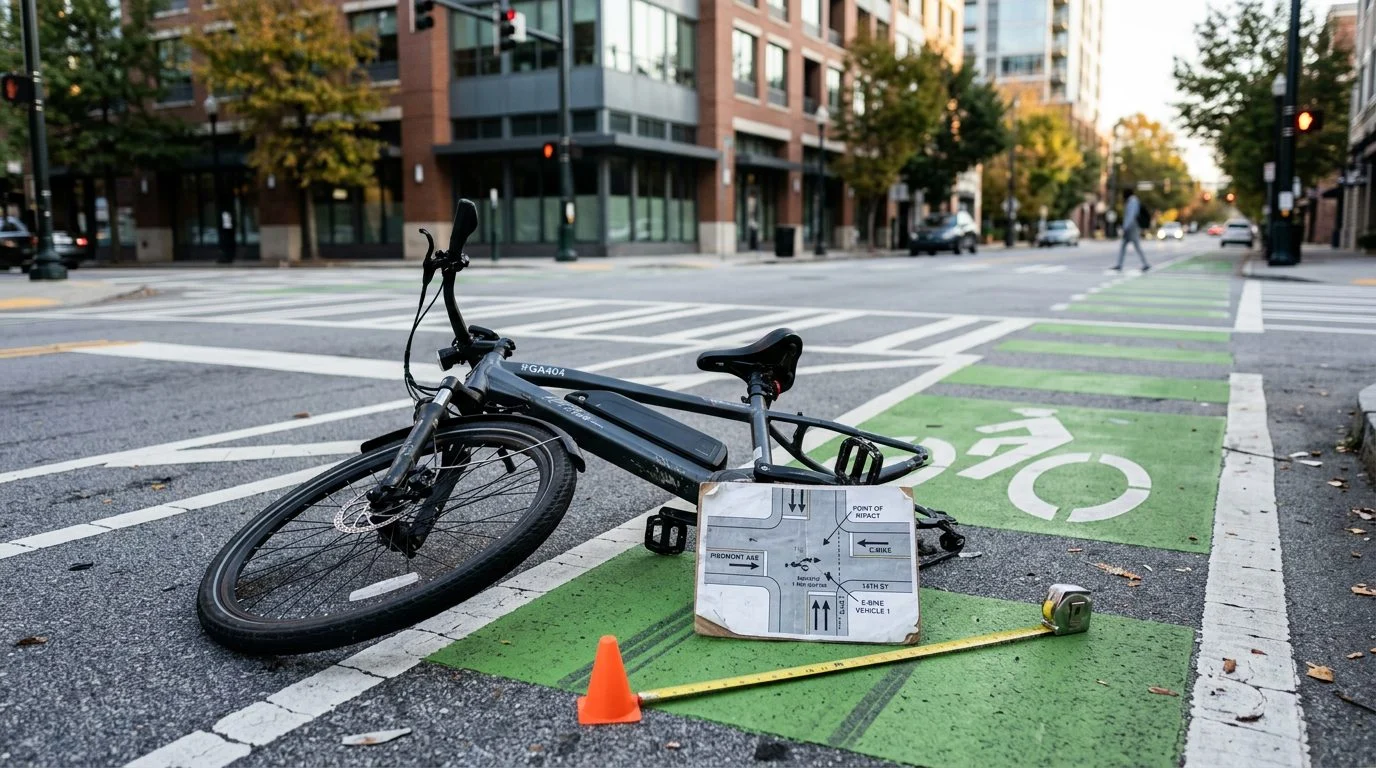
Some vehicles and e-bike controllers record speed, braking and power data. Whether that data exists depends on the equipment involved. Scene photos, damage patterns, and the condition of the battery, brakes and tires can matter just as much.
Engineers look at the change in speed at impact, called delta-V, to judge how much force reached the rider. That number helps answer the “low impact” argument with physics instead of opinion.
Brakes, tires, batteries, controllers and maintenance vendors can be other liable parties. Each may carry its own insurance, which can mean more coverage for your claim.
Terance Madden leads the firm, which has represented people hurt in Georgia since 1999.
The firm has an office in Jonesboro, in Clayton County.
Talk to the Firm About Your Coverage
The firm can help you sort out whether the at-fault driver’s policy or your own auto policy will pay after your e-bike crash.
Maybe medical bills are stacking up, an insurer wants a recorded statement, and nobody has told you which policy applies. You don’t have to sort that out alone.
Reach out for a free first consultation. It is confidential and comes with no obligation to continue. The firm works on a no-fee-unless-we-win basis, but you may still be responsible for court costs and case expenses.
Not sure what your next step is?
Talk it through with our team — the first consultation is free, confidential, and carries no obligation.
Frequently Asked Questions
Does my auto insurance cover an e-bike crash in Georgia?
It depends on your policy. Your own auto policy may include uninsured motorist (UM) coverage, which applies when the at-fault driver has no insurance, and underinsured motorist (UIM) coverage, which applies when that driver’s limits are too low.
Does homeowner’s or renter’s insurance cover an e-bike crash?
Some homeowner’s and renter’s policies include personal liability coverage, which can respond when you are found legally responsible for injuring someone. Some policies exclude motorized vehicles, so read the exclusions closely or have T. Madden & Associates, P.C. review them.
What if the at-fault driver’s insurance is not enough to cover my injuries?
Your own UIM coverage, an umbrella policy, or a claim against another liable party may add to what is available.
What should I do after an e-bike crash?
Get medical care right away, and keep the e-bike, its battery, your helmet and photos of the scene. Talk with T. Madden & Associates, P.C. before you give any insurer a recorded statement, because an insurer’s first offer is rarely what a claim is worth.