

Lithium battery fire lawyer · Georgia
The Battery Maker Is Gone. Who Else Can Be Held Responsible?
A battery company's name on the box is rarely the only name in the story. Here is how to look past it.
T. Madden & Associates, P.C.
1999
Representing Georgians since
5
Georgia offices, including Jonesboro and Atlanta
Free
First consultation, with no obligation to continue
By Terance Madden · Published November 18, 2026
A battery caught fire, and the company that made it has closed. If the battery company has gone out of business, the question of who pays still matters in a Georgia case.
If the Battery Maker Is Gone, Your Claim Is Not Over
A missing maker changes who you can sue. It does not erase your claim. Other companies in the product’s path to the buyer still have their own records, their own role and, often, their own insurance.
Georgia law uses the term “product seller” for a business that sells, distributes, labels, assembles or otherwise moves a product into the stream of commerce, meaning the flow of goods from maker to buyer O.C.G.A. § 51-1-11.1. That definition is wide. It reaches far beyond the name printed on the battery pack.
Time matters too. Georgia gives two years to bring most injury claims, counted from when the right to sue arises O.C.G.A. § 9-3-33. Waiting while the family hunts for the maker can eat into that time.
Your first step is a list. Write down every company whose name, parts or sales touched the device. Who sold it? Who imported it? Who made the cells? Those answers decide who the defendants are.
If a battery fire hurt your family and the maker is gone, other companies in the chain may still be part of your claim, and we can help you find them. Talk it through with our team — the first consultation is free, confidential, and carries no obligation.

What a Chain of Distribution Means for Your Battery Fire Claim
A chain of distribution is the path a product takes from the factory to the person who uses it. Each link can carry its own responsibility and its own insurance.
The links usually include the manufacturer, the cell or component maker, the importer, the distributor, the retailer, the online seller, and any company whose name appears on the product. This map shows who to name and what each one did.
Georgia makes a manufacturer of new personal property liable, irrespective of privity, to any natural person who may use, consume, or reasonably be affected by the property and suffers injury because it was not merchantable and reasonably suited to its intended use, but no action may be commenced for such an injury more than ten years after the first sale for use or consumption. That applies even without privity, which is a direct sales contract between the parties. The product must have been not merchantable (not fit for ordinary use) and not reasonably suited to its intended use when sold, and that condition must have caused the injury O.C.G.A. § 51-1-11.
The law also sets a time limit for claims against a manufacturer. That limit runs ten years from the first sale for use or consumption of the product, not from the fire, and it does not cover certain negligence claims: those for negligent manufacture of products that cause disease or birth defect, or those arising from conduct showing willful, reckless, or wanton disregard for life or property. The law says nothing in the time-limit provision relieves a manufacturer from the duty to warn of a danger once that danger becomes known to the manufacturer, as explained in Chrysler Corp. v. Batten.
Who Else Can Be Liable When the Maker Is Missing
Sellers, importers and parts suppliers are all part of a product’s path to the buyer, and their roles are often part of the review. How far each one reaches depends on what it did with the product.
A seller is not treated the same as a manufacturer. Under Georgia law, a product seller is not a manufacturer and is not liable as one for strict liability, meaning liability for a defective product without proof of carelessness.
Georgia case law shows how this plays out. A company that only puts its own name on a product, with no input into its design or making, is treated as a product seller and not a manufacturer Alltrade, Inc. v. McDonald.
Warranty claims are a second path. Unless excluded or modified under Code Section 11-2-316, a warranty that goods shall be merchantable is implied in a contract for their sale if the seller is a merchant with respect to goods of that kind [O.C.G.A. § 11-2-314]. That warranty can extend to a natural person in the buyer’s family or household, or a guest in the buyer’s home, if it is reasonable to expect that such person may use, consume, or be affected by the goods, and who is injured in person by breach of the warranty O.C.G.A. § 11-2-318.
Off-brand and unmarked batteries are harder. When no maker can be identified, the search runs back to the sellers who put that product on the market.
How Engineering Evidence Shows Which Party Caused the Fire
The battery, its markings and its charging history usually show where a fire started and which party had a hand in it.
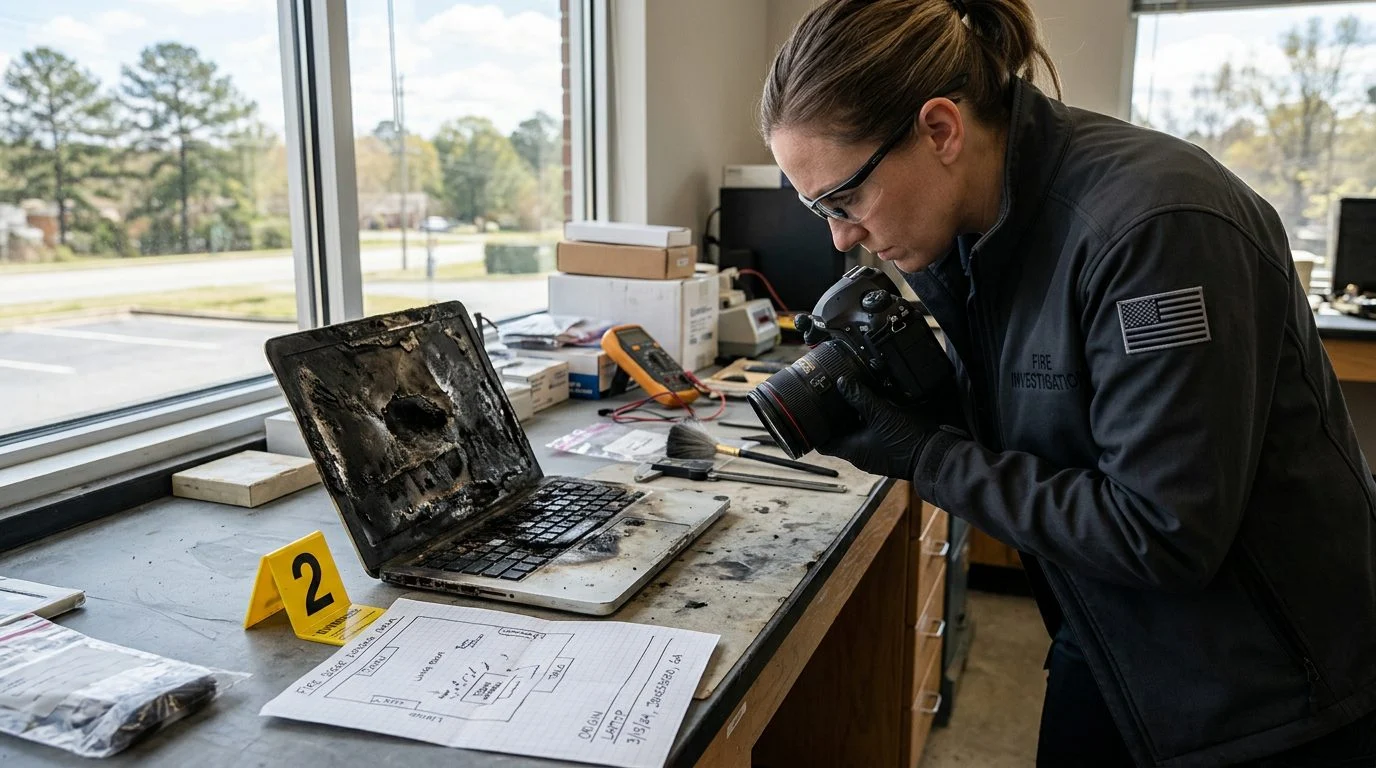
Battery fire evidence is physical. Cell markings, certification marks and labels matter. So do the battery management system (the circuit that watches charge and temperature), the charger, and any sign of overheating or an internal short circuit.
Before law school, Terance Madden trained as an electrical engineer and earned a B.S. in Electrical Engineering. He starts a case by asking what the evidence shows and how the fire began. He traces the origin and cause, then checks whether the failure started in a cell, a pack, a charger or a mismatch between parts.
That matters because each answer points somewhere else. A defective cell points toward the maker or cell supplier. A bad charger points toward whoever made or sold it. Misuse can shift fault toward the owner, and Big Insurance will push that point hard.
Preserve everything. Keep the battery or what is left of it, the charger, the box, receipts, serial numbers and photos. Do not throw the device away or try to repair it. Ask for the fire report, and keep a copy.
How Big Insurance Uses the Missing Maker Against You
Big Insurance often argues that nobody is left to pay, so the claim should be small.
Expect the playbook. An insurer may open with a low first offer, ask for a recorded statement early, and drag out the claim with delays. It may blame the owner, the charger or how the battery was stored, and never look hard at the seller or the parts supplier.
Disputing treatment is another tactic. The other side may argue the burns or smoke injuries were not as serious as your doctors documented. Keep every record, every bill and every appointment note.
Here are three things to leave knowing. Big Insurance is not on your side. An insurer’s first offer is rarely what a claim is worth. And the missing maker does not have to end the recovery, because a claim can reach every party and every layer of coverage.
Recorded statements deserve care too. Anything you say can be used later. Stick to facts you know, and do not guess about the cause of the fire or the cost of your care.
How the Firm Pursues Every Party and Every Layer of Insurance
The firm pursues every party in the chain and every insurance layer that may apply, not only the company that has closed.
Insurance can stack. Liability policies are the base. Umbrella policies (extra coverage above a main policy) and excess policies (coverage that starts after another limit is used up) may add more. Corporate coverage held by companies in the chain can also be part of the picture. UM/UIM (uninsured and underinsured motorist coverage) is pursued where the facts fit it.
The firm builds each case as if it will go to trial. That means the firm builds the file from the start of the case. The firm works in plain English, so families can follow what is happening in their case. The firm has offices in Jonesboro, Atlanta, Decatur, Macon and Augusta.
If you are the spouse, mother or adult daughter managing the recovery, you often handle the bills, medical records and calls with insurers. Keep one folder. Log every call with the date, the name and what was said. Send copies of every bill and record to the firm, and keep the originals.
Not sure what your next step is?
Talk it through with our team — the first consultation is free, confidential, and carries no obligation.
Who Pays for Medical Bills, Lost Income and Wrongful Death When the Maker Is Gone
The parties found responsible, and the insurance behind them, are the source of payment. The closed company’s name is not.
Georgia separates general damages (losses the law presumes from the act, which need no exact amount to recover) from special damages (losses you must prove) O.C.G.A. § 51-12-2. Special damages are losses that actually flow from a tortious act, and they must be proved in order to be recovered. For medical and healthcare expenses, Georgia law limits special damages to the reasonable value of medically necessary care O.C.G.A. § 51-12-1.1.
Fault is divided too. Each liable party pays its own share, and those shares are not joint liability O.C.G.A. § 51-12-33. A defendant can also point to a nonparty (a person or entity not in the lawsuit) by giving notice, filed as a pleading, not later than 120 days prior to the date of trial that the nonparty was wholly or partially at fault. That is why the firm identifies every possible party early.
If a fire killed a spouse or parent, the rules change. A surviving spouse may recover the full value of the decedent’s life (the person who died), as shown by the evidence O.C.G.A. § 51-4-2. The spouse’s share is no less than one-third of that recovery. If there is no surviving spouse, children may recover. The personal representative (the person who handles the estate) may recover funeral, medical and other necessary expenses from the injury and death when death results from a crime or from criminal or other negligence, under O.C.G.A. § 51-4-5.
Talk to a Georgia Injury Lawyer About a Battery Fire Claim
If a battery or e-bike fire hurt you or someone you love, and the maker can’t be reached, other companies in the chain may still be part of your claim.
Think of a scooter left charging overnight, smoke in the hallway and a maker that no longer answers its phone. Those facts raise the same question: who else had a hand in that battery?
The first consultation is free, confidential and carries no obligation to continue. The firm works on a no-fee-unless-we-win basis, but you may still be responsible for court costs and case expenses.
Our team can help you sort out who was in the chain, what records to keep and which insurance layers may apply, so you don’t have to face that question alone. Start a free case evaluation.
Frequently Asked Questions
Can I still bring a claim if the battery company has gone out of business?
Often, yes. A business that has closed may still have liability insurance, and other companies in the sales chain may still be responsible for a defective product. A lawyer can review what is left after a fire to help sort out the facts of the case.
Who else can be held responsible when a lithium battery fire happens in Georgia?
Depending on the facts, the retailer, distributor, importer, or seller of the battery or the device it powered may be responsible. A company that made a defective part can also be part of the claim. Tracing the product’s path from maker to buyer is a key step.
Will insurance pay if the battery maker is gone?
It may. Some manufacturers carry liability coverage that can still respond after the business closes, depending on the policy terms and when the product was made and sold. Big Insurance does not work for the injured person, and its first offer is rarely what a claim is worth.
What if the battery was an off-brand product bought online?
Off-brand and counterfeit batteries can still support a product liability claim. The sellers, online marketplaces, and importers involved may be responsible, and their role depends on the facts. Call T. Madden & Associates, P.C. for a free, confidential consultation with no obligation to continue.