

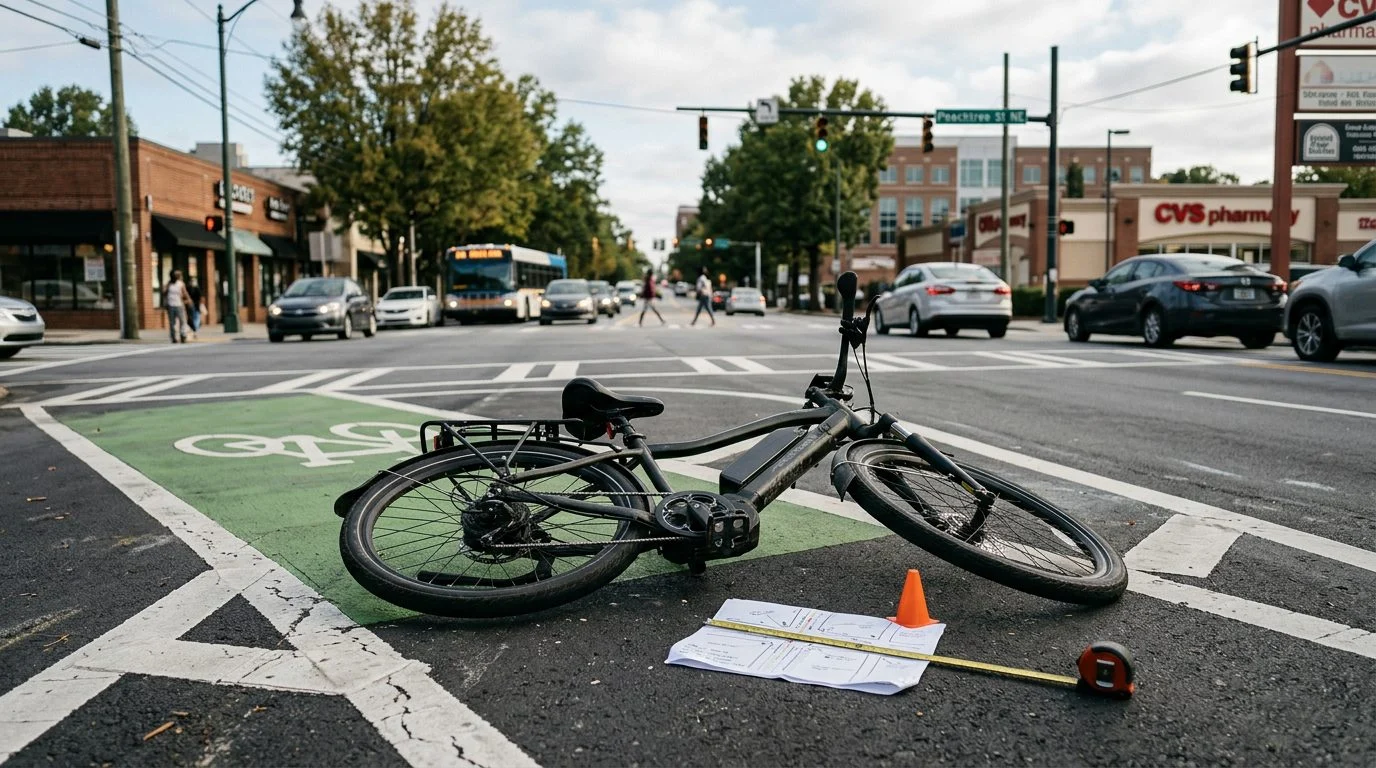
Bike Lane Crashes in Georgia
Hit in a Bike Lane? Fault Depends on What Each Person Did
Drivers, riders and e-bike users all share the road. Here is how we look at who caused a bike lane crash and what to do if you were hurt.
T. Madden & Associates, P.C.
Since 1999
Representing people hurt in Georgia
5
Georgia offices, including Atlanta, Macon and Augusta
24/7
Call us any time
By Terance Madden · Published November 27, 2026
You may be the rider, or you may be the spouse, parent or adult daughter trying to make sense of a bike lane crash. The driver says it wasn’t their fault. You need a straight answer.
A bike lane crash is not automatically the driver’s fault. Being in a bike lane helps a rider’s position, but it doesn’t settle fault by itself. Fault turns on what each person did, what the evidence shows, and how the crash happened.
This page answers that question. Our e-bike accident lawyer page covers the full claim process for e-bike riders.
The Short Answer: No, a Bike Lane Crash Is Not Automatically the Driver’s Fault
But that isn’t the end of the question. Anyone reviewing the crash will ask what the driver did, what the rider did, and where each of them was when it happened.
Did the driver check before turning right? Did the rider swerve into traffic a second before impact? Was the rider using lights after dark? The answers decide how fault is split. That split decides how much money can be recovered.
If someone you love was hurt in a bike lane in Georgia, you don't have to sort out fault alone. Start a free case evaluation with our team and talk through the facts. Talk it through with our team — the first consultation is free, confidential, and carries no obligation.
What Georgia Law Says About Fault: Modified Comparative Negligence
Georgia uses modified comparative negligence (O.C.G.A. § 51-12-33; Quynn v. Hulsey (2020)). That is a rule that splits blame by percentage. Each person’s share is weighed, and the share changes the recovery.
Under O.C.G.A. § 51-12-33, the judge reduces damages in proportion to the injured person’s share of fault. The injured person is called the plaintiff. The same statute says a plaintiff who is 50 percent or more responsible cannot receive any damages.
That 50 percent line matters. A rider with a smaller share of fault can still recover, but the amount goes down. A rider at 50 percent or more recovers nothing (O.C.G.A. § 51-12-33; Quynn v. Hulsey (2020)).
Shared fault matters even when the driver clearly made a mistake. Every percentage point counts, so the other side looks for any share it can assign to the rider.
Georgia also has an avoidance rule. Under O.C.G.A. § 51-11-7, a plaintiff who by ordinary care could have avoided the consequences of the defendant’s negligence is not entitled to recover. In other cases, the person being sued (the defendant) is not relieved just because the plaintiff contributed. The moves made in the seconds before impact matter a great deal.
Is a Cyclist Ever at Fault?
Yes. A cyclist can share fault, depending on the facts. Shared fault isn’t a label stuck on a rider at the start.
Insurers and courts look at certain moves. Riding against traffic, weaving out of the bike lane without warning, and cutting sharply into a car’s path all invite a fault argument. So does riding at night without lights.
A rider’s mistake doesn’t erase the driver’s duty. A driver who fails to watch for riders is still making a choice. A crash between a car and a person on a bike can cause serious injuries. The driver’s failure to meet their duty of care can create liability even if the rider made a mistake too.
The real question is what each person did in the seconds before impact. Clear records answer that question. Vague stories don’t.
Common Bike Lane Crash Patterns and Who Usually Owes What
The pattern of a crash shapes the fault question, but the facts still decide it. Four patterns come up again and again.
The right hook happens when a driver turns right across the bike lane and clips a rider going straight. The turn is the moment that matters. Did the driver signal, check the lane and look over a shoulder before turning? Those answers shape who bears more blame.
The door zone crash happens when a parked car’s door swings into a passing rider’s path. A car door opened into the path of a passing cyclist can cause a serious crash. A driver who pulls out from the curb into the bike lane without looking creates the same kind of risk.
The merge or the stop happens when a driver merges across the bike lane, stops inside it, or passes too close. These are choices the driver controls, and they are easy to test against the evidence.
The sudden swerve happens when a rider moves into the lane without warning. Was the swerve a reaction to a hazard, like a car door or a road defect? Or was it a rider’s sudden choice? The evidence has to answer that.
What Georgia’s Bicycle and Vehicle Rules Require
A broken duty that causes harm can support a claim.
Under O.C.G.A. § 51-1-6, when the law requires a person to refrain from an act that may injure another, the injured party may recover for breaking that duty if they suffer damage. It does not list every traffic rule.
Both the rules for bicyclists and the rules for drivers feed the fault analysis.
E-bikes add a question. Whether an e-bike is treated like a bicycle or something else can change the analysis. Our e-bike accident lawyer page covers e-bike rules in more depth.
How Big Insurance Decides Who Is at Fault, and How It Uses That Decision
A first offer from Big Insurance is rarely what a claim is worth. Big Insurance is not on your side. Its job is to pay less, and it often decides fault early, before the facts are in.
Expect these tactics. An early request for a recorded statement, often before you know the full extent of your injuries. A request for a quick signature. Delays in paying medical bills. Disputing treatment as unnecessary. And arguments that the crash was “low impact” or that the rider was at fault.
The response is to look at every source of coverage. The driver’s liability coverage is the first place to look. If the driver has no insurance, uninsured motorist (UM) coverage may apply. Underinsured motorist (UIM) coverage, umbrella or excess policies, and corporate coverage can matter too, especially when a business vehicle is involved.
Georgia also sets rules for motor vehicle settlement offers. Under O.C.G.A. § 9-11-67.1, from the time a cause of action accrues until the named defendant files an answer, for offers to settle a motor vehicle injury claim that are prepared by or with the assistance of an attorney on behalf of a claimant, the date by which payment shall be delivered cannot be less than 40 days from receipt of the offer.
Damages have two kinds. Under O.C.G.A. § 51-12-2, general damages are presumed to flow from the wrong and need no proof of amount. Special damages, like bills and lost pay, must be proved. A claim should count the full cost of the injury, including care that continues over time.
Big Insurance often points at everyone but the driver. Under O.C.G.A. § 51-12-33, the fault of every person or entity who contributed is considered, regardless of whether they are named as a party to the suit. A settlement offer should be judged against what the case is worth, not just the number on the table.
Not sure what your next step is?
Talk it through with our team — the first consultation is free, confidential, and carries no obligation.
How the Evidence Decides the Fault Question
The physical evidence often says more than anyone’s memory after a crash. Scene photos, dashcam or doorbell video, early witness statements, vehicle damage, and the final resting place of the bike and the car all matter. So do skid marks and any data stored on an e-bike or vehicle.
Before law school, Terance Madden trained as an electrical engineer, so he starts a case by asking what the evidence shows and how the crash happened. Terance Madden’s electrical engineering background guides each crash case: he first looks at what the vehicles, the scene and the records actually show, then works out step by step how the collision happened. He looks at speed, distance and sight lines. He also asks which records exist and must be kept. When a driver says the rider came out of nowhere, he tests that claim against the physical record.
Sight lines and timing can show whether a driver had a real chance to see a rider. Those numbers have to come from the evidence, not from guesses.
Other parties can be part of the picture too. When a bike or e-bike part fails, a maintenance shop, a parts maker or a seller may share responsibility. On an e-bike battery, the cells, the charging circuit and the certification marks can matter. Each of those parties may carry its own insurance.
What a Family Should Do in the First Days After a Bike Lane Crash
The most useful early steps are writing things down, keeping records, and going to every medical visit.
If you are the person keeping track, you are carrying a lot. Here is a short checklist.
- Write down what happened while memory is fresh. Note the time, the weather, the lighting, and what the driver said.
- Get the names and phone numbers of anyone who saw the crash.
- Photograph the bike, the helmet and the clothing before they are repaired or thrown away.
- Keep every bill, receipt and mileage log for trips to care.
- Keep follow-up appointments and follow the treatment plan. Gaps in care give the other side something to argue.
Pause before you give a recorded statement to anyone from an insurance company. Talk with us first. Also avoid posting about the crash, the injuries or the rides you’ve taken since. Posts get read out of context.
Who Can Be Compensated When a Bike Lane Crash Causes Harm
Georgia allows claims for medical bills, lost income and other harm from a crash. Each type of harm has its own proof.
Necessary expenses are a legitimate part of the claim. Under O.C.G.A. § 51-12-7, necessary expenses from an injury count in estimating damages.
Emotional distress is a legal term for mental and emotional harm. Whether it is part of a claim depends on the facts and the injuries. Where the entire injury is to feelings, O.C.G.A. § 51-12-6 says no set measure applies. The measure is left to the enlightened consciences of impartial jurors.
If a crash causes a death, the family may have a claim. Under O.C.G.A. § 51-4-5, the personal representative (the person who manages the estate) may recover funeral, medical and other necessary expenses when death results from criminal or other negligence.
Timing matters. Georgia’s general deadline to sue for injuries to the person is two years, under O.C.G.A. § 9-3-33. Waiting can cost you the claim, so don’t wait to get answers.
What to Know After a Bike Lane Crash
If you are still sorting out who was at fault, you are not behind. A crash you didn’t choose can bring medical bills and insurance calls you didn’t expect. You are managing it for someone you love, and that is a heavy job.
Terance Madden has been in practice since 1999, and T. Madden & Associates, P.C. has offices in Jonesboro, Atlanta, Decatur, Macon and Augusta. The initial consultation is free, confidential and without obligation to continue. The firm works on a no-fee-unless-we-win basis, but you may still be responsible for court costs and case expenses.
If someone you love was hurt in a bike lane in Georgia, you don’t have to work out fault alone. Start a free case evaluation and talk through the facts with our team.
Frequently Asked Questions
Who is usually at fault in a bike lane crash in Georgia?
Fault depends on what each person did. A driver who turns across a bike lane without checking, opens a car door into it, or drives in the lane without room to spare may be at fault, and so may a rider who swerves out of the lane without warning.
Can I still recover compensation if I was partly at fault for a bike lane crash?
Yes, in many cases. Georgia uses a modified comparative fault rule under O.C.G.A. § 51-12-33: you can recover if you are less than 50% at fault, and your award is reduced by your percentage of fault.
How long do I have to file a bike lane crash claim in Georgia?
Georgia generally gives injured people two years after the right of action accrues (the date the claim arises) to file a personal injury lawsuit under O.C.G.A. § 9-3-33, and loss of consortium claims have four years. Some situations have different deadlines, so it is important to act early.
What should I do after a bike lane crash to protect my claim?
Get medical care, report the crash to police, and photograph the scene, your injuries, and your bike. Write down witness names and avoid giving a recorded statement to Big Insurance before you talk with us first. T. Madden & Associates, P.C. offers a free first consultation, which is confidential and comes with no obligation to continue.