

E-bike and car crash lawyer · Jonesboro, Atlanta, Decatur, Macon, Augusta
Hit by a Car Backing Out of a Driveway? We Help Georgia E-Bike Riders Get Answers
A driver who pulls out without looking can change your life in one moment. Here is how we look at what happened and how we help you move forward.
T. Madden & Associates, P.C.
1999
Year the firm began practicing law
5
Georgia offices: Jonesboro, Atlanta, Decatur, Macon, Augusta
Free
First consultation, confidential, no obligation
By Terance Madden · Published November 18, 2026
Your e-bike is on the pavement, and the driver who backed out is telling the insurer you came out of nowhere. That story does not end the question.
Crashes that happen when a driver pulls out into a rider’s path can cause serious injuries. Your own share of blame, if any, reduces what you can recover, so the facts matter.
A Car Pulled Out of a Driveway and Hit You on Your E-Bike: What Comes Next
A driver who backs out or pulls into a rider’s path has created the danger, and the rider is the one who got hurt.
This page is for the rider hit on an e-bike or bicycle. It’s also for the spouse, parent or adult child handling the bills, missed work and insurance calls.
Liability means the legal responsibility for harm that someone else’s careless driving caused. Under Georgia law, when the law requires a person to refrain from an act that may injure another, an injured person can recover for breach of that legal duty if they suffer damage (O.C.G.A. § 51-1-6).
T. Madden & Associates, P.C. handles e-bike and bicycle crash claims. The firm has been in practice since 1999, with offices in Jonesboro, Atlanta, Decatur, Macon and Augusta. Terance Madden is the responsible lawyer for this page.
If a driver backed out into your path and the insurer now says the fault was yours, you don't have to answer that alone; reach out to the firm, available 24/7. Talk it through with our team — the first consultation is free, confidential, and carries no obligation.
Why Big Insurance Says the Rider Was at Fault
Big Insurance often blames the rider, and its first offer is rarely what a claim is worth. Expect a few moves:
- A low first offer, made before the full cost of the injury is known.
- A request for a recorded statement, an interview the insurer can use later. Early words about speed or timing can be twisted.
- A claim that you “came out of nowhere” or were going too fast.
- A “low impact” argument that says the crash could not have hurt you much.
- Delays, and attacks on the treatment you need.
You don’t have to give a recorded statement. Talk to a lawyer before you do.
The response is to pursue every layer of coverage that applies. That includes the at-fault driver’s liability policy, your own uninsured or underinsured motorist coverage (UM and UIM, which covers injuries from a driver with too little or no insurance), an umbrella or excess policy only where it affirmatively provides that coverage or a policy endorsement does, and corporate or vehicle-owner coverage where the facts support it. Georgia requires auto policies to include uninsured motorist coverage, with limits the insured can choose (O.C.G.A. § 33-7-11).
A claim should be valued on the full cost of the injury over time. That includes future care and lost earning power where the injury calls for it. The firm prepares every claim as if it may go to trial.
Georgia’s Fault Rules and Your Filing Deadline
Georgia divides fault by percentage, and your percentage can cut what you recover.
- The judge reduces your damages in proportion to your share of fault. This is comparative fault: your share of blame reduces your recovery (O.C.G.A. § 51-12-33).
- If you are 50 percent or more responsible, you get no damages.
- Each person found liable pays only its own percentage. Those payments are not joint liability, meaning one party does not pay the whole bill for another.
That’s why “you were at fault” is the insurer’s favorite line. Every percentage point assigned to you lowers the number.
Georgia’s general deadline for injury suits is two years. That deadline is the statute of limitations, the time limit to file suit (O.C.G.A. § 9-3-33). Other rules can apply, so don’t treat two years as a target. The clock keeps running while the insurer reviews.
The Evidence That Shows What Happened
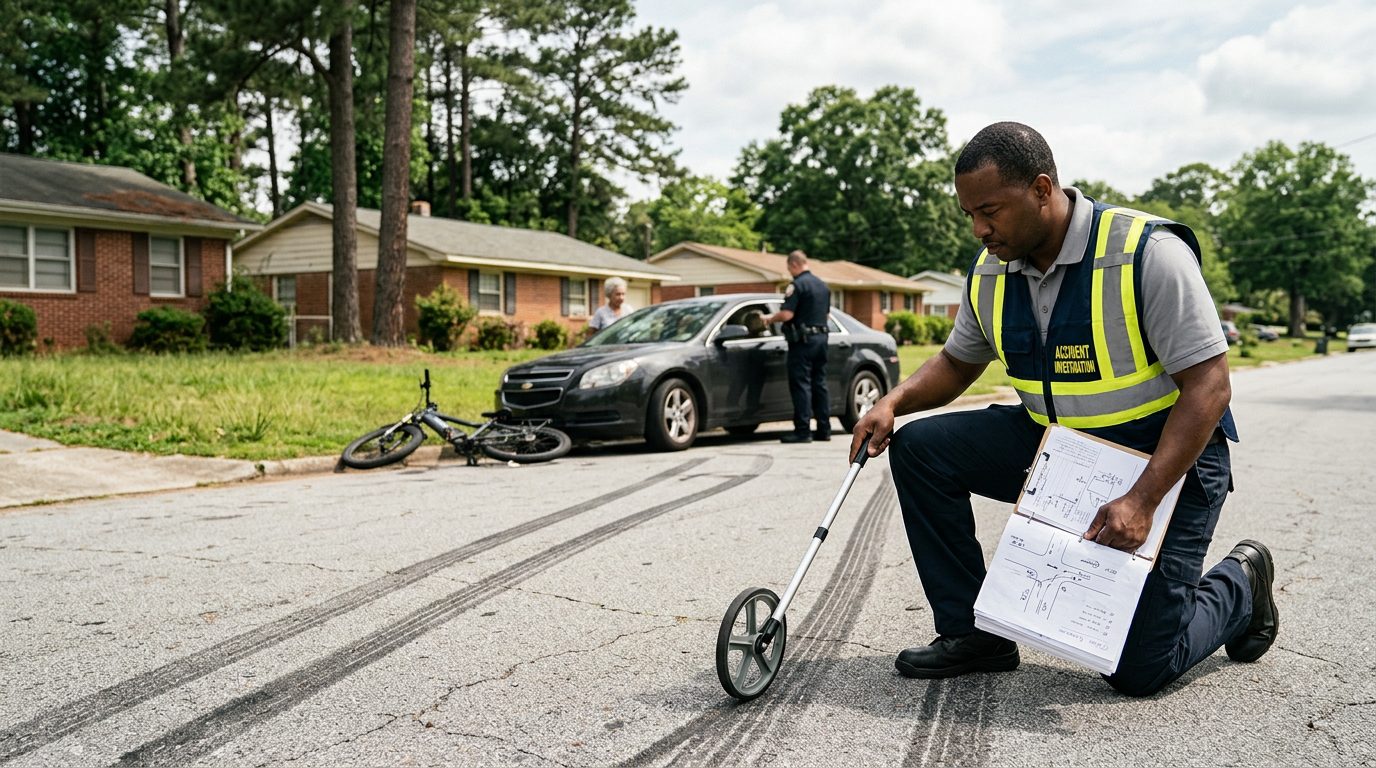
Physical evidence often answers the “came out of nowhere” claim better than memory does.
Terance Madden trained as an electrical engineer before he went to law school. Before law school, he trained as an electrical engineer, so he starts a case by asking what the evidence shows and how the crash happened.
In a driveway crash, he looks at where the car sat before it moved. He checks whether a fence, hedge, parked van or pillar blocked the driver’s view, and where the bike was when the two met. Damage on the car and the bike can show the angle of impact and test the other side’s story.
Save what you can, and do it early:
- Photos of the driveway, the road and both vehicles.
- The e-bike in its damaged state. Don’t repair or sell it yet.
- Any stored ride or app data that may show speed and braking.
- Camera footage from nearby homes or businesses. Many systems overwrite old video.
- The driver’s statements and the names of witnesses.
Repairs, overwritten video and lost phones erase proof fast.
What a Driveway Crash Claim Can Cover
A claim can cover your medical bills, lost income and the harm to your daily life.
- Medical care: ambulance, emergency care, follow-up visits, surgery, therapy, prescriptions, devices and future care your doctor recommends.
- Lost income: missed work, reduced hours, lost overtime and lower future earnings.
- Daily life: pain, fear and the riding you can no longer do.
Georgia limits medical damages to the reasonable value of medically necessary care, and the jury decides that value (O.C.G.A. § 51-12-1.1). Bills and wages are special damages and must be proved.
Other parties can share responsibility. If the driver was working, Georgia law can make the employer answer for torts within the scope of its business (O.C.G.A. § 51-2-2). Georgia’s Supreme Court has also held that claims for negligent hiring, training, supervision and retention are based on the employer’s own alleged negligence (Quynn v. Hulsey).
How the Process Works, Step by Step
The process starts with a conversation, then the firm takes on the insurance calls while you focus on recovery.
- Reach out. Start a free case evaluation online or by phone, available 24/7. Have ready the date and place, the driver’s name and insurer if you know them, photos and medical records.
- Consult. The firm reviews the facts, explains Georgia’s rules and answers your questions. The first consultation is free, confidential, and comes with no obligation to continue. The firm works on a no-fee-unless-we-win basis, but you may still be responsible for court costs and case expenses, and the firm explains those before you sign anything.
- Notify and preserve. The firm tells the insurers it represents you, so you don’t handle the calls alone. It sends requests to keep evidence.
- Document. The firm tracks medical care and lost income, and builds a record of how the injury changes daily life.
- Demand and negotiate. The firm presents the claim and answers low offers and disputes about treatment.
- File suit if needed. If Big Insurance won’t pay fairly, the firm files suit before the deadline and prepares the case for trial.
Terance Madden, the responsible lawyer for this page, works on the case with our team. How long each step takes depends on how the injury heals.
Not sure what your next step is?
Talk it through with our team — the first consultation is free, confidential, and carries no obligation.
Common Questions From Riders Hit by a Driver Pulling Out
The driver says I came out of nowhere. Does that settle it?
No. The driver’s word is one piece of evidence, and the physical proof and the driver’s duty to avoid harm carry the weight.
Do I have to talk to the other driver’s insurer?
You don’t have to give a recorded statement. A lawyer can handle the insurer’s calls and requests for you.
What if I was partly at fault?
Your recovery drops by your share of fault. If you’re 50 percent or more responsible, you get no damages (O.C.G.A. § 51-12-33).
Can the firm tell me what my claim is worth?
No dollar figure can be promised. Value depends on the injury, the proof and the coverage available, and the consultation reviews those facts.
If a driver pulled out and hit you, and the insurer is already calling it your fault, you don’t have to sort it out alone. Reach out to the firm now. Its phone line is open 24/7.