

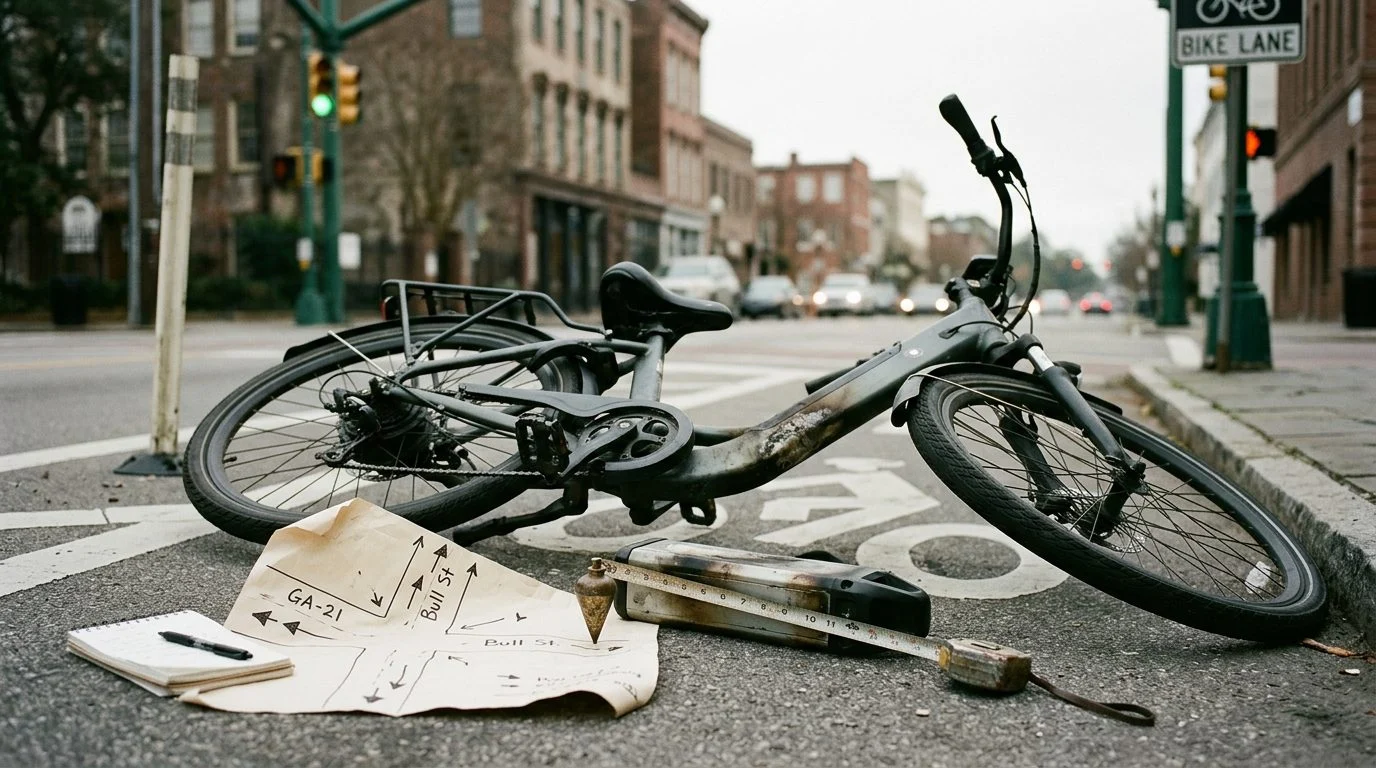
E-Bike Accident Lawyer in Georgia
Hurt by an e-bike battery fire?
Batteries, chargers and the shops that sold or repaired them can all play a part. We look at each one and tell you where your claim may stand.
About T. Madden & Associates, P.C.
1999
Year the firm began practice
5
Georgia offices: Jonesboro, Atlanta, Decatur, Macon and Augusta
By Terance Madden · Published November 9, 2026
Hurt when an e-bike battery caught fire, swelled or cut out under you? Hurt in an e-bike crash? Someone other than you may owe you money for your injuries.
The maker, parts suppliers, seller and some repair shops can each be responsible, depending on the facts.
What an E-Bike Battery Fire or Defect Crash Is
A battery fire or defect crash happens when the bike, its battery or its charger fails and that failure hurts you. A fall is not the only way these injuries happen.
Most e-bikes run on a lithium-ion battery, a rechargeable pack of cells that stores a lot of energy in a small space. A battery management system is the circuit that watches voltage, current and temperature to keep those cells in safe limits. When it fails, a cell can overheat.
That overheating can turn into thermal runaway. The battery heats itself, releases heat and smoke, and keeps feeding the heat. It can start while you ride or while the battery charges.
This page is for riders who were burned, thrown or hurt when the battery or bike failed. It is also for the spouse, mother or adult daughter handling the aftermath.
Hurt when an e-bike battery failed and you aren't sure who else owes you? Our team can review the battery, charger and bike records with you, so you don't face the insurers alone. Talk it through with our team — the first consultation is free, confidential, and carries no obligation.

Who Else Can Be Held Liable Besides the Rider
More than one party may be responsible, and each one may carry its own insurance.
- The manufacturer or brand. Sometimes the maker of a vehicle, part or product is also involved in how a crash or injury happened.
- Battery cell makers and parts suppliers. A bad cell, a faulty battery management system or a defective connector can make them responsible.
- The charger maker. This matters when the charger caused the failure or fed it.
- The seller or importer. A store or importer that sold the bike may be a responsible party, depending on the facts.
- Converters, repair shops and battery resellers. A swapped battery, a modified controller or a bad repair can shift or share fault.
Georgia law says that when someone breaks a legal duty and that breach causes damage, the injured person may recover. O.C.G.A. § 51-1-6 provides that when the law requires a person to perform an act for the benefit of another or to refrain from doing an act which may injure another, the injured party may recover for the breach of such legal duty if he suffers damage thereby. O.C.G.A. § 51-1-2
Under O.C.G.A. § 51-12-33, each person found at fault pays only its own share. The shares are not joint. Under O.C.G.A. § 51-12-33, the trier of fact, meaning the jury or the judge deciding the case, must consider the fault of all persons or entities who contributed to the alleged injury or damages, regardless of whether the person or entity was, or could have been, named as a party to the suit. Fault of a nonparty is considered if the plaintiff entered into a settlement agreement with the nonparty, or if a defending party gives notice not later than 120 days prior to the date of trial that a nonparty was wholly or partially at fault.
What the Evidence Shows and Why It Matters
The evidence shows whether the bike, battery or charger failed on its own, or whether something changed it first.
Look at the battery label and any safety marks. Check the burn pattern and the spot where the fire started. Examine the cells and connectors. Swollen cases, melted terminals and cracked cells each point to a different cause. Gather the charger model, receipts, repair notes and any records the bike or charger keeps.
Terance Madden leads T. Madden & Associates, P.C., which has been in practice since 1999. The firm reviews how a cell, its battery management system and a charger work together. He can explain what a failure pattern points toward, and what it cannot prove. A burn pattern alone does not show which part failed.
Preserve everything now. Keep the bike, battery, charger and packaging. Don’t repair, throw away or charge a damaged battery. Photograph the scene and your injuries. The Georgia Supreme Court has held that the duty to preserve evidence arises when litigation is reasonably foreseeable to the party controlling the evidence, not only after a suit is filed. Phillips v. Harmon Other responsible parties will rely on the same proof, so keep it intact from the start.
How Big Insurance Responds and What the Firm Does About It
Big Insurance is not on your side, and a first offer is rarely what a claim is worth.
Expect the tactics. Big Insurance often argues that the owner modified, misused or charged the battery wrong. It may open with a low offer. It may ask for a recorded statement soon after the crash, before anyone knows the cause. It may delay while the bike sits unexamined, or dispute your treatment as unrelated to the crash. Talk to the firm before you give any recorded statement.
The response is to pursue every layer of coverage. That includes the liability coverage of each responsible party, which pays for harm that party causes. It includes uninsured or underinsured motorist coverage from your own policy where it applies. It includes umbrella or excess policies, which add coverage above the base limits, and corporate coverage held by the companies involved.
The claim also counts the full cost of the injury. That means future medical care and lost earning capacity, not only the bills received so far.
The firm prepares each claim as if it will go to trial. A file built for court holds up when an offer falls short.
Georgia Deadlines, the Steps and the Family Member Managing Recovery
Georgia generally gives two years to file an injury lawsuit, so start early (O.C.G.A. § 9-3-33; Kenneth B. Cameron v. Jmp Pizza, Inc (2026)).
O.C.G.A. § 9-3-33 sets that general two-year rule for injury claims, with exceptions the statute names. Don’t wait for an insurer to finish its review before you think about the deadline.
Here is how a claim usually moves:
- A free case review and intake.
- Preserving the bike, battery, charger and records.
- Identifying every responsible party and its insurer.
- Sending a demand to the insurers.
- Negotiating, with each offer measured against the full value of the claim.
- Filing a lawsuit if the offers fall short.
The firm explains each step in plain English, so the family knows where the claim stands.
For the spouse, mother or adult daughter managing recovery, keep one log. Record symptoms, appointments, receipts, lost work days, and every insurer call or letter. Send insurer calls to the firm before answering questions. Bring the log to each medical visit.
Why This Firm and What It Costs
T. Madden & Associates, P.C. has been in practice since 1999, with offices in Jonesboro, Atlanta, Decatur, Macon and Augusta.
Terance Madden is the responsible lawyer for this page. The firm’s lawyers include Terance Madden and Shenia Madden. Our team handles the paperwork, the records and the calls, so the family can focus on recovery. If you need an e-bike battery fire lawyer in Georgia, the firm starts with the facts of your bike, battery and charger.
The Terance Madden Foundation supports community work alongside the firm’s practice.
The first consultation is free, confidential and comes with no obligation to continue.
Not sure what your next step is?
Talk it through with our team — the first consultation is free, confidential, and carries no obligation.
Questions Families Ask About E-Bike Battery Claims
Most e-bike battery questions come down to who is responsible and what proof you keep.
Can I sue the maker if the battery caught fire?
Some injuries involve questions about a product’s design, how it was built, or the warnings that came with it. Whether it is depends on the facts and the proof.
What if I was partly at fault?
Georgia reduces your damages by your share of fault. If you are 50 percent or more responsible, you cannot recover damages. O.C.G.A. § 51-12-33
What if the store sold me the bike?
A seller may be a responsible party. The firm looks at its role alongside the maker’s.
What if I changed the battery or controller myself?
Keep records of any change, and tell the firm about it at the start.
Should I keep the damaged battery?
Yes. Keep it, don’t charge it, and don’t repair it.
Will my insurance pay?
Coverage depends on the policies involved. The firm reviews every layer that may apply, including policies held by other responsible parties.
Talk to the Firm About Your E-Bike Battery Crash
If your e-bike battery burned, failed or threw you, you may have a claim against more than the bike’s owner. Request a free case evaluation with T. Madden & Associates, P.C., or call the firm, available 24/7, so we can go over who else may be responsible.
Related practice areas
- Motorcycle Left-Turn Crash in Georgia: Who Pays?