

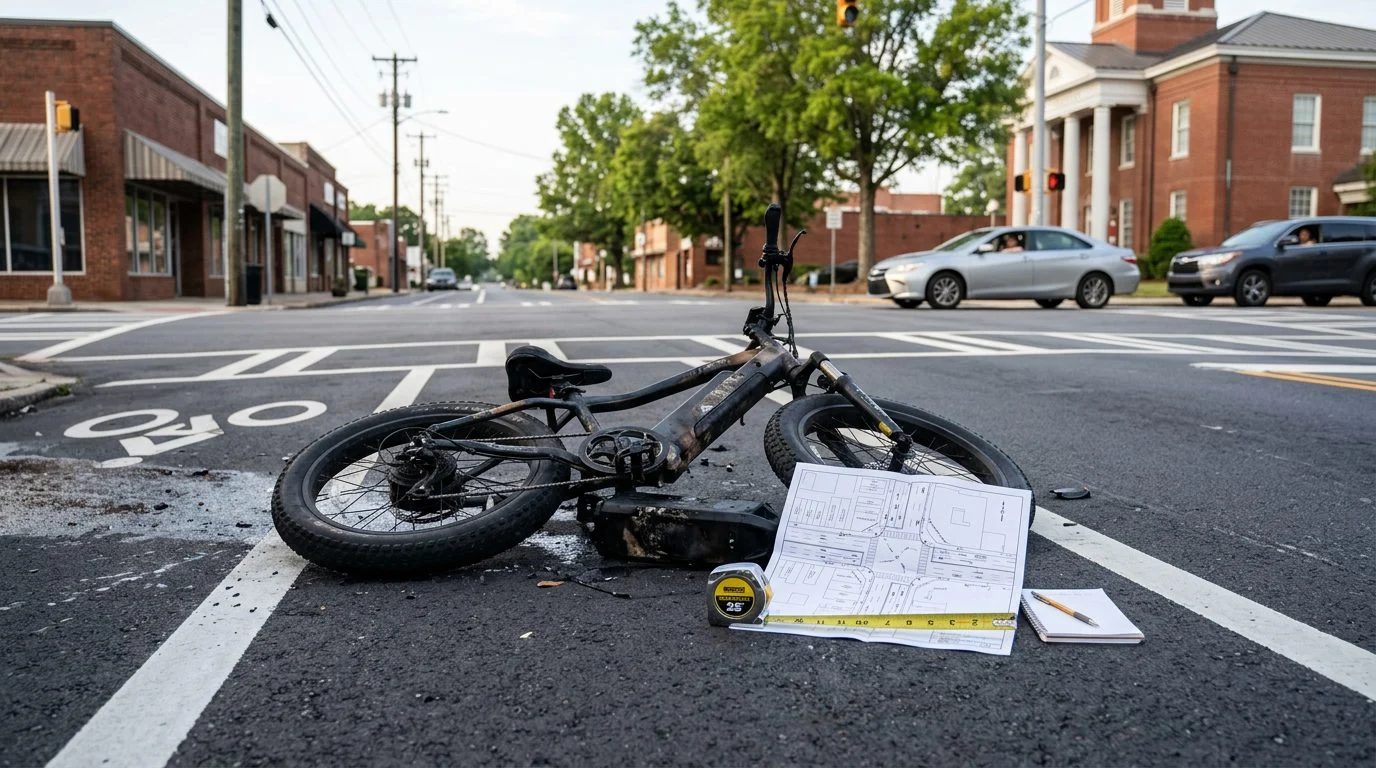
Georgia E-Bike Battery Fire: Can You Claim the Car or House?
By Terance Madden · Published November 21, 2026
Your e-bike battery caught fire. Now the car is scorched, or the back room of the house is gone. Can you claim what burned? Yes. A battery fire can support a claim for the property it destroyed, not only for injuries.
This page explains which property counts, who may be responsible, how Big Insurance tends to handle the loss, and what to save before anything is moved.
Yes, a Battery Fire Can Lead to a Property Claim
Property damage means the loss of things the fire took or ruined. That includes the e-bike, the car, the house and its walls, the contents, and the loss of use, such as a rental while the home is repaired. Each piece may be part of the claim.
Under O.C.G.A. § 51-1-11, a manufacturer can be liable for injury to a person or property even without a direct contract with the injured person (legal term: privity). This applies to any person who may use, consume, or reasonably be affected by the product, when the product was not merchantable and reasonably suited to its intended use at the time of sale, and that condition was the proximate cause (the direct cause) of the injury.
Time limits matter too. The ten-year limit runs from the date of the first sale for use or consumption of the product, not from the date the claim arises (O.C.G.A. § 51-1-11(b)(2)).
Whether a particular loss is recoverable depends on the facts of the fire and the damage.
Who Can Be Responsible for an E-Bike Battery Fire
More than one party can be responsible. The list may include the battery maker, the bike maker or assembler, the seller, and the maker of a replacement battery or charger.
The defect can sit in the cells, the battery management system (the circuit board that watches charge and heat), the charger, or the wiring. Where the fire started matters. A fire that starts in a charger points to the charger. A fire that starts in the cells points elsewhere. Off-brand and uncertified parts raise hard questions. Who made the cells? Who tested them? Who sold them to you, and what did the label promise?
Negligence means a failure to use reasonable care that causes harm. Georgia describes the absence of ordinary diligence, the care an ordinarily prudent person takes in the same or similar circumstances, as ordinary negligence (O.C.G.A. § 51-1-2).
Sellers face a different rule. Under O.C.G.A. § 51-1-11.1, a product seller is not treated as a manufacturer. In a strict liability claim, which does not require proof that the company was careless, a product seller is not liable as a manufacturer.
Georgia also implies a warranty of merchantability (a promise the law adds to a sale) under O.C.G.A. § 11-2-314, but O.C.G.A. § 51-1-11.1 does not itself create a cause of action in strict liability or any other legal theory. Under O.C.G.A. § 11-2-314, unless excluded or modified under Code Section 11-2-316, goods sold by a merchant must be at least fit for their ordinary purposes and adequately packaged and labeled as the agreement requires.
Fault can also be shared. Under O.C.G.A. § 51-12-33, a judge reduces the damages awarded to the plaintiff by the plaintiff’s own percentage of fault. The remaining damages are apportioned among the liable persons according to each person’s percentage of fault. Each person pays only their own share, not joint liability, which would make one person responsible for another’s share. A plaintiff who is 50 percent or more responsible recovers no damages.
Your Home and Auto Policies: What to Check First
Start with your own policies. Home, renter’s and auto policies may respond to a fire. Whether an e-bike fire is covered depends on the policy language and the facts. Read the declarations page and the sections on fire and damage.
After an insurer pays a loss, it may pursue the party it believes caused the fire. This is called subrogation (an insurer going after the party it blames). That party’s insurer may then pay. Your own insurer’s payment does not settle who owes the rest.
Your payment may still leave gaps. The deductible, items the policy does not cover, and the loss of use are common ones. Those gaps are where a separate claim may matter.
Several kinds of insurance may apply to a single injury, including home or renter’s, auto, umbrella, and any policy tied to the product or the seller. Keep a copy of every policy in the family file.
Big Insurance and the First Offer
Big Insurance is not on your side. A first offer is rarely what a property loss is worth. Hold onto those two points before any call.
Expect a few tactics. Big Insurance adjusters often open with a quick, low offer. They may ask for a recorded statement before the facts are clear. They may request documents that stretch out payment. They may dispute the value of a damaged car or the scope of home repairs. Some argue that something other than the battery started the fire. Each delay costs you time.
The response is to pursue every layer that applies, not only the first policy. Special damages (losses that actually flow from the fire, such as hotel stays and replacement costs) must be proved under O.C.G.A. § 51-12-2. That is why records matter.
Before you give a recorded statement or sign a release, talk with a lawyer.
Save the Bike, the Battery and the Charger
Keep the bike, the battery and the charger. They show what failed and where the fire started.
Before law school, Terance Madden trained as an electrical engineer. He reads a battery fire the way an engineer reads a circuit. He looks at the cells, the charging circuit, the certification marks on the labels, and the burn patterns that trace where heat began. Melted connectors and damaged wiring can point to the origin. He asks what failed first and which records and data must be kept. Those answers shape who may be responsible.
Do not repair, open or charge a damaged battery. Do not throw away the packaging, manuals or receipts. Tell the firm where each item is, so it can be preserved before anyone moves it.
Gathering Information Before Memory Fades
Start the file now, while details are fresh. Photograph and video every room and every damaged item, before and after cleanup. Do the same for the car.
Gather receipts, purchase records, online order history, warranty papers and manuals. Write down the model and serial number on the battery label.
Make a written inventory of lost belongings, with age and approximate value. Keep a log of costs such as hotel nights, rentals and cleaning. Those costs need paper behind them.
If you are the one managing the household’s paperwork, keep one folder, paper or digital. Put every bill, letter and claim number in it. That folder keeps the claim organized when a lot is happening at once.
Reports, Deadlines, and Keeping Records in Order
Get the fire department’s report and any police report. Write down the report numbers. Agencies keep these records, and you can ask for copies.
Georgia gives four years for injury to personal property and for damage to real estate, under O.C.G.A. § 9-3-31 and O.C.G.A. § 9-3-30. A claim for breach of a contract for sale must be brought within four years, and the clock starts when the breach occurs, whether or not the buyer knows of it. For a warranty, the breach occurs when tender of delivery is made, unless the warranty explicitly extends to future performance of the goods and discovery of the breach must await that performance. The parties may agree in the original contract to reduce that period to not less than one year (O.C.G.A. § 11-2-725).
The firm checks deadlines early. Don’t wait for the insurer to finish its review first.
Keep a dated log of every call, letter and offer. Write down the name of the person who spoke.
If you are carrying this for your family, one written record of decisions protects everyone. It gives you answers when a claim takes months.
Your Next Step After an E-Bike Fire at Home or in the Car
A burned car and a damaged house are a lot to carry. Doing it while you also deal with an insurer makes it harder.
If an e-bike or lithium battery fire burned your car, house or belongings, reach out to the firm about your own fire. We’ll look at which parties and which coverage may apply to your loss, with no promise of any result.
T. Madden & Associates, P.C. has been in practice since 1999. The first consultation is free, confidential, and with no obligation to continue. Start with a free case evaluation.
Frequently Asked Questions
Can I file a claim if my e-bike battery caught fire and damaged my home?
Yes. A property damage claim can seek payment for your home, belongings, and other losses caused by a fire, including one started by a defective or off-brand lithium-ion battery. Talk with T. Madden & Associates, P.C. to find out what your claim may include.
Who can be held responsible for an e-bike battery fire?
Depending on the facts, the battery maker, the seller, the company that assembled the e-bike, or another party in the supply chain may be responsible. This is called product liability, which means a company can be held accountable when a defective product causes harm.
Will my renters or homeowners insurance cover fire damage from an e-bike battery?
Many renters and homeowners policies cover fire damage, but coverage depends on your policy’s terms and the cause of the fire. Do not accept a first offer or sign a release until you understand what your claim is worth.
How long do I have to file a property damage claim in Georgia?
Georgia sets a deadline called a statute of limitations, and for damage to property it is generally four years. Product injury claims can have different deadlines, so contact T. Madden & Associates, P.C. early. The first consultation is free, confidential, and comes with no obligation to continue.