

E-Bike & Lithium Battery Injury Claims · Georgia
Hurt by a battery fire or a crash? Know which claim fits before you decide.
A defective battery, a charger, or a driver who failed to pay attention can all cause serious harm. The right claim depends on what happened and who is responsible.
T. Madden & Associates, P.C.
1999
Year the firm began practice
5
Georgia offices: Jonesboro, Atlanta, Decatur, Macon, Augusta
By Terance Madden · Published November 26, 2026
Your e-bike battery burned, or a crash left you hurt, and now you need to know which claim fits. A battery fire claim asks whether the product was defective. Every crash case starts with the same questions: how the crash happened and what the evidence shows. Many cases ask both questions, and the evidence decides which one your family can prove.
This guide compares the two claims, shows which facts point where, and explains what to protect first.
Two Claims, Two Different Questions
A product liability claim asks whether a product was unsafe or defective when it was sold. It can reach the maker, the seller or the importer.
A negligence claim asks whether a person failed to use reasonable care. The word negligence comes up often in injury cases, and it is a legal term worth understanding before you talk to a lawyer. Georgia defines ordinary negligence as the absence of the care that ordinarily prudent people use in similar circumstances (O.C.G.A. § 51-1-2).
The same injury can fit either claim. A burn from a battery fire might point to a defective battery. It might also point to a careless repair. The facts decide which claim the family can prove. For the full picture, read our Georgia e-bike claims guide.
If a battery burned your home or a crash left you hurt, the firm can help you sort out which claim your facts support, and you don't have to figure it out alone. Talk it through with our team — the first consultation is free, confidential, and carries no obligation.
When a Battery Fire Claim Fits
A battery fire claim fits when a lithium-ion battery overheats, smokes or burns, even if no crash happened. Lithium-ion is the battery type most e-bikes use. Fires often start while the bike sits charging or parked. They can also start during a ride.
The key question is whether the battery, its charger or its warnings were designed, built or labeled in a way that made failure more likely. Did the instructions match the real risk? Off-brand, aftermarket and replacement batteries and chargers raise these questions often. That alone does not prove a defect. The facts have to show it.
Georgia sales also carry an implied warranty of merchantability. That is a promise, built into a sale by a seller who is a merchant in those goods, unless excluded or modified, that the goods meet basic standards, including that they pass without objection in the trade, are fit for their ordinary purposes, are adequately packaged and labeled, and conform to what the label says. O.C.G.A. § 11-2-314 sets out that rule.
Terance Madden holds a B.S. in Electrical Engineering and trained as an electrical engineer before law school. He reads how a battery pack and its charging circuit should behave. That helps him ask what failed, where the fire started and why.
When a Crash Claim Fits
A crash claim fits when another person’s carelessness caused the crash and your injuries. Common examples include a driver who turned in front of a rider, a driver who was texting or speeding, and a property owner who left a dangerous road or sidewalk condition unfixed.
Georgia uses shared fault. Your damages shrink by your own percentage of fault. Under O.C.G.A. § 51-12-33, a plaintiff who is 50 percent or more responsible for the injury gets no damages.
Keep the scene, the police report, witness names and any video. Photos of the bike and the road help too.
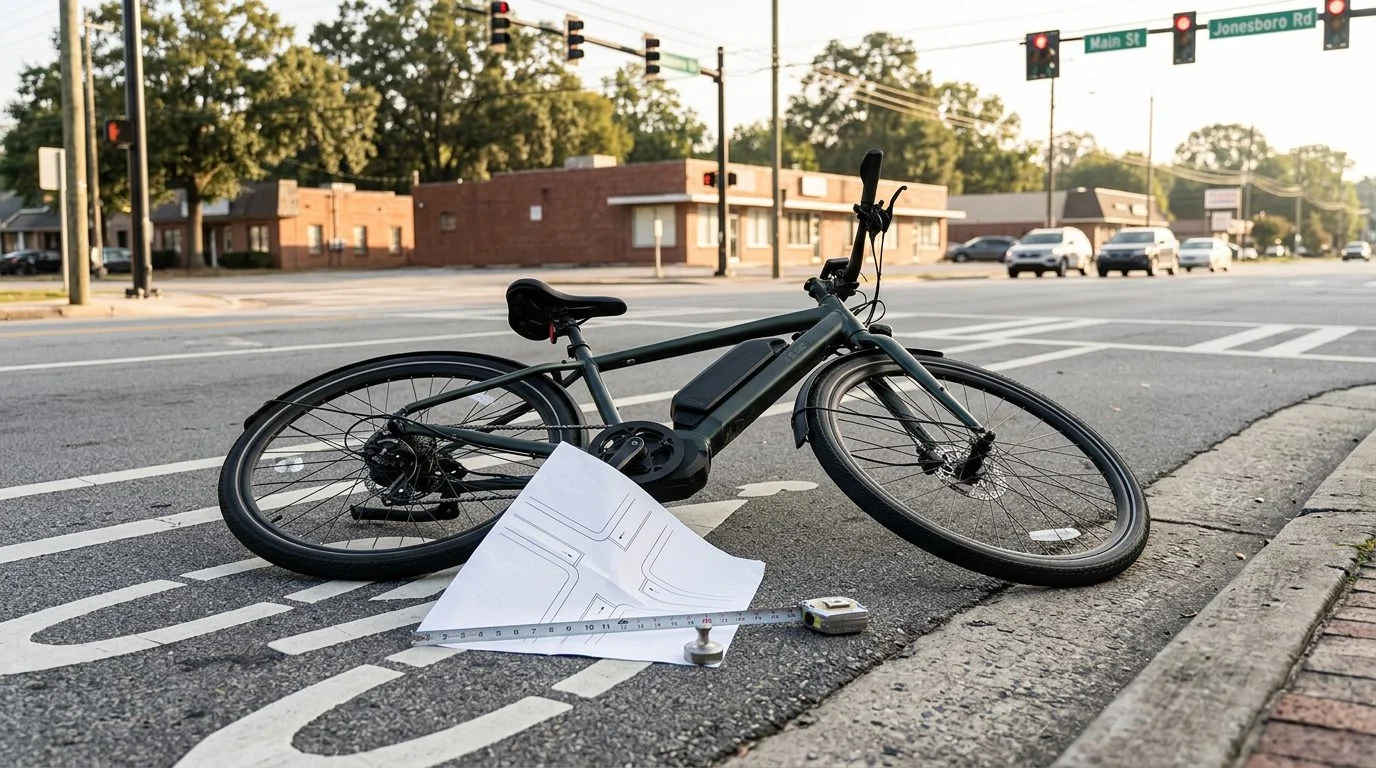
Terance Madden starts a crash case by asking what the evidence shows and how the crash happened. He looks at the physics of the impact, where the bike and vehicles came to rest, and what the marks on the road show. Those details can show who had the chance to avoid the crash.
Side by Side: Which Situation Points Where
A fire with no crash, and a battery or charger in question, points toward a product claim. A crash where another person broke a traffic rule or a duty of care points toward a negligence claim.
| Question | Battery Fire Claim | Crash Claim |
|---|---|---|
| What triggers it | Battery overheats, smokes or burns, with or without a crash | A crash caused by a driver, rider or property condition |
| Main legal question | Was the product defective when sold? | Did someone fail to use reasonable care? |
| Who may be responsible | Maker, seller or importer; a repair shop that changed the battery | Driver, property owner or other party whose carelessness caused the crash |
| Key evidence | Battery, charger, packaging, manual, receipts, photos | Police report, photos, witness names, video, vehicle data |
| Where evidence usually lives | Home, garage, repair shop, retailer records | Crash scene, police file, nearby video, phones |
| Insurance to check | Manufacturer’s and seller’s liability coverage | At-fault driver’s liability coverage; your own uninsured motorist coverage |
Use this table as a starting point. Each case turns on its own facts, and the strongest claim often becomes clear only after the evidence is reviewed.
When the Claim Is Both
One event can support both claims. A battery may get knocked loose in a crash and burn later. A battery fire may make a rider lose control and crash.
When both fit, the family may bring a product claim against the maker or seller and a negligence claim against the driver or property owner. Under Alltrade, Inc. v. McDonald, a company that only puts its own name on a product made by someone else, with no input into its design or making, is a product seller. Under O.C.G.A. § 51-1-11.1, a product seller is not treated as a manufacturer in a strict liability claim (liability without proof of carelessness).
Timing matters too. Under O.C.G.A. § 51-1-11, no action may be commenced for an injury caused by a product that was not merchantable and reasonably suited to its intended use more than ten years after the first sale of that product for use or consumption. A claim of negligence against a manufacturer is subject to the same ten-year limit, except an action seeking to recover for injuries or damages arising out of the manufacturer’s negligence in manufacturing products that cause a disease or birth defect, or arising out of conduct that shows a willful, reckless, or wanton disregard for life or property. The Georgia Supreme Court has held that this limit does not bar a claim that a manufacturer failed to warn of a known danger (Chrysler Corp. v. Batten).
A jury can assign fault to everyone who contributed, named as a party or not. Each liable person pays its own share, not the whole amount. A repair shop or maintenance vendor that worked on the battery or wiring may be another party to examine. More liable parties can mean more insurance.
Protect the Evidence and the Medical Record
Keep the damaged battery and charger in a safe spot away from living space. Don’t charge or repair them. Photograph everything. Keep the packaging, receipts and messages about the purchase.
Local fire-safety guidance also helps. Carroll County lithium-ion battery safety guidance covers charging, warning signs and disposal.
Evidence changes fast. A device can be thrown out. A bike can be repaired. A crash scene can change within days.
Follow every treatment plan. Keep every bill. Write down symptoms and missed work as they happen. If Medicare paid any bills, CMS says its payment can be conditional. CMS explains that a conditional payment must be repaid when a settlement, judgment or other payment is made.
If you’re the daughter, spouse or mother keeping the appointments, bills, photos and calendar, you’re doing the work this case depends on. Our team works closely with the family member who keeps those records. The insurance claim forms walkthrough and the guide for family members cover the next steps.
Not sure what your next step is?
Talk it through with our team — the first consultation is free, confidential, and carries no obligation.
How Big Insurance Responds to Each Claim
Big Insurance is not on your family’s side. A first offer is rarely what a claim is worth.
Big Insurance often opens with a low offer. It may ask for a recorded statement early, before the family knows the full extent of the injury. It may delay payment. It may dispute whether the treatment was needed. It may argue “low impact” or “the battery was not the cause.”
Pursue every coverage layer. That includes the at-fault person’s liability coverage, any umbrella or excess policy, the manufacturer’s or seller’s corporate coverage in a product claim, and your own uninsured or underinsured motorist coverage.
A claim should count future care and lost work, not only today’s bills.
Hurt in a Fire or Crash? Start With a Free Consultation
A free consultation is the simplest way to learn which claim fits your facts. You don’t need to sort it out on your own first.
T. Madden & Associates, P.C. has practiced since 1999, with offices in Jonesboro, Atlanta, Decatur, Macon and Augusta. For local context, see the Clayton County guide and the Jonesboro guide.
The first consultation is free, confidential, and carries no obligation to continue. To talk through your battery, your crash, or both, reach out through the firm’s contact page.
Quick Answers
Can I sue the maker if my e-bike battery caught fire?
Possibly.
Is there a time limit for a product claim?
Georgia’s statute of repose, a hard outer cutoff, is set out in O.C.G.A. § 51-1-11. A strict liability claim against a manufacturer cannot be commenced more than ten years after the date of the product’s first sale for use or consumption, and O.C.G.A. § 51-1-11(b)(2) states no exceptions to that limit. The same ten-year limit also applies to a claim that a manufacturer was negligent, except an action seeking to recover for injuries or damages arising out of the manufacturer’s negligence in making products that cause a disease or birth defect, or arising out of conduct that shows a willful, reckless, or wanton disregard for life or property. The statute also says this limit does not relieve a manufacturer of its duty to warn about a danger from using a product once the manufacturer learns of that danger. It is not the general deadline for filing an injury claim.
Does a battery fire need a crash to support a claim?
No. A battery fire claim can exist without a crash.
Can Medicare be repaid from a settlement?
Yes. Medicare payments made as conditional payments must be repaid when a settlement, judgment or other payment is made.
What if I was partly at fault?
Georgia reduces your damages by your share of fault. At 50 percent or more, you recover nothing (O.C.G.A. § 51-12-33; Quynn v. Hulsey (2020)).