

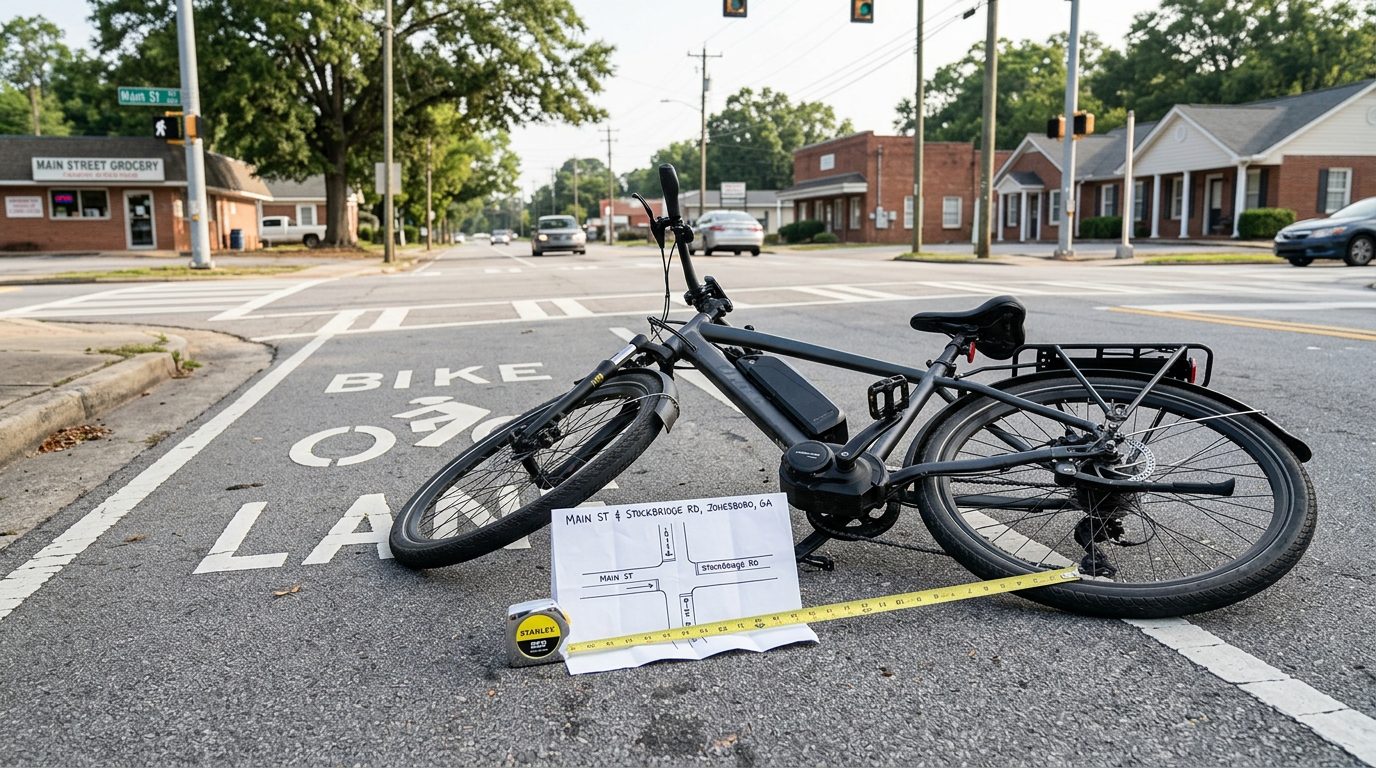
E-bike crashes in Georgia
Your E-Bike's Data Can Help Show What Happened
Controller logs and app records can capture speed, braking and location. Learn what they hold, why they can disappear, and what to save today.
Why injured riders call T. Madden & Associates, P.C.
1999
Practicing Georgia injury law since
Free
Confidential first consultation with no obligation to continue
24/7
Call us any time
By Terance Madden · Published November 11, 2026
If you were hurt on an e-bike, the bike and the phone in your pocket may hold evidence you can’t see. The direct answer: an e-bike’s controller and companion app can store data that helps show how a crash unfolded. That data proves fault only when someone saves it fast and reads it correctly.
This page covers what each source may record, what it cannot show, and what to do in the first days after a crash someone else caused.
The short answer: the bike may remember more than you do
Yes, an e-bike can hold useful crash evidence, but only if the records survive. The controller is the bike’s onboard computer. It runs the motor, the battery and the display, and it can keep a running record of how the bike was operating.
The companion app is the phone program many makers use to set up the bike and track rides. Together, the two sources may show what the bike was doing in the seconds before impact.
Many riders ask whether the bike will “tell on them.” It can tell a story about speed and braking, and that story can help the rider or hurt the rider. That’s why the data needs a careful read. It’s one piece of evidence. The scene, witnesses, medical records and the other party’s conduct matter just as much.
Not sure what your next step is?
Talk it through with our team — the first consultation is free, confidential, and carries no obligation.
What the controller may record
The controller may record speed, pedal-assist level, throttle use, battery voltage and temperature, and fault codes. Exactly what gets logged depends on the make and model.
Most entries carry a timestamp. An engineer can line those timestamps up against the crash timeline, which turns scattered numbers into a sequence of events. A fault code logged near the moment of impact can point to a motor or battery problem that needs a closer look.
Not every e-bike stores the same data. Recording varies by manufacturer and by firmware, the software that runs the bike. Some bikes keep little or nothing useful, so no one should assume a log exists until someone checks.
The NHTSA on event data recorders page explains how vehicle event data recorders capture crash information. An e-bike controller is a different device. The car rules do not carry over automatically, so ask early what the bike stores.
What the phone app may hold
The app may hold ride trips, GPS tracks, speed readings and start and stop times, if it paired with the bike over Bluetooth. Bluetooth is the short wireless link many bikes use to talk to a phone.
App data often lives in two places: on the phone and in a manufacturer account online. That makes the phone itself evidence. It isn’t just a remote control for the bike.
Settings can change what survives. Auto-delete features, cloud sync, app updates, a new phone and account changes can each remove or move records. A screenshot and a phone backup are simple steps that keep the trip history intact until someone can pull the full data.
Parents and adult children often set up these apps for a family member. If that’s you, check whose name is on the account and who can log in.
What the data can prove, and what it cannot
The data can show how fast the bike moved, whether the motor was assisting, and whether the rider slowed or braked before impact. Those are concrete facts, and they can be checked.
The data cannot show what the other driver saw, what they intended, or whether they looked before they turned. Those points need witnesses, video, scene evidence or the other side’s own statements.
Terance Madden holds an engineering degree and reads this kind of evidence himself. That training helps with the questions that matter most: Is the log complete? Is its clock synced to real time? Has anything changed since the crash?
Crash physics adds a second check. Impact speed and delta-V (the change in velocity during the hit) can be compared with the damage to the bike and the injuries to the rider. If the numbers and the story don’t line up, the gap shows up early.
Why timing decides what survives
Evidence is most at risk in the first days after a crash, when a bike gets repaired, reset or sold. Batteries, firmware updates, factory resets, phone upgrades and account changes can each overwrite or erase records.
Preservation means keeping evidence in its post-crash condition until someone can inspect it. Georgia law can require this before a lawsuit is ever filed. In Phillips v. Harmon, the court held that the duty to preserve evidence arises when litigation is reasonably foreseeable to the party that controls the evidence, not only when a suit is pending.
Here’s the first-week checklist:
- Don’t repair, reset, update or factory-restore the bike.
- Photograph the bike, the damage, the scene and any skid marks.
- Screenshot the app’s trip history and settings.
- Back up the phone that ran the app.
- Write down witness names and phone numbers.
- Keep the helmet and clothing you wore.
How Georgia fault rules use this evidence
Georgia reduces an injury claim by the injured person’s share of fault. Under O.C.G.A. § 51-12-33, the judge reduces damages in proportion to that percentage. This is comparative fault (shared fault).
Under O.C.G.A. § 51-12-33 (Quynn v. Hulsey (2020))(g), a plaintiff who is 50 percent or more responsible for the injury or damages claimed is not entitled to receive any damages. If the injured person is 50 percent or more responsible, the statute says no damages are recoverable. That line is why speed and braking records matter so much.
When more than one party is liable, the trier of fact (the jury or judge deciding the case) splits the award by each party’s percentage of fault. Each share belongs only to the party it is awarded against. The statute does not make those shares joint.
The data helps with that split. A log that confirms the rider slowed and braked can answer a claim that the rider was speeding. A log that shows a sudden motor surge can shift the split the other way.
Not sure what your next step is?
Talk it through with our team — the first consultation is free, confidential, and carries no obligation.
Other parts and other insurance
Other parties can share the blame, and each one can add a source of insurance. Some crashes involve more than one party. Defective parts or poor repair work are sometimes part of the story, and the firm can look into whether they played a role.
Big Insurance is not on your side. Its adjusters often open with a lowball offer, ask for a quick recorded statement, question the log’s accuracy or the rider’s speed, dispute the treatment, and let the file sit. A first offer is rarely what your claim is worth.
A claim may involve more than one source of coverage. That can include the at-fault driver’s liability coverage, your own uninsured or underinsured motorist coverage, any umbrella or excess policy, and corporate coverage. Georgia requires auto policies to include an uninsured motorist endorsement, within limits the statute sets at the insured’s option (O.C.G.A. § 33-7-11).
A full picture of an injury’s cost can include more than the first bills. Some evidence, such as video or vehicle data, can be lost if it is not preserved early.
If your bike is still in the garage
If the bike and phone are still in your hands, the next steps matter most. Start with preservation before anything else.
If you’re the spouse, parent or adult daughter keeping this bike and phone safe, you’re doing more than paperwork. You’re protecting the proof your loved one needs.
Can the data prove fault by itself?
No single record settles fault. Speed and braking data works best next to the scene, witness statements and medical records.
Does the app keep ride history after a crash?
Sometimes. It depends on the app, its settings and the account, so save it now.
A bike in the garage, a phone holding the trip history, and a crash someone else caused is a lot to carry alone. The firm works on a no-fee-unless-we-win basis, but you may still be responsible for court costs and case expenses. The firm has offices in Jonesboro, Atlanta, Decatur, Macon and Augusta.