

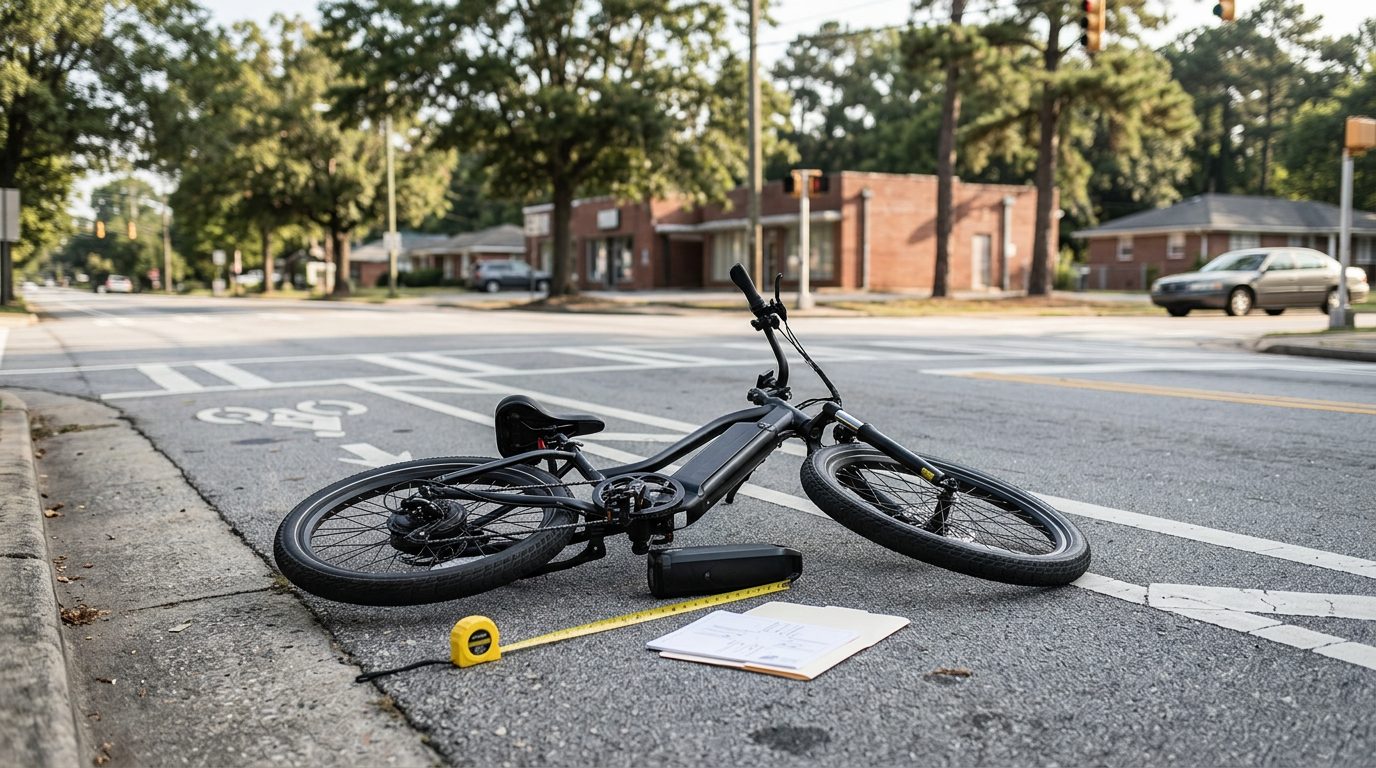
Clayton County e-bike crashes
Hurt on an e-bike? Find out who pays your medical bills.
Bills start arriving while you are still healing. Here is how to sort out which sources may cover them, and where to begin.
Serving injured riders since 1999
1999
Year T. Madden & Associates, P.C. began practice
5
Offices across Georgia, including Jonesboro in Clayton County
24/7
Call us any time
By Terance Madden · Published November 15, 2026
If you’re the one opening the envelopes after an e-bike crash, you already know how fast the bills stack up. Someone in the family is making the calls, tracking appointments and trying to work out who pays.
Here’s the short answer. Medical bills after an e-bike crash can be paid from more than one source. Those can include the rider’s health plan, medical payments coverage on an auto policy, uninsured motorist coverage and the at-fault driver’s liability coverage. Which ones apply turns on the crash and the policies involved.
Who This Question Usually Lands On
This question usually lands on the person managing the recovery: a spouse, a mother or an adult daughter. That person is driving to appointments, reading statements and sitting on hold with insurance companies. Nobody planned for this job.
This guide covers where medical bills can come from, how fault changes who pays, how Big Insurance handles bike injury claims and what to protect right now. It is not a promise about any outcome. Every crash has its own facts.
A rider has no steel frame around them. That’s why a crash can lead to broken bones, head injuries and long recoveries. If you’re keeping the paperwork, start a folder today. Put in every bill, statement and letter from an insurer. Organized papers help at every stage of a claim.
Ask the rider what hurts, what they can’t do now and what has changed since the crash. Write it down in their own words. Those notes matter later, when the story has to be told clearly. Your family has carried hard things before. This is one more thing to get organized, one step at a time.
If a rider you love was hurt in a crash caused by someone else, you don't have to sort out the bills alone. Reach out for a free case evaluation. Talk it through with our team — the first consultation is free, confidential, and carries no obligation.
Where Medical Bills Can Be Paid From
Medical bills after an e-bike crash can come from several sources. Each one works differently, and the first one people hear about is not always the one that pays.
Health insurance. The rider’s own health plan may cover care after a crash, even when someone else caused it. Check how the plan handles the claim before assuming it won’t pay. Georgia law also shapes how a medical bill is proven in court. When the injured person suing for damages has any form of public or private health insurance, including benefits under a governmental workers’ compensation program, the proof of a reasonable bill includes both the amount charged and the amount actually needed to satisfy it under the insurance contract or the workers’ compensation program, whether or not the insurance has been used, is used, or will be used to pay it, as O.C.G.A. § 51-12-1.1 provides.
Medical payments coverage (MedPay). Some auto policies carry an optional add-on called medical payments coverage, or MedPay. It pays certain medical bills after a crash, up to a set limit. Check the front-page summary of any auto policy in the household for it.
Uninsured and underinsured motorist coverage (UM/UIM). Uninsured motorist (UM) coverage applies when the at-fault driver has no insurance. Underinsured motorist (UIM) coverage applies when that driver’s limit is too low to cover the harm. Under O.C.G.A. § 33-7-11, Georgia auto liability policies must include this coverage within policy limits, unless the insured rejects it in writing; the coverage excludes umbrella or excess liability policies unless affirmatively provided for in such policies or in a policy endorsement.
The at-fault driver’s liability coverage. Liability coverage pays for the harm the at-fault driver causes, up to the policy limit. A low limit means less money from that policy alone. That’s why the other layers matter.
Household policies. Some household or renters policies carry medical payments coverage too. Whether one applies takes a close look at the policy wording. The firm reviews each available layer of insurance coverage in a case.
Who Is at Fault When a Bike Hits a Car
Fault goes to the person whose careless or reckless choice caused the crash, and a rider’s own share of fault can reduce what they recover.
Georgia uses comparative fault, which means each person’s share of blame counts. If the injured person is partly at fault, the judge reduces the damages by that share, under O.C.G.A. § 51-12-33. A person who is 50 percent or more responsible recovers no damages under the same statute. Georgia also makes each at-fault party pay only its own share, so every party’s insurance matters.
Evidence settles fault. Photos of the bike and car, damage patterns, witness statements and any camera or phone video can show who made the choice that caused the crash. Don’t repair or throw away the bike or helmet until the evidence has been looked at.
Terance Madden’s engineering training. Before law school, Terance Madden trained as an electrical engineer. He starts by asking what the physical evidence shows: where the bike and car came to rest, how the damage lines up and how the crash unfolded. He also asks which records exist and which must be preserved before they disappear. That matters when someone calls a crash “low impact” and expects the family to accept it.
Other liable parties. If a battery defect, brake failure or faulty part played a role, the maker or seller may be a liable party. Product liability, a claim that a defective product caused harm, can mean more insurance to pursue. The firm also represents people hurt in fires and explosions tied to defective lithium-ion batteries.
What Big Insurance Does With a Bike Injury Claim
Big Insurance is not on the family’s side, and a first offer is rarely what a claim is worth.
Big Insurance often opens with a small offer, early and fast. It may ask for a recorded statement before the family knows the full injury. It may delay payment or argue that a treatment wasn’t needed. Some will call a crash “low impact” and say an e-bike could not have caused the injury. Each tactic aims to close the claim cheaply.
Before you give a recorded statement or sign a release, talk with a lawyer first. A release can end the claim for good.
Here’s the response. The firm pursues every coverage layer: liability coverage, UM/UIM, umbrella and excess coverage where they exist, and corporate coverage when a company is at fault. It prepares a claim as if it will go to trial. The firm’s engineering background helps test a “low impact” argument against the physics of the crash. Don’t let the clock set the terms of your family’s settlement.
What Compensation Covers, Including Future Care
Compensation covers the losses the rider can prove, including care they will need later. The amount depends on the facts.
Georgia separates two kinds of damages. General damages, such as pain and suffering, are presumed to flow from a wrongful act and can be recovered without proof of an amount. Special damages, such as medical bills and lost wages, must be proved, under O.C.G.A. § 51-12-2. Necessary expenses from an injury are a legitimate part of the estimate, as O.C.G.A. § 51-12-7 states.
Serious injuries can need care for years, such as surgery, rehab, medication and help at home. Those costs belong in the claim when they are medically needed. Georgia law lets the fact finder reduce future economic losses to present value, the value today of money paid later, using a 5 percent discount rate or another rate it considers appropriate, under O.C.G.A. § 51-12-13.
Bills climb fast. Ambulance transport, scans, surgery and rehab each add charges, so keep every statement. Some families get treatment under a letter of protection, an arrangement where the provider waits to be paid from the case. A medical journal review of liens explains that an uninsured crash victim may receive treatment under a provider lien, with payment deferred until the claim is resolved.
Records and Deadlines to Start Now
Georgia generally gives two years to file a personal injury lawsuit. The two years run from when the right of action accrues, under O.C.G.A. § 9-3-33. Don’t wait for insurance talks to finish before you protect that deadline.
Start these steps now:
- Keep every bill, explanation of benefits, pharmacy receipt and mileage log for medical trips.
- Photograph the bike, helmet, clothing and the scene, if it’s still there.
- Save texts, emails and messages about the crash.
- Write down the date, time, route and what the rider remembers while it’s fresh.
- Keep appointments and follow the treatment plan. Gaps in care are often used to argue an injury wasn’t serious.
- Think before posting about the crash or the rider’s activities. Insurers can use posts to dispute injuries.
Not sure what your next step is?
Talk it through with our team — the first consultation is free, confidential, and carries no obligation.
Questions Clayton County Families Ask
Who is at fault when a bike hits a car?
Fault turns on who made the careless choice and how the crash happened. Georgia reduces a rider’s damages by the rider’s own share of fault.
Does the rider need a lawyer to get medical bills paid?
Families often talk with a lawyer while bills are still arriving, so they know which sources to pursue.
What if the at-fault driver has no insurance?
Uninsured motorist coverage may pay under an auto policy, within its limits. Georgia requires auto liability policies to include it unless the insured rejects it in writing.
Can a rider recover if they were partly at fault?
Georgia reduces damages by the rider’s share of fault. At 50 percent or more, the rider recovers no damages.
What does it cost to work with the firm?
You may still be responsible for court costs and case expenses.
If the Bills Are Already Piling Up
If the bills are already piling up, you don’t have to sort out the insurance alone. A rider stuck at home, a family on the phone with insurers and a crash nobody chose is a hard place to sit.
The firm’s Jonesboro office serves Clayton County families. The first consultation is free, confidential and comes with no obligation to continue. Reach out through the firm’s contact page to request a free case evaluation, and bring the bills and insurance papers you’ve gathered so far.