

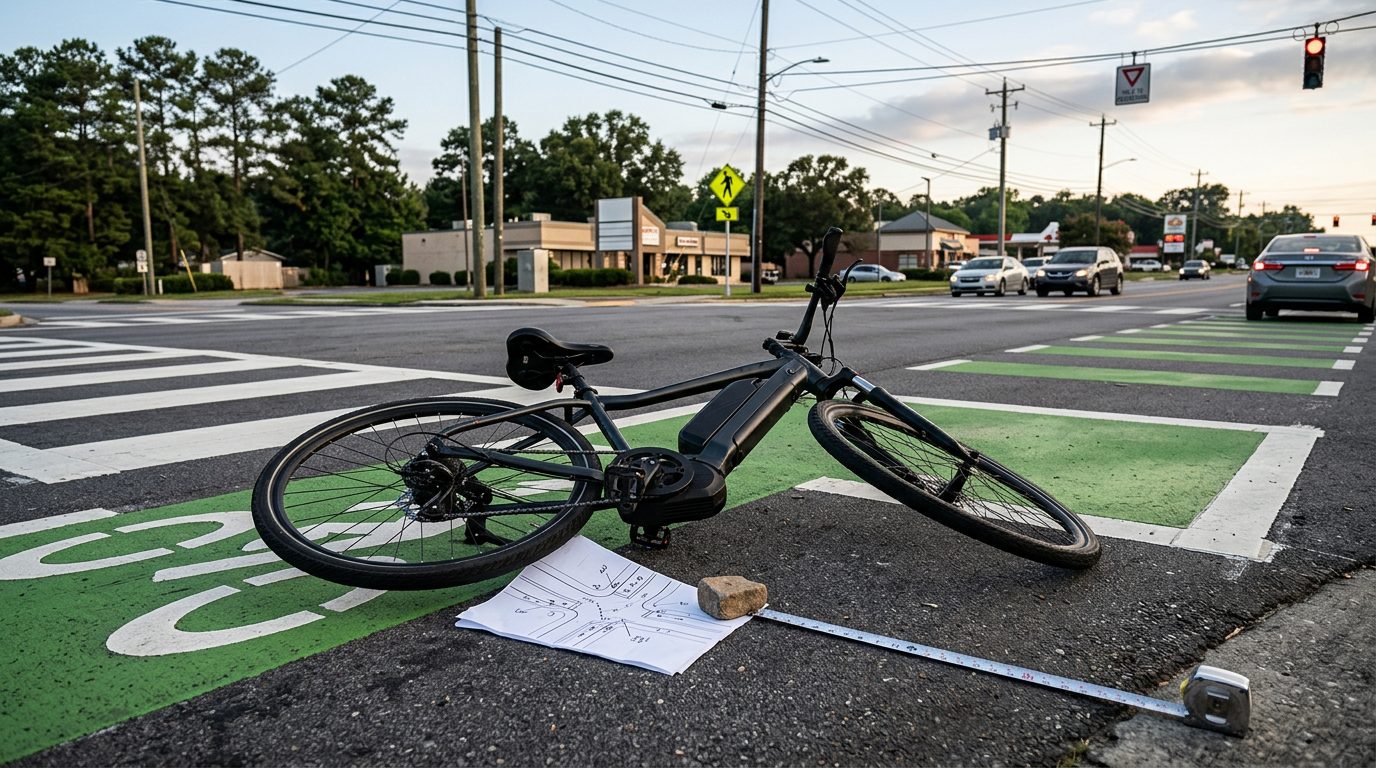
E-bike crashes in Georgia
A low-speed label doesn't measure your injury
Insurers often reach for the word 'minor' first. Here is how to see past it and what to protect while your case is being reviewed.
T. Madden & Associates, P.C.
1999
Year the firm began practicing law
5
Georgia offices: Jonesboro, Atlanta, Decatur, Macon and Augusta
24/7
Call us any time
By Terance Madden · Published November 21, 2026
An insurance adjuster just called your e-bike crash a “low-speed impact.” You’re sore, the bills are stacking up, and you want to know what that label really means.
Here’s the short answer. It means Big Insurance wants to pay less. It is a negotiating position, not a medical finding. A low speed does not mean a minor injury.
What Big Insurance Means by a Low-Speed Impact
A low-speed impact is Big Insurance’s claim that the crash forces were too small to cause serious harm. The phrase sounds technical, but it works like a sales pitch for a small check.
The label often shows up in the first offer. That offer can arrive before anyone has reviewed your medical records. An insurer’s first offer is rarely what a claim is worth.
E-bike riders hear this label often. Riders usually have fewer policies to draw on than drivers do, so the label keeps the number small. Big Insurance is not on your side, even when the adjuster sounds friendly and calm.
Ask one question: what does “low speed” describe? It describes how fast the bike was moving. It does not describe how hard your body was stopped. Those are two different questions.
Not sure what your next step is?
Talk it through with our team — the first consultation is free, confidential, and carries no obligation.

The Tactics Behind the Low-Impact Argument
The low-impact argument rarely comes alone. It usually arrives with a set of tactics that work together.
- Lowball offers. A small number, made before the full medical picture is known.
- Recorded statements. A recorded interview, often taken while you’re in pain or on medication. Later, one loose word can be used to challenge your story.
- Delays. Slow letters, slow answers and slow payment of medical bills can wear a rider down.
- Disputed treatment. The claim that the ER visit or the follow-up scan was not needed.
- “The bike looks fine.” Photos of a scratched frame are used to suggest you must be fine.
Each tactic has a response. You can decline or postpone a recorded statement until a lawyer has reviewed it. You can ask the insurer to put its position in writing. Georgia law also limits medical damages to the reasonable value of medically necessary care, so the bills must match the treatment that was needed (O.C.G.A. § 51-12-1.1). Your medical records, not the bike’s photos, are the proof that matters for your care.
Why a Low Speed Does Not Mean a Minor Injury
A low speed does not mean a minor injury, because how your body stops matters more than the bike’s top speed.
Engineers use the term delta-V for this. Delta-V is the change in speed your body goes through when the crash stops you. It is measured across the impact, not from the bike’s top speed. A rider can be moving slowly and still stop hard against a car door, a curb or the pavement.
Before law school, Terance Madden trained as an electrical engineer. That training shapes how he works a case. He asks what the evidence shows and how the crash happened. On an e-bike, that evidence can include the motor class, speed settings, and controller or battery records. Those records can show how fast the bike was moving at impact, and they must be preserved before they’re lost. You can read more about e-bike speed and class evidence.
Nobody can say what the impact forces were until that evidence is reviewed. Don’t let a label stand in for the data.
Other Parties Who May Share the Liability
More than one party can share the blame for an e-bike crash. Each one may carry its own insurance.
A car driver who turned into your path is one likely party. Your own conduct still counts under Georgia’s fault rules, which the next sections cover. A bike part can also be at fault. Brakes, a battery, a charger or a controller can fail. A repair shop’s work can contribute too.
Georgia product law adds another path. A manufacturer can be liable to a natural person who uses, consumes or is reasonably affected by a product, and who is injured because the product was not merchantable and reasonably suited to the use intended when sold, even without a direct contract with that person (O.C.G.A. § 51-1-11), but no action under this rule may be commenced for an injury after ten years from the date of the first sale. A store that only sells a product is not treated as its manufacturer in a strict liability claim (a claim that does not require proof of carelessness) (O.C.G.A. § 51-1-11.1).
Each extra liable party can mean another source of insurance to pursue. The firm’s lithium battery fire and product liability work covers cases where a battery or part defect is in question.
Which Insurance Policies Can Respond to Your Crash
Several policies can respond to one e-bike crash. The low-speed label should not close any of them.
- The at-fault driver’s liability policy. It pays for harm the at-fault driver causes.
- Your own uninsured and underinsured motorist coverage (UM and UIM). UM pays when the at-fault driver has no insurance. UIM pays when that driver’s limits are too low. Check your own auto policy with the guide on which auto policies can respond.
- Umbrella or excess coverage. Extra limits that sit above a base policy.
- Corporate coverage. Where a business’s vehicle, equipment or work is involved.
Whether each policy applies depends on the facts.
Lifetime costs count too. Future medical care and lost earning power can be part of a claim. Georgia law lets a jury reduce future losses to present value (today’s dollars) using a 5 percent rate or another rate it finds appropriate (O.C.G.A. § 51-12-13).
The firm reviews every layer that may apply and prepares each claim as if it will go to trial.
What Georgia Law Says About Fault and Filing Deadlines
Georgia cuts your recovery by your share of fault. This is called comparative fault (shared fault). A person who is 50 percent or more responsible for the injury recovers no damages (O.C.G.A. § 51-12-33).
Georgia generally gives two years to file an injury lawsuit (O.C.G.A. § 9-3-33). Some claims have other time limits, so check the date early. Waiting on an insurer’s reply can use up time you need.
Written settlement offers have rules too. For a motor vehicle collision claim, a written offer prepared with a lawyer’s help must give at least 30 days to accept.
Not sure what your next step is?
Talk it through with our team — the first consultation is free, confidential, and carries no obligation.

Protect the File Before the Low-Impact Label Sticks
Start the file now. Gather the crash report, photos, medical records and witness names.
- Photos of the bike, the scene and your injuries.
- Every medical record and bill, with the date of each visit.
- Names and phone numbers of anyone who saw the crash.
- The bike itself. Don’t repair, sell or discard it until someone has looked at it.
- Any lien (a legal claim against your settlement to repay a bill). Track each one from day one.
If you’re the spouse, mother or adult daughter handling bills, calls and appointments, your role matters. The firm works with the person managing that paperwork, so the file stays clear for everyone.
Why does Big Insurance call an e-bike crash low speed?
Because a low label makes a smaller claim look reasonable. It describes the crash, not your medical condition.
Can a low-speed e-bike crash cause serious injury?
Yes. Injury depends on how quickly your body stops, not on how the bike looks afterward.
Should I give a recorded statement?
You can decline or postpone it until a lawyer has reviewed the questions.
How long do I have to file?
Georgia generally gives two years to file an injury lawsuit, but some claims have other limits (O.C.G.A. § 9-3-33; Kenneth B. Cameron v. Jmp Pizza, Inc (2026)).
If an insurer has already called your crash a low-speed impact, talk with the firm before you answer more questions. The first consultation is free, confidential, and comes with no obligation to continue. Contact T. Madden & Associates to start your free case evaluation.