

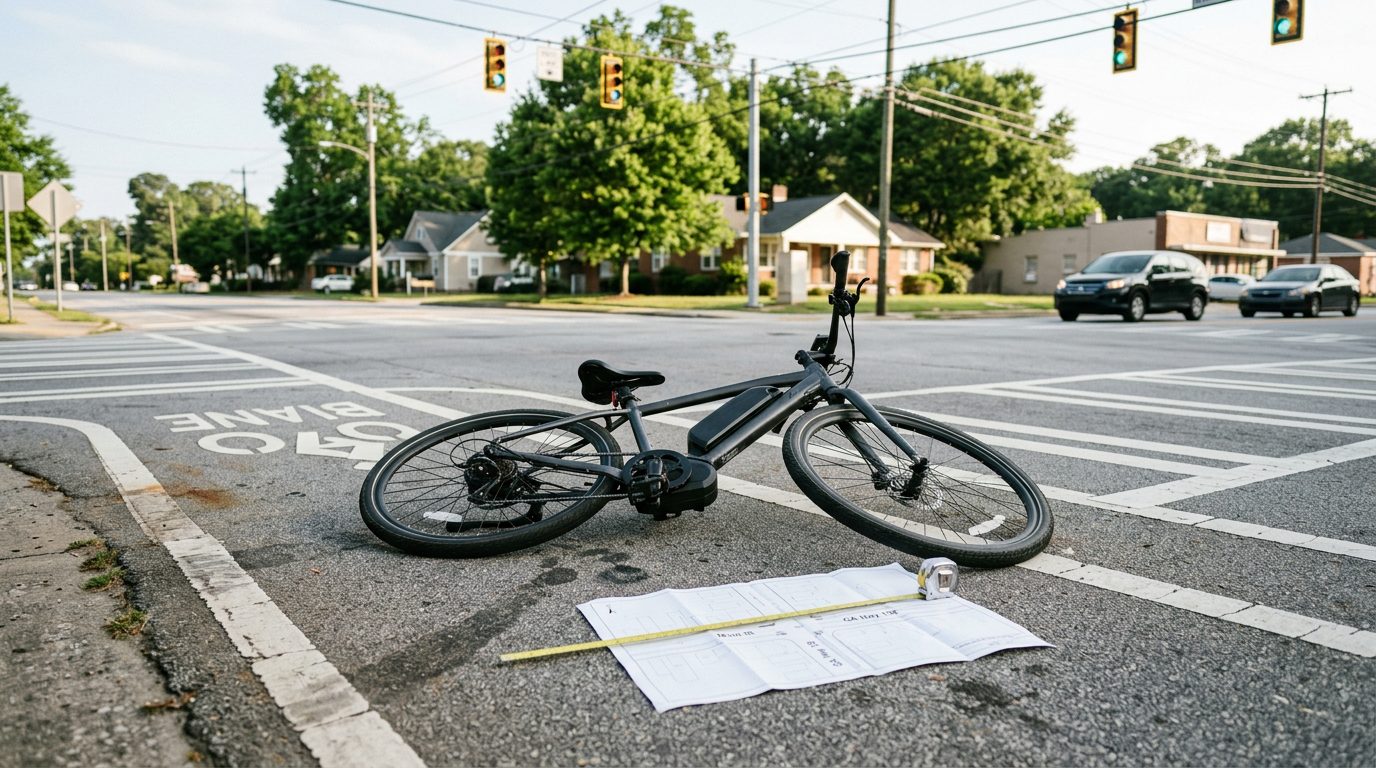
E-bike crashes | Georgia personal injury
A slow e-bike crash can still break bones and brains
Physics explains why a rider can get hurt badly at low speed. Here is what to look for, and how to protect your claim from the start.
T. Madden & Associates, P.C.
1999
Year the firm began representing injured people
24/7
Call line available around the clock
By Terance Madden · Published November 23, 2026
You saw the rider go down. It didn’t look like much, and maybe they stood up and said they were fine. Now there are hospital bills, and the person you love can’t sleep or lift a grocery bag.
So why does an e-bike crash at low speed cause serious injury? The damage comes from how fast the body stops, not just how fast the bike was rolling. A short, hard stop on pavement can deliver a lot of force in a split second.
Low Speed Does Not Mean Low Force
A low-speed e-bike crash can still produce a high-force impact. Force depends on how quickly the body is stopped, and the speed at the start of a ride tells only part of the story.
Think about a rider who hits a curb or the edge of a driveway. The bike stops in a moment. The rider’s body doesn’t stop with it. It keeps moving until something hard catches it: the pavement, a pole, a car door or the ground.
That final stop is where most of the injury happens. A ride that feels slow to a bystander can still end with serious force on the ground. The surface, the angle and the rider’s body position all change the result.
Researchers who study bicycle injuries have found that injury severity depends on several factors. Those factors vary from crash to crash, which is why two riders at the same speed can end up with very different injuries. You can read a peer-reviewed bicycle injury study for the research itself.
If a crash that looked minor left you or someone you love with a hard recovery, you don't have to sort out Big Insurance's calls alone; reach out for a free case evaluation and talk through what the evidence shows. Talk it through with our team — the first consultation is free, confidential, and carries no obligation.
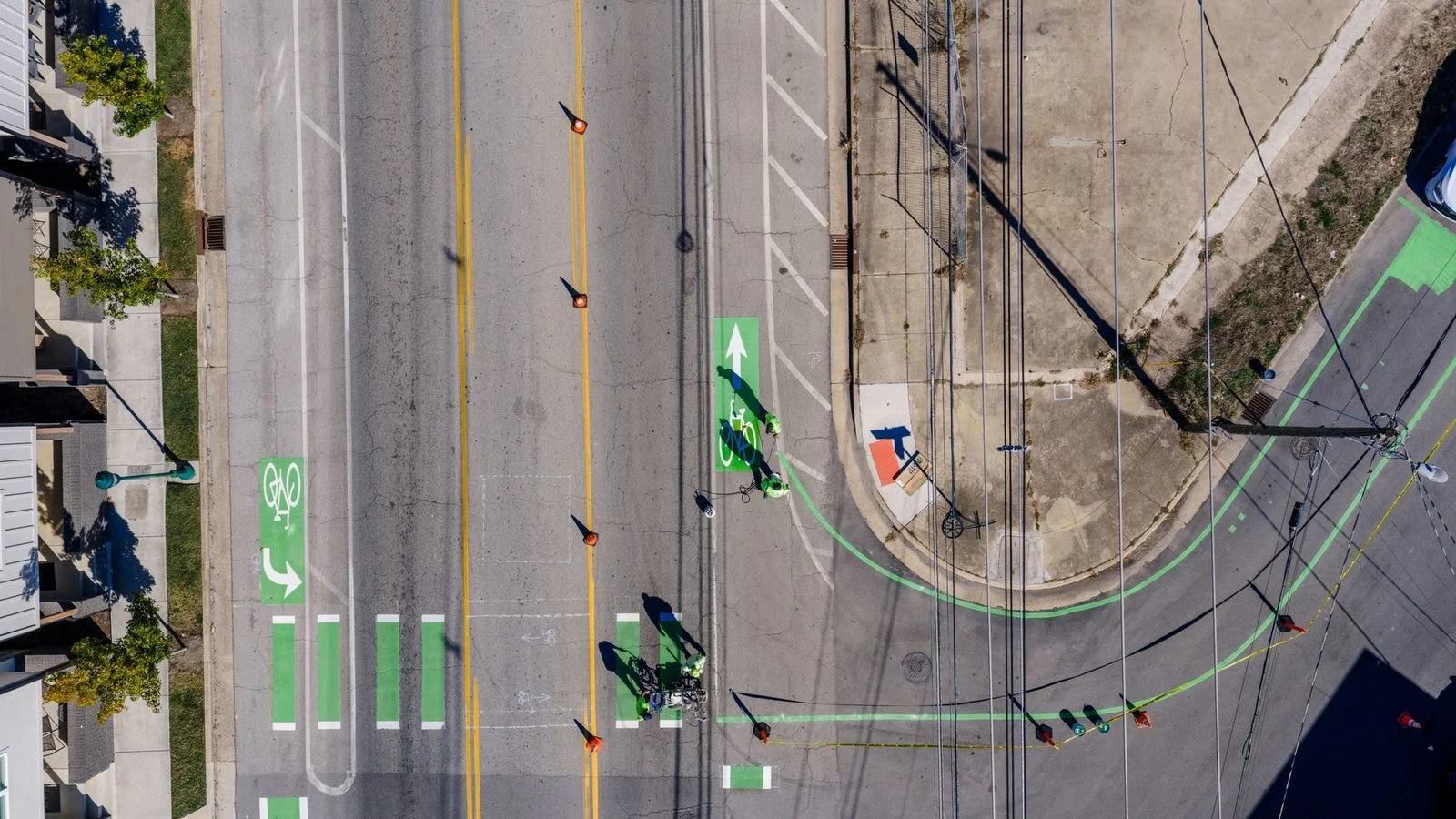
Energy Grows With the Square of Speed
Energy rises with the square of speed. Doubling a rider’s speed roughly quadruples the energy the body must absorb.
Physicists call energy of motion kinetic energy (the energy an object carries because it is moving). The formula is KE = ½mv², where m is mass and v is speed. The key point is that speed is squared.
Here’s what that means in plain terms. A rider going 20 miles per hour carries four times the energy of the same rider going 10 miles per hour, at the same weight. Speed is the lever that matters most, and it grows fast.
Most people don’t feel that math. They feel a bike that seems to roll gently. But the energy doesn’t care how the ride feels. When the rider hits something, the body has to absorb all of it in a very short time.
That is why a crash that starts at a modest speed can still cause serious harm. The energy is still there when the rider reaches the ground.
Why E-Bikes Hit Harder Than Regular Bikes
E-bikes hit harder than pedal bikes because they weigh more and can get up to speed faster. The battery and motor add mass, and motor assist changes how quickly a rider moves.
Energy depends on mass too. Add weight, and the same speed carries more energy into a fall or a collision. A battery pack and motor can add a lot of weight, and the rider’s body adds more on top of that.
Motor assist adds a second effect. A rider can reach a higher speed with less effort than on a pedal bike. That speed can feel normal on a bike lane or sidewalk, but it still carries real energy when the rider loses control.
Battery and controller problems matter too. Off-brand or modified batteries and controllers can change how a bike behaves and how a fire or failure unfolds. T. Madden & Associates, P.C. represents people hurt by lithium battery fires and by defective products, and that work includes the parts that fail.
Stopping Fast: The Ground Is the Real Impact
Injury depends most on how fast the body goes from moving to stopped. A rider who lands on asphalt, concrete or a curb stops in a very short distance.
Deceleration (the rate a body slows down) is the term for this. A short stopping distance means a large deceleration. Big deceleration puts big force into bones, joints and soft tissue.
Common contact points include the hip, wrist, shoulder, knee, ribs and head. Many riders put a hand out to break a fall. That can protect the face but break the wrist, elbow or collarbone. A fall from a seat can end with the hip or ribs hitting the ground.
The bike matters too. Handlebars, pedals and the battery case can strike the body. The landing position, the angle of the fall and what the rider hits all change the injury. The same speed can produce very different injuries, so the scene matters a great deal.
Head Injuries and Rotational Forces
A head injury can be serious even after a low-speed fall, and it doesn’t always show up at the scene. When the head stops suddenly, the brain moves inside the skull.
Traumatic brain injury (TBI, an injury to the brain from an outside force) is one example. The Administration for Community Living describes TBI and notes that crashes, including automobile crashes, can cause one.
Rotational forces (twisting forces) matter too. An off-center hit can turn the head and brain, not just push them. Twisting can injure brain tissue, and symptoms can show up later, not right away.
If a rider hit their head, get a medical evaluation, even if they say they feel fine. Keep notes on headaches, dizziness, sleep, mood, memory and balance. Write down the date of each change.
If you’re caring for a child, watch closely. A child may not describe symptoms clearly. Watch for changes in behavior, sleep, balance, school focus and memory, and tell the doctor what you see.
Delta-V: The Number Engineers Read
Delta-V (change in velocity) is the change in speed a body goes through during an impact. Engineers use it to judge how hard a crash was.
Delta-V matters because it links speed, mass and time. A rider who goes from moving to stopped over a very short time takes a large change in speed in a short window. The shorter the time, the harder the stop feels to the body.
Crash physics is evidence. Investigators can read it from where the bike came to rest, skid and gouge marks on the pavement, the point of impact, and how the rider and any other vehicle moved. Those marks show what happened, in order.
Each real case needs its own measurements from its own scene and bike. That is where the physics work begins, and it is why the scene should be documented early.
Not sure what your next step is?
Talk it through with our team — the first consultation is free, confidential, and carries no obligation.
How Terance Madden’s Engineering Training Shapes the Case
Terance Madden trained as an electrical engineer before he went to law school. Terance Madden trained as an electrical engineer, and that training shapes how he works an e-bike case.
He starts by asking what the evidence shows and how the crash happened. He looks at the bike’s condition, the battery, the motor and the maintenance history together. Those records need to be kept, because they can change or disappear after a crash.
Other parties can be liable too. A battery or component maker, a repair shop or a seller may have a role if a part failed or was installed wrong. Each of those parties may carry its own insurance, which can mean more coverage to pursue.
Engineering training doesn’t replace medical records or witness statements. It gives a way to test what each piece of evidence actually shows, and to ask the next question.
The ‘Low Speed’ Argument Big Insurance Uses
Big Insurance often argues that a low-speed crash could not cause serious injury. That argument is a tactic, and a first offer is rarely what a claim is worth.
Big Insurance is not on your side. Expect these moves:
- A quick, low offer made before the medical picture is clear.
- A request for a recorded statement early in recovery, while the rider is still hurting and foggy on details.
- Delays in paying medical bills or processing the claim.
- Disputes over whether the treatment was needed, or whether this crash caused it.
- The “low impact” or “it was only a fall” argument.
Each move has a response. The physics evidence shows how the body stopped. The bike and battery records show what the rider was riding. Medical imaging and treating doctors’ opinions show the injury.
Then the claim looks at every coverage layer that may apply. That includes liability coverage, uninsured and underinsured motorist coverage (UM/UIM, insurance that pays when the at-fault driver has too little or none), umbrella and excess coverage, and corporate coverage when a business is involved.
Special damages (losses that must be proved, such as medical bills and lost wages) are one part of a claim. The Georgia statute on general and special damages (O.C.G.A. § 51-12-2) says special damages must be proved to be recovered. Future care and lost earning capacity belong in the picture too.
The firm builds each claim as if it may go to trial.
Is the Rider Ever at Fault?
A rider can share fault. Georgia reduces a recovery by the injured person’s share of fault, and it bars recovery when that share is 50 percent or more (O.C.G.A. § 51-12-33; Quynn v. Hulsey (2020)).
Under O.C.G.A. § 51-12-33, the judge reduces damages in proportion to the plaintiff’s percentage of fault. The statute also says a plaintiff who is 50 percent or more responsible may not receive any damages.
Each liable person pays only its own share. Under the same statute, apportioned damages are each person’s own liability and are not joint liability.
The physics can show how the crash unfolded. Did a driver turn in front of the rider? Did a door open? Did the rider have room to stop? The evidence answers those questions, and the answers shape fault.
Big Insurance often uses shared fault as leverage. Don’t accept a fault label without looking at the evidence behind it.
What to Preserve After a Low-Speed E-Bike Crash
Keep the bike, the battery and the charger as they are. Take photos of the scene before anything is moved or repaired.
Here’s the list that matters most:
- The bike and battery, unrepaired and unsold.
- The charger, cords and adapters.
- Photos of the scene, the bike and the rider’s injuries over time.
- Names and contact details for any witnesses.
- The helmet and clothing the rider wore.
Don’t try to charge, open or repair a damaged battery. Keep every medical record, bill and work-absence note. Start a simple daily log of pain, limits, sleep, medicine and appointments.
Avoid posting about the crash on social media. Don’t give a recorded statement to any insurance company before you talk with a lawyer.
If the rider is on Medicare, the rules change. Medicare may make conditional payments (payments for care while a claim is pending), and those must be repaid from a settlement. The Medicare Secondary Payer overview explains that federal law takes precedence over state laws and private contracts. Claims must also be reported under the Medicare case reporting rules.
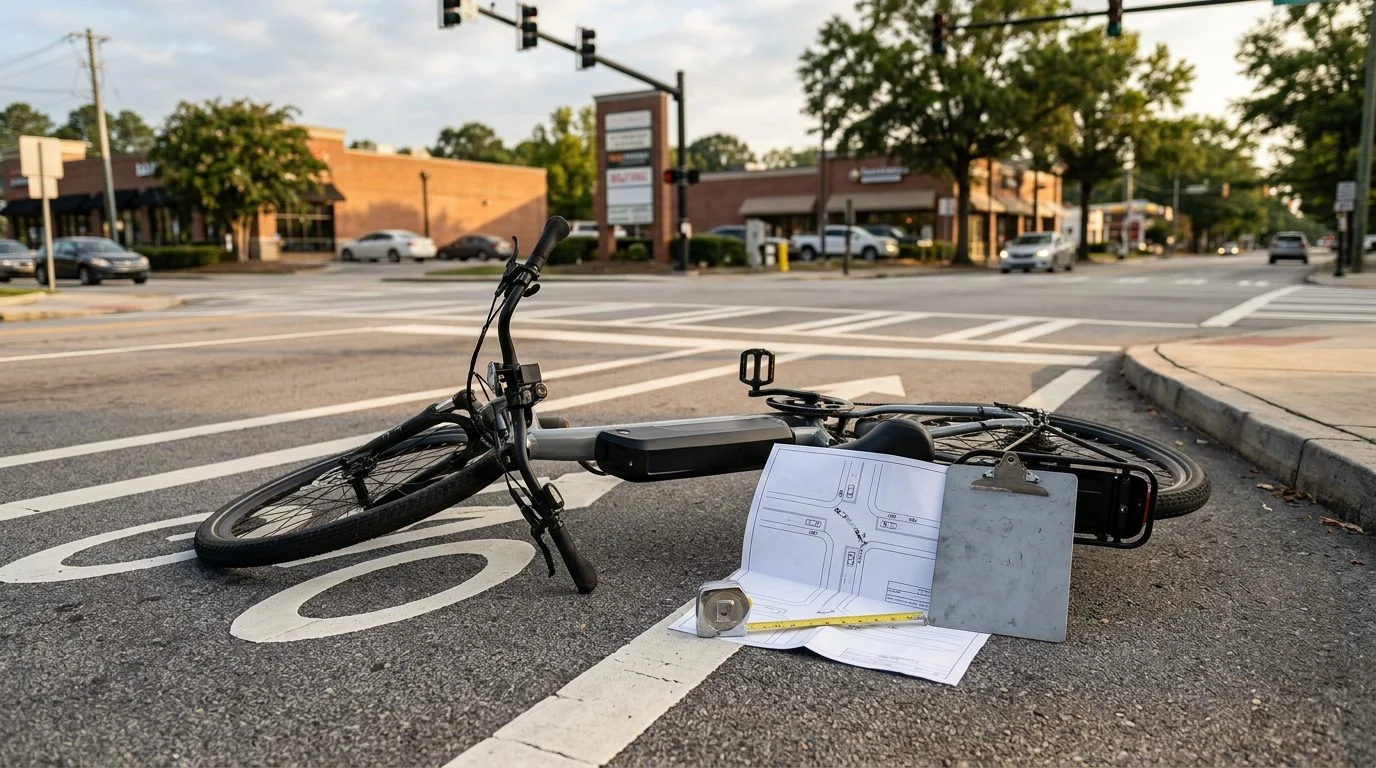
Take the Next Step for the Person You Are Caring For
If you’re the one handling calls, bills and appointments, you know how heavy this gets. A rider with a head injury or a broken wrist may need months to recover, and someone has to keep track of all of it.
T. Madden & Associates, P.C. is a Georgia personal injury firm, in practice since 1999, with offices in Jonesboro, Atlanta, Decatur, Macon and Augusta. The firm represents people hurt in e-bike crashes and their families.
Quick Answers
Can a low-speed e-bike crash cause a serious injury?
Yes. Injury depends on how quickly the body stops, so a short stop on a hard surface can cause serious harm at a modest speed.
Can the rider be at fault?
Yes, in part. Georgia reduces damages by the injured person’s share of fault and bars recovery at 50 percent or more (O.C.G.A. § 51-12-33; Quynn v. Hulsey (2020)).
How long do I have to file a lawsuit?
Georgia generally gives two years to sue for injuries to the person, under O.C.G.A. § 9-3-33 (injuries to the reputation must be brought within one year, and actions for injuries to the person involving loss of consortium within four years), as quoted in a Georgia Court of Appeals opinion.
The initial consultation is free, confidential, and carries no obligation to continue. If a crash that looked minor left you or someone you love with a hard recovery, you don’t have to sort out Big Insurance’s calls alone; reach out for a free case evaluation and talk through what the evidence shows.
Related practice areas
- E-Bike Accident Lawyer in Georgia
- E-Bike Accident Lawyer in Clayton County
- Crash Evidence in E-Bike Controller, App and Battery Data?