

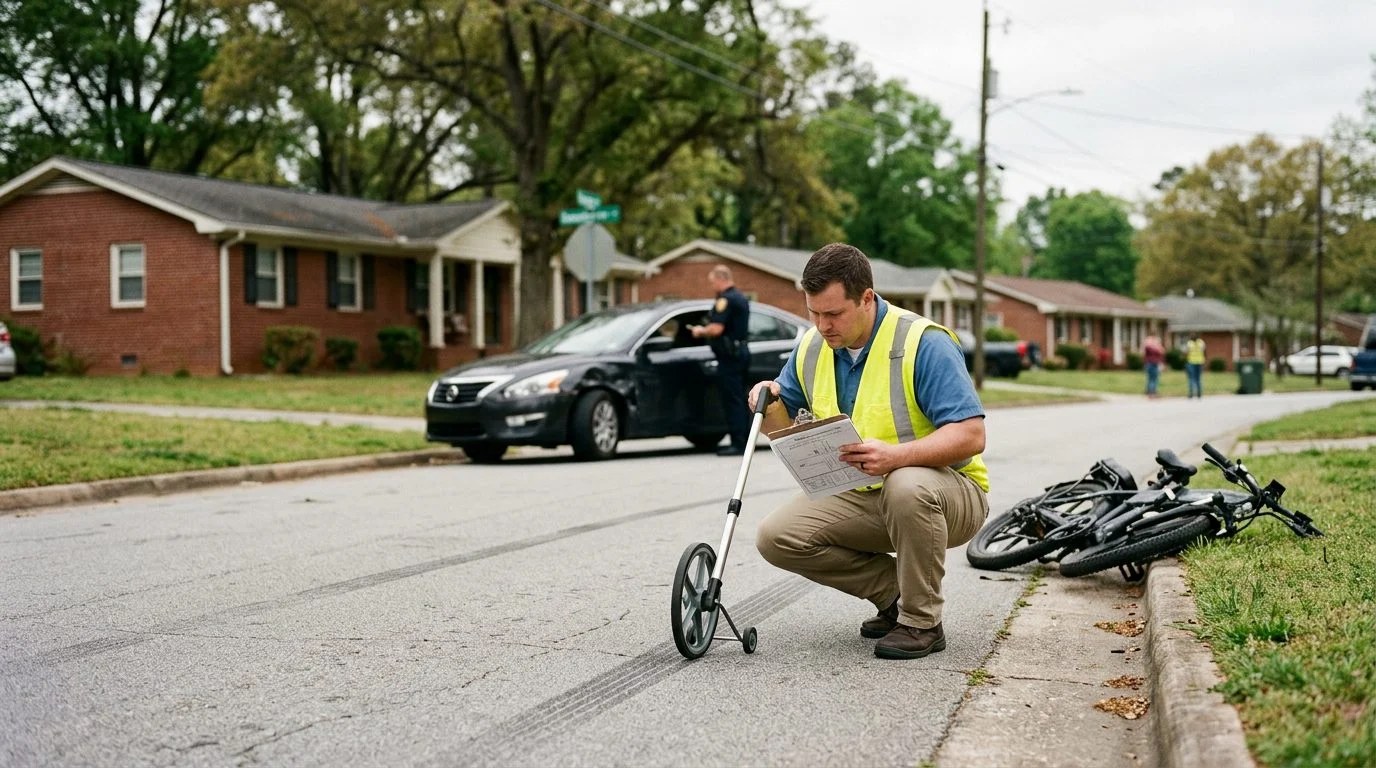
E-bike crashes in Georgia
Hurt on an e-bike? Your car insurance may be part of the answer.
The firm reads the policies, the crash report and the evidence, so you can see which coverage may apply to your injuries.
Serving Georgians since 1999
Since 1999
Representing people hurt in Georgia
5 offices
Jonesboro, Atlanta, Decatur, Macon and Augusta
By Terance Madden · Published November 14, 2026
Your bike took the hit, your body is sore, and the bills are already coming in. Does car insurance cover an e-bike crash in Georgia? It can, but which policy pays depends on who caused the crash and what the policy wording says.
Three Policies That Can Respond to Your Crash
Three kinds of coverage can respond to an e-bike crash: the at-fault driver’s liability coverage, your own uninsured motorist coverage, and your own medical payments coverage. Each one follows different rules, so check all three.
Start with the at-fault driver. If that driver’s carelessness caused your injuries, their liability coverage is the first place to look. Then check your own policy, because it may fill gaps the driver’s policy leaves.
If you were hurt in an e-bike crash, you may have a claim, and you don't have to sort out the policies alone. Call T. Madden & Associates, P.C. for a free, confidential consultation with no obligation to continue. Talk it through with our team — the first consultation is free, confidential, and carries no obligation.
Which Coverage Can Pay for Your Injuries
Liability coverage pays for harm the driver legally caused, up to the policy’s limits. Limits are the most the insurer will pay under that policy.
- Liability coverage (the at-fault driver’s policy): Pays for injuries that driver caused, up to that policy’s limits.
- Uninsured motorist (UM) coverage on your policy: Can pay when the at-fault driver has no insurance, or when the at-fault driver’s liability insurer has legally denied coverage under its policy.
- Underinsured motorist (UIM) coverage: Can pay when the at-fault driver’s limits are too low to cover your losses. Check whether your policy includes it.
- Medical payments (med-pay): Pays medical bills under your own policy. It is often not tied to who was at fault, but its limits and terms control.
- Household policies: Under Georgia’s uninsured motorist statute, a resident spouse or relative of the named insured is an insured, and the policy’s definition must be read with that rule.
The same statute caps the total. Your combined recovery from UM coverage and the at-fault driver’s liability coverage cannot exceed all your economic and noneconomic losses. Policy definitions and exclusions can narrow what pays. Don’t treat a denial or a low limit as the final word. We read the wording with you, line by line.
How Georgia Law Treats Fault in an E-Bike Crash
Georgia cuts your recovery by your share of fault. At 50 percent or more, you recover nothing (O.C.G.A. § 51-12-33; Quynn v. Hulsey (2020)).
Georgia uses comparative fault (shared fault). Under O.C.G.A. § 51-12-33, the judge reduces your damages in proportion to your percentage of fault. If you are 50 percent or more responsible, you get no damages.
Fault is also split among everyone who contributed. Damages are apportioned (divided) among the liable people. They are not joint liability, so each person pays only the share assigned to them. The jury considers the fault of everyone who contributed, even people who were never sued.
Most bike cases turn on ordinary care. Negligence means failing to use the care an ordinarily prudent person would use in the same circumstances, under O.C.G.A. § 51-1-2. Both the rider and the driver are measured by that standard.
Where Big Insurance Pushes Back on E-Bike Claims
Big Insurance is not on your side, and its first offer is rarely what your claim is worth. Expect these tactics:
- A call soon after the crash asking for a recorded statement (an audio record of your answers) before anyone knows the full medical picture.
- A quick, low offer made before treatment ends.
- Delays in paying or in answering your letters.
- Claims that your treatment was unnecessary or lasted too long.
- A “low impact” argument that says a bike rider could not have been hurt much.
Our response is to pursue every layer: liability, UM and UIM, med-pay, umbrella or excess policies (extra coverage above a base policy), and any corporate or other responsible party’s coverage. We also value the claim over the full time the injury lasts. General damages are recoverable without proof of an amount, while special damages must be proved, under O.C.G.A. § 51-12-2. The jury may reduce future economic losses, such as future medical bills and lost wages, to present value under O.C.G.A. § 51-12-13. We prepare every case as if it may go to trial.
What to Do in the First Days After the Crash
Protect your health and your proof. Both matter to the claim.
- Get medical care and keep every record, including follow-up visits and prescriptions.
- Report the crash to police. If it caused injury or death to any person, or property damage to an apparent extent of $500 or more, the driver must immediately notify the local police department (or, outside a municipality, the county sheriff or the nearest state patrol office), under O.C.G.A. § 40-6-273.
- Tell your own insurer about the crash, and ask what coverage it is opening for you.
- Keep the bike, battery, charger and damaged parts. Don’t repair or discard them before someone inspects them.
- Write down the route, the time, the weather and any witness names while your memory is fresh.
Georgia generally gives two years after the right of action accrues to file an injury lawsuit (loss of consortium claims have four years), under O.C.G.A. § 9-3-33. Don’t let that time run while you wait on offers. Our guide on reporting a crash without a police report covers what to do when no officer comes.
For the Person Managing the Recovery
The person who keeps the calls, bills and appointments organized is often a spouse, mother or adult daughter. That job needs a system.
- Bills, explanation-of-benefits forms and every collection notice.
- Insurance letters, with the date received and any deadline in them.
- Mileage and receipts for trips to appointments.
- Pay stubs and a log of missed work.
- The name, date and summary of every call from an insurer.
Some providers offer treatment under a letter of protection (a promise to be paid from any settlement). Georgia makes those arrangements relevant evidence in a claim, under O.C.G.A. § 51-12-1.1. Ask about one before you sign anything.
You don’t have to take the insurer calls alone. We can handle those calls and paperwork so your family can focus on recovery.
Not sure what your next step is?
Talk it through with our team — the first consultation is free, confidential, and carries no obligation.
How T. Madden & Associates, P.C. Approaches These Cases
T. Madden & Associates, P.C. has practiced since 1999, with offices in Jonesboro, Atlanta, Decatur, Macon and Augusta.
Terance Madden, the responsible lawyer for this page, leads T. Madden & Associates, P.C., a firm in practice since 1999. Before law school, he trained as an electrical engineer, so he starts by asking what the evidence shows and how the crash happened. On an e-bike, that means checking the brakes, battery and motor, because a part’s maker or a repair shop may share fault and carry its own insurance. Those records must be preserved before the bike is repaired or lost.
We explain each step in plain English. We don’t leave you guessing about the next letter, and we treat you and your family with dignity and respect. Our fees are no-fee-unless-we-win, but you may still be responsible for court costs and case expenses. The Terance Madden Foundation also supports community work in the areas we serve.
Frequently Asked Questions
Does my own car insurance pay if an uninsured driver hits me on my e-bike?
It may, through uninsured motorist coverage on your own policy. Georgia law requires auto policies to include that coverage unless a named insured rejects it in writing.
Does med-pay pay if I was partly at fault?
Med-pay is often not tied to fault. Your policy’s limits and terms decide what it pays.
What happens if I am partly at fault?
Georgia reduces your damages by your share of fault. At 50 percent or more, you cannot recover damages (O.C.G.A. § 51-12-33; Quynn v. Hulsey (2020)).
How long do I have to file a lawsuit?
Georgia generally allows two years from the crash to file an injury lawsuit (O.C.G.A. § 9-3-33; Kenneth B. Cameron v. Jmp Pizza, Inc (2026)). Don’t wait to find out whether your claim fits that rule.
Do I have to give a recorded statement to the other driver’s insurer?
No. Talk with us before you give any recorded statement.
Is talking with the firm about my crash free?
Yes. Your first consultation is free, confidential and without obligation to continue.

Talk With the Firm About Your Crash and Your Coverage
If you’re reading this for someone you love, you’re carrying a lot right now. A crash they didn’t choose has left them hurt, bills are arriving, and you’re trying to figure out which policy should pay. You don’t need every answer today. Call T. Madden & Associates, P.C. for a free, confidential consultation, or start a free case evaluation. Our phone line is available 24/7.