

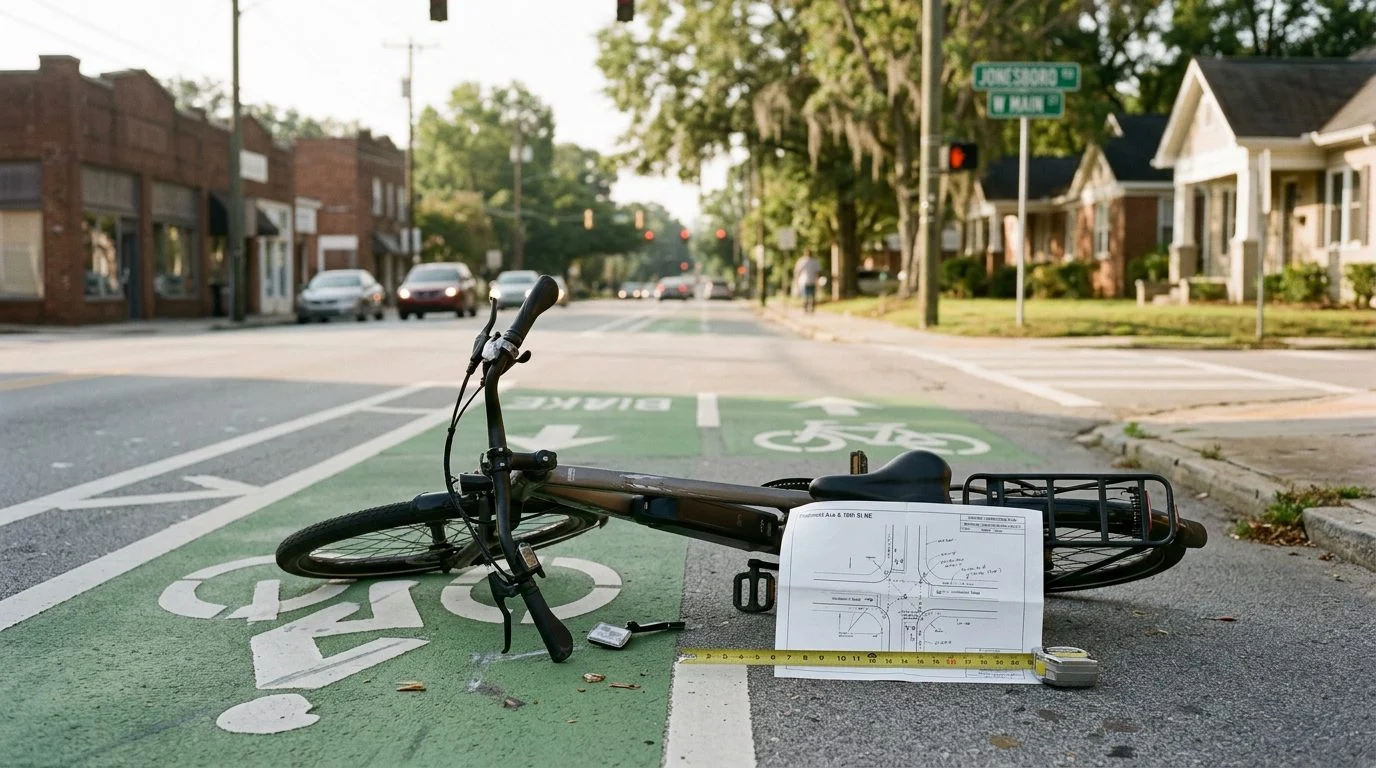
E-Bike Crashes | Clayton County, Atlanta, Decatur, Macon and Augusta
Hurt on an E-Bike Without Health Insurance? Find Out Who Pays.
Medical bills can stack up fast when there is no health plan to fall back on. Here is how an injured rider can still move forward.
Why Riders and Families Call the Firm
1999
Representing Georgians since
5
Offices in Georgia, including Jonesboro and Atlanta
By Terance Madden · Published November 23, 2026
An e-bike crash in Georgia with no health insurance can leave you with hospital bills and no plan to pay them. That is a hard spot, and often a family member ends up holding the paperwork.
The short answer: the bills do not have to come out of your pocket first. Payment can come from the at-fault party’s liability insurance (coverage that pays when a person or company is legally responsible for harm), from coverage on your own auto policy, and from the injury claim itself.
Who Pays the Bills When You Have No Health Insurance?
Several sources can pay, and the facts of the crash decide which ones apply. T. Madden & Associates, P.C. is a Georgia personal injury firm in practice since 1999, with offices in Jonesboro, Atlanta, Decatur, Macon, and Augusta. Terance Madden is the responsible lawyer for this page.
Start with these sources:
- The at-fault party’s liability insurance. If someone else caused the crash, that person’s policy may pay for your injuries.
- Your own uninsured motorist coverage. Georgia law requires auto liability policies to promise payment for bodily injury caused by an uninsured motor vehicle’s owner or operator. A policyholder can reject this coverage in writing or choose lower limits, so check your own policy. You choose the limits.
- Other liable parties. A property owner, a repair shop, or a parts maker may share fault. Each one can bring another insurance layer into the claim.
- The injury claim itself. Money recovered from the at-fault party can cover bills you never sent to a health plan.
Some auto policies also carry medical payments coverage, which can pay medical bills after a crash. If you are on Medicare, it may have made conditional payments. Those must be repaid from a settlement.
Hurt in an e-bike crash with no health plan to cover the bills? Our team can review your options with you in a free consultation, any hour of the day. Talk it through with our team — the first consultation is free, confidential, and carries no obligation.
What Georgia Lets You Claim Beyond the Medical Bills
Georgia law lets you claim the bills you can prove and the losses that never came with a bill. Damages are the money a court or insurer awards to make an injured person whole.
- Medical costs. Georgia treats necessary expenses from an injury as a legitimate part of the claim.
- Reasonable value. Medical charges are limited to the reasonable value of medically necessary care. Missing insurance payments do not erase the bills. The jury still weighs what the care was worth.
- Proof. Special damages, the losses that actually flow from the crash, must be proved. General damages, the harm the law presumes from a wrong, can be recovered without proof of an exact amount.
- Future losses. A jury may reduce future medical costs and lost wages to present value, using a 5 percent rate or another rate it deems appropriate.
- Shared fault. Georgia reduces your recovery by your share of fault. If you are 50 percent or more responsible, you recover nothing (O.C.G.A. § 51-12-33; Quynn v. Hulsey (2020)). How the crash happened, the speed, and the lane position often decide that split.
- Time limit. Georgia generally requires a personal injury lawsuit within two years.
Serious injuries can affect work and daily life for years. Lifetime costs belong in the claim from the start.
How Big Insurance Responds to an Injured Rider Without Health Coverage
Big Insurance is not on your side. A first offer is rarely what your claim is worth.
Expect these tactics:
- Low early offers made before anyone knows the full extent of the injury.
- Requests for a recorded statement. Casual phrases get pulled out and used later.
- Delays in paying or deciding anything.
- Disputes over treatment. Big Insurance may argue a test or visit was unneeded or not caused by the crash.
- “Low impact” arguments. The claim is that a crash looked minor, so the injuries must be minor.
The uninsured angle makes these tactics hit harder. A quick check can look like the only way to cover the next bill. That pressure is part of the strategy. A signed release can end the claim, and it can close the door on medical costs you have not seen yet.
The response is to pursue every coverage layer. That means the at-fault party’s liability, your uninsured or underinsured motorist coverage, medical payments, umbrella, excess, and corporate coverage. Our team builds the file as if the case will go to trial. Talk to a lawyer before you give a recorded statement or sign anything.
Why the Bike, Battery, and Crash Data Can Change Who Pays
The bike itself often holds the evidence that shows who is responsible.
A battery management system (the circuit that watches cell voltage, temperature, and charge) can log fault events. Controller settings control how much power the motor can draw and how fast the bike can go. Those records show what the bike was doing before the crash.
Off-brand batteries and chargers raise another question. Missing certification marks, mismatched chargers, or failed cells can point to a defective product. Georgia law treats a product seller differently from a manufacturer for strict liability, so who built, sold, or repaired the part matters.
Terance Madden trained as an electrical engineer before he went to law school, and he uses that training to ask what the evidence shows and how the crash happened. Before law school, he trained as an electrical engineer. He starts a case by asking what the evidence shows, how the crash happened, and which records must be kept. In a battery case, that means looking at the cells, the charging circuit, and where the fire or failure began.
Steps to Protect What You Are Owed and What to Expect
Get medical care first, then protect the proof.
- Get checked by a doctor and follow the treatment plan.
- Get the police report number. Note the time, place, weather, and witness contact details. Our Clayton County e-bike crash police report guide explains what to ask for.
- Keep the bike, battery, charger, and helmet. Do not repair or sell them before someone examines them.
- Keep a log of missed work, lost pay, mileage to appointments, and help you needed at home.
- Send insurance calls to the firm before you answer questions or sign anything.
Here is what to expect: a free first consultation, a review of the crash facts and your coverage, letters asking others to preserve records, medical record gathering, a settlement demand, negotiation, and a lawsuit if needed. Timelines depend on the injuries and the coverage involved.
Often one person runs the file. A spouse, mother, or adult daughter may handle the calls, bills, and appointments. The firm works with that person too, with your permission.
Frequently Asked Questions About E-Bike Crashes and No Health Insurance
Can I still make a claim without health insurance?
Yes. A claim rests on your bills, records, and losses, not on a health plan.
What if the driver left the scene?
Georgia requires a driver in a crash with injury to stop, give their name and registration number, and help the injured person. Your own uninsured motorist coverage may still apply.
Can I pursue a battery maker?
Possibly. The claim may reach the maker, seller, or repair shop, depending on the facts.
Does having no health insurance hurt my claim?
Not by itself. The claim turns on proof of care, its reasonable value, and how the injuries affect your life.
What does it cost to talk to the firm?
The first consultation is free, confidential, and carries no obligation to continue.
If you were hurt on an e-bike and bills are stacking up with no health plan behind them, you don’t have to sort this out alone. Contact T. Madden & Associates, P.C. for a free consultation or to start a free case evaluation, available 24/7.