

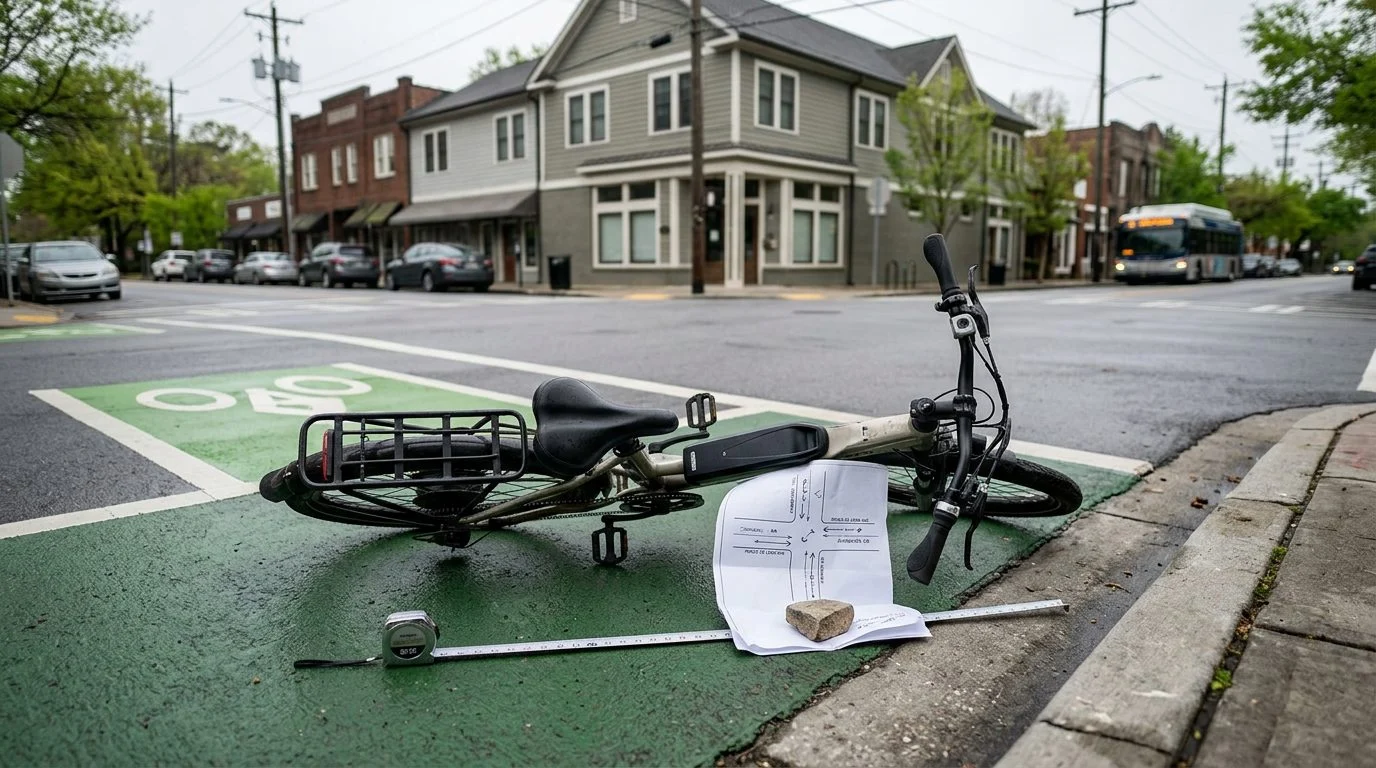
E-bike crashes | Jonesboro, Atlanta, Decatur, Macon and Augusta
Hit From Behind on Your E-Bike? Get a Free Case Evaluation.
A rear-end impact can leave you with serious injuries and a bike you can't use. Here is how Georgia law looks at who may be responsible, and how our team can help you sort it out.
T. Madden & Associates, P.C.
Since 1999
Representing injured Georgians
5 offices
Jonesboro, Atlanta, Decatur, Macon and Augusta
24/7
Call us anytime
By Terance Madden · Published November 22, 2026
Your loved one was riding an e-bike when a driver hit them from behind. Now you’re handling medical bills, insurance calls and questions nobody warned you about.
In most rear-end e-bike crashes, the driver who hit the rider is where fault starts. Your job is to prove what that driver did, then find every other party who may owe money.
Who Is Usually Liable When a Driver Hits an E-Bike From Behind?
The driver who struck the rider from behind is usually the first person whose choices get examined.
Georgia law looks at negligence, which is a failure of care. The law describes ordinary diligence as the care an ordinarily prudent person uses under the same or similar circumstances. Its absence is ordinary negligence (O.C.G.A. § 51-1-2). In plain words, a driver who fails to use reasonable care and causes harm may be liable for that harm.
Common driver choices in these crashes include:
- Following too closely behind the rider
- Looking at a phone or away from the road
- Driving too fast for the conditions
- Failing to see a rider in a bike lane or on the shoulder
Each of these choices is something the other side has to answer for.
Hit from behind on your e-bike and not sure who pays? Your family may have a claim, and our team can talk it through with you. Talk it through with our team — the first consultation is free, confidential, and carries no obligation.
Who Else Can Be Liable Besides the Driver?
Other parties can share fault, and each one can add another source of insurance.
If the driver was working, the employer may answer too. Georgia law makes a person liable for torts a servant, wife, or child commits by his command or in the prosecution and within the scope of his business (O.C.G.A. § 51-2-2).
Claims for negligent hiring, training, supervision, and retention are based on the alleged negligent acts of the employer (Quynn v. Hulsey). Those claims rest on the alleged negligent acts of the employer in hiring, training, supervision, and retention (Quynn v. Hulsey). The Georgia Supreme Court addressed these claims in Quynn v. Hulsey. An employer must also use ordinary care not to hire or keep an employee it knew or should have known posed a risk of harm to others (Munroe v. Universal Health Services).
A defective product can also cause or worsen a crash. Georgia law makes a manufacturer of new personal property liable in tort, even without privity (a direct contract between buyer and maker), to any natural person who may use, consume, or reasonably be affected by the property, when the product was not merchantable and reasonably suited to its intended use and that condition caused the injury (O.C.G.A. § 51-1-11). Those claims must be filed within ten years of the product’s first sale. Under O.C.G.A. § 51-1-11(c), the ten-year limit that runs from the first sale of a product also applies to negligence claims against a manufacturer. The limit does not apply to claims for injuries from a manufacturer’s negligence in making products that cause a disease or birth defect, or to claims based on conduct that shows a willful, reckless, or wanton disregard for life or property.
Repair shops and maintenance vendors can share fault too, especially if their work on brakes or tires played a part in the crash.
How Georgia’s Fault Rules Affect Your Claim
Georgia cuts a claim by the injured person’s share of fault, and it bars recovery at 50 percent or more (O.C.G.A. § 51-12-33; Quynn v. Hulsey (2020)).
This is called comparative fault (shared fault). The judge reduces damages in proportion to the injured person’s percentage of fault. An injured plaintiff who is found 50 percent or more responsible cannot receive any damages (O.C.G.A. § 51-12-33).
Each liable party pays only its own share.
In Quynn v. Hulsey, the jury put 50 percent of the fault on the truck driver and employer, and 50 percent on the pedestrian. The estate recovered nothing (Quynn v. Hulsey).
Expect the other side to argue the rider was in the road, moved too fast or had weak lights. Those points get tested against the evidence. They should not be accepted just because someone says them.
Georgia’s deadline for most injury claims is two years after the right of action accrues (O.C.G.A. § 9-3-33). Don’t wait on that clock.
What the Evidence Shows, and How an Engineer Reads It
The physical evidence shows where each person was, how fast each was moving, and whether anyone braked or swerved.
Before law school, Terance Madden earned a B.S. in Electrical Engineering. He starts a case by asking what the evidence shows, how the crash happened and which records exist and must be saved. In an e-bike case, that includes the controller, battery and charger, if those parts survived.
Key evidence in these cases includes:
- Damage patterns on the car, frame, wheels and brakes
- Skid marks, braking and any swerve
- Where the rider and vehicle came to rest, and each one’s speed
- Controller, battery and charger data, if the parts survived
- Dash camera and nearby business video
- Scene photos taken soon after the crash
- Witness names and statements
- Medical records that tie injuries to the crash
Video and vehicle data can be lost if no one asks for it early. Battery cells, charging circuits and certification marks can also show whether a part failed.
How Big Insurance Responds to a Rear-End E-Bike Claim
Big Insurance is not on the injured rider’s side, and a first offer is rarely what the claim is worth.
Expect a few familiar tactics:
- An early request for a recorded statement, before the injuries are fully known
- A low first offer made before the medical picture is complete
- “Low impact” arguments that the crash could not have caused real harm
- Disputes over treatment and bills
- Long delays can wear a family down while they wait for answers
Georgia treats general damages as presumed from the wrong, so they need no proof of amount. Special damages must be proved (O.C.G.A. § 51-12-2). In civil actions to recover damages for injury or death to a person, special damages for medical expenses are limited to the reasonable value of medically necessary care (O.C.G.A. § 51-12-1.1). Future care and lost earning ability can be part of a claim when the injury supports them.
If your loved one has Medicare, a stalled insurance payment changes who pays first. Medicare may make a conditional payment, which must be repaid from a settlement or judgment (CMS Medicare Secondary Payer). Providers may bill Medicare when an insurer does not pay promptly, usually within 120 days (Medicare.gov).
Common Questions About E-Bike Hit-From-Behind Claims
Will the driver’s insurance pay my bills right away?
Often not. Insurers may dispute bills or ask questions first, so plan for a longer timeline.
Can I still recover if I was partly at fault?
Yes, if your share of fault is under 50 percent. Georgia reduces damages by your share and bars recovery at 50 percent or more (O.C.G.A. § 51-12-33).
What if the driver was working when the crash happened?
The employer may share liability under Georgia’s servant-liability statute, and it may carry its own coverage.
Is the free consultation really free?
Yes. The first consultation is free, confidential and carries no obligation to continue. La consulta inicial es gratuita, confidencial y sin compromiso de continuar.
Not sure what your next step is?
Talk it through with our team — the first consultation is free, confidential, and carries no obligation.
What to Do Next After a Rear-End E-Bike Crash
Start with medical care, then write down what happened while you still remember it.
- Get medical care and keep every record and bill.
- Photograph the scene, the e-bike, its battery and charger, and the damage.
- Write down the driver’s details, the car’s plate and any witness names.
- Ask before repairing, selling or discarding the bike or any replaced part.
- Note the time, place and weather while the details are fresh.
If you’re managing the recovery, keep a simple log of medical visits, missed work and out-of-pocket costs. Those numbers show what the crash has cost your family.
Be careful before you give a recorded statement or sign any release. Talk with us first.
T. Madden & Associates, P.C. has practiced since 1999, with offices in Jonesboro (Clayton County), Atlanta, Decatur, Macon and Augusta.
If you’re weighing a hard decision after someone you love was hit from behind, you don’t have to sort out fault alone. Start a free case evaluation, or call our team 24/7.