

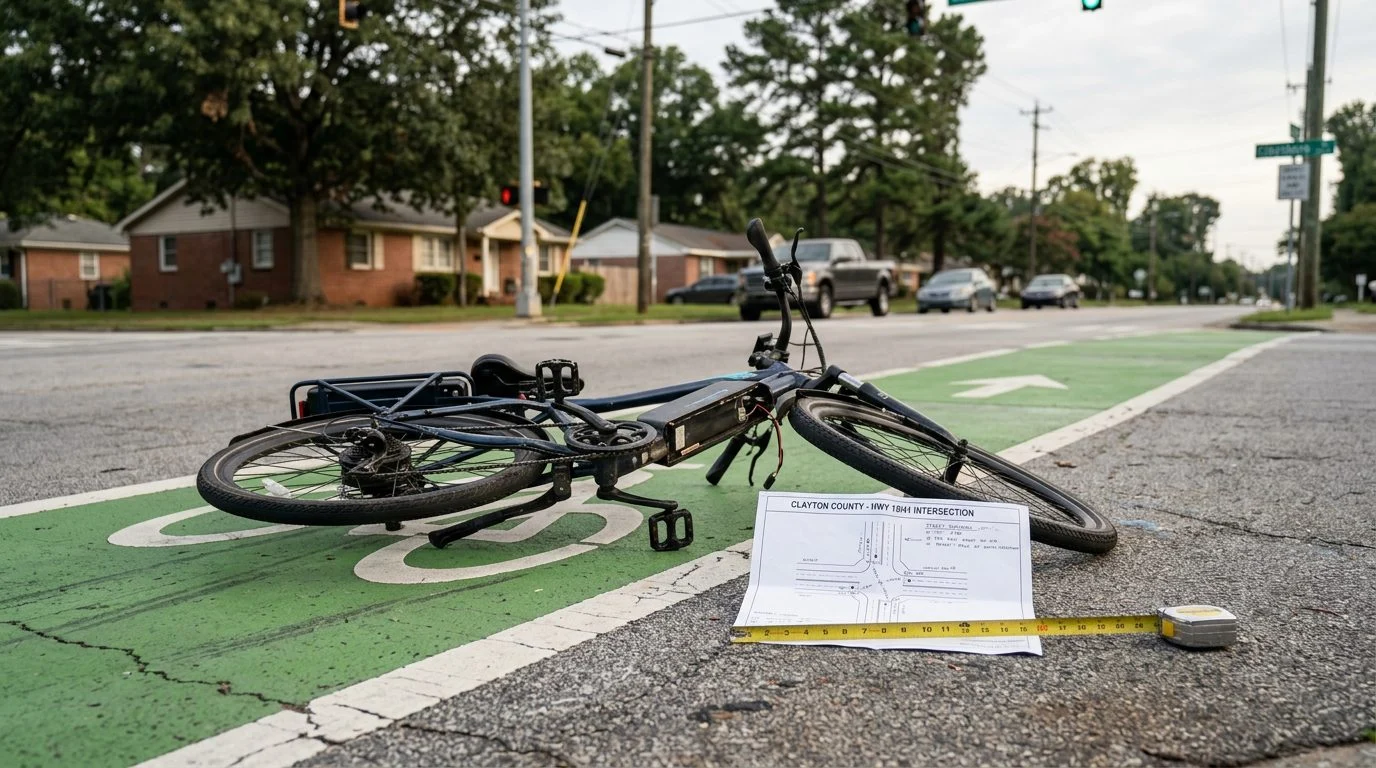
E-Bike Crash Lawyer | Clayton County, Georgia
Hurt on Your E-Bike by a Pothole or Broken Pavement? Talk to Our Clayton County Team.
T. Madden & Associates, P.C. has represented injured Georgians since 1999, and we start by asking what went wrong on the road.
The firm at a glance
1999
Representing injured Georgians since
5
Georgia offices, including Jonesboro in Clayton County
Free
First consultation, confidential and without obligation
By Terance Madden · Published November 12, 2026
Hurt on an e-bike when a pothole or failed drain threw you off? You may have a claim against the government that owns that road, and its notice rules are tighter than most people expect.
Many of these claims don’t start with the rider. They start with a spouse, parent or adult daughter who is now handling the bills, the appointments and the paperwork.
Can You Sue Over a Road Defect That Hurt You on an E-Bike?
Yes, you may have a claim against the entity that owns and maintains the road, but it follows different rules than a claim against a driver. Before any lawsuit, a government defendant usually must receive written notice first. That notice can be due far sooner than the two-year window most people have heard about.
Georgia’s general deadline for personal injury suits is two years after the right of action accrues, under O.C.G.A. § 9-3-33. That is the general rule. Claims against counties, cities and the State run on separate notice rules, and those are the ones that catch families off guard.
If you’re the one managing this, put the deadline on your calendar now. Keep the bike, the helmet, the photos and every medical record. Those items are the start of the claim, and they’re easy to lose in the weeks after a crash.
Hurt on an e-bike when the road gave way under you? You may have a claim, and the firm can review your notice timeline with you before it runs out. Talk it through with our team — the first consultation is free, confidential, and carries no obligation.

What Counts as a Road Defect in Clayton County?
A road defect is a condition in the road, shoulder or right-of-way that made the ride unsafe. Common examples include potholes, broken pavement edges, washed-out shoulders, failed storm drains and loose debris. Missing, hidden or blocked warning signs count too, along with poor lighting and faded lane markings.
E-bike riders feel these hazards differently. A narrow tire has less room to clear a rut. A battery-assisted bike often carries more speed than a standard bicycle, so a small drop can become a hard fall. Less margin for error means a small defect can cause a serious crash.
Proof usually starts at the scene. Photos taken soon after the crash show the hazard’s depth, width and position. Measurements, weather records, maintenance history and earlier complaints show how long the condition existed.
Terance Madden trained as an electrical engineer before he went to law school, and he holds a B.S. in Electrical Engineering. He reads a road claim the way he reads any technical problem. What did the surface, drainage and signage actually measure? How would a rider’s speed and tire contact have met that condition? He works to preserve the records that answer those questions before they disappear.
Who Owns the Road Decides Where the Claim Goes
The owner of the road sets the rules for your claim. Most roads belong to Clayton County, to a city such as Jonesboro, or to the State of Georgia on a state route. Each owner has its own notice procedure, its own place to file and its own defenses.
Identifying the owner is one of the first steps. The firm checks who has jurisdiction and who maintains the road early in the review. A wrong guess costs time, and time matters here. This check matters most near a city line or on a road that changes hands.
The firm’s Jonesboro office serves Clayton County, and the firm also has offices in Atlanta, Decatur, Macon and Augusta. Your road owner, not your office location, decides which notice rule applies.
The Notice Deadline Comes Before the Lawsuit
For a county, the claim must be presented within 12 months after it accrues or becomes payable, or it is barred, under O.C.G.A. § 36-11-1. Minors and other persons under disabilities get 12 months after the disability is removed. For a city, a written claim goes to the governing authority (the city council or commission) within six months of the event, under O.C.G.A. § 36-33-5. It must be served on the mayor or the chairperson of the city council or city commission, personally or by certified mail or statutory overnight delivery. That notice must state the time, place and extent of the injury and the negligence that caused it. For the State, written notice is due within 12 months of when the loss was discovered or should have been discovered, under O.C.G.A. § 50-21-26.
City notice has one more step. The claim must include the specific amount of monetary damages being sought. The law says that amount is an offer of compromise and is not binding on you if the claim is litigated.
Don’t wait on this. A missed notice can end a claim that would otherwise have real value, even when the injuries are serious.
How Fault Is Split When the Rider Is Partly to Blame
A rider who shares some fault can still recover. Under O.C.G.A. § 51-12-33, damages are reduced in proportion to the plaintiff’s percentage of fault. A plaintiff who is 50 percent or more responsible for the injury is not entitled to any damages.
The fact-finder (the jury, or the judge when there is no jury) assigns a percentage to every party who contributed to the harm. Each liable party pays its own share.
This is where an engineer’s training helps. The question is the crash sequence: the rider’s line, speed and braking, and whether the defect was visible or hidden. Terance Madden looks at the physical evidence to answer those questions, and the focus stays on the injured rider’s side of the story.
What the Government Will Argue, and How the Claim Answers It
Government defendants often raise the same points. They may say the notice came too late. They may say the entity never knew about the defect, or that any rider would have seen the hazard.
Each point gets a direct answer. The firm checks the timeline of when the defect appeared. It pulls maintenance and complaint records and proof of how long the condition existed. Photos, measurements and an early, complete notice filing carry the response.
The firm prepares every claim as if a judge or jury will hear it. That means gathering the records a court would expect to see, from the start. The firm answers each argument with evidence, and it does not predict how any argument will come out.
Not sure what your next step is?
Talk it through with our team — the first consultation is free, confidential, and carries no obligation.
What the Claim Can Cover and Who Carries the Load
Every injury case is different, so the losses a client may be able to pursue depend on the facts of that case. Some losses, such as medical bills, must be proved. Medical expenses are limited to the reasonable value of care that was medically necessary, under O.C.G.A. § 51-12-1.1.
Medical expenses are limited to the reasonable value of medically necessary care, treatment, or services; the State’s dollar limits are set separately, under dollar limits. Except as provided in paragraph (2), no person may recover more than $1 million because of loss arising from a single occurrence, regardless of the number of state government entities involved, and the State’s aggregate liability per occurrence may not exceed $3 million, under O.C.G.A. § 50-21-29.
The person managing the recovery carries a heavy load. Keep one folder for appointments, bills, letters and deadlines. Write down the date and name of every call. Save the bike as it is until photos are done, and keep copies of any written notice sent to the road owner. The Terance Madden Foundation supports community causes, but this page’s focus is your claim.
Talk to the Firm Before the Notice Clock Runs Out
You may be reading this for someone you love, in a situation nobody chose. You may not be ready to decide anything yet, and that’s fair. A short review of the road, its owner and the notice timeline can show whether a government claim fits the facts.
The first consultation is free and confidential, with no obligation to continue. Reach out through the firm’s contact page. The firm has offices in Jonesboro, Atlanta, Decatur, Macon and Augusta. Terance Madden is the responsible lawyer for this page.
Frequently Asked Questions
Can I make a claim if I hit a pothole or broken pavement on my e-bike in Clayton County?
Possibly. If a road defect such as a pothole, sinkhole, or broken pavement caused your crash, the government body that maintains that road may be responsible. Every case turns on its facts, so call T. Madden & Associates, P.C. to talk through yours.
How soon do I need to act after a road defect crash in Georgia?
Call the firm as soon as you can so the notice requirements are handled in time.
Will the insurance company pay a fair amount quickly?
Don’t expect it. Big Insurance often opens with a low offer, and a first offer is rarely what a claim is worth. The firm pursues every available layer of coverage, including liability, uninsured and underinsured motorist coverage, and any umbrella policy, and prepares your case as if it will go to trial.
Why does an engineering background matter in a road defect case?
Before law school, Terance Madden trained as an electrical engineer, so he starts by asking what the evidence shows and how the crash happened. He reviews road conditions, photos, measurements, and maintenance records in plain terms to build the case.