

E-bike injuries · Georgia
Hurt on an e-bike? Know your path: settlement or lawsuit.
Here is how the firm weighs each option, what happens at every step, and who keeps your case moving.
T. Madden & Associates, P.C.
1999
Year the firm began practice
5
Georgia offices
Free
First consultation, no obligation
By Terance Madden · Published November 23, 2026
Your loved one is home from the hospital, the bike is in the garage, and the insurance calls have started. Now you need to know what comes next.
The Georgia e-bike injury case process moves in a clear order: a free first consultation, an investigation, a damages review, an insurance demand, and then either a settlement or a lawsuit filed in court.
What steps do attorneys take from first consultation through settlement or filing suit in a Georgia e-bike injury case?
Our team starts by gathering the facts of what happened and what your injuries have cost you. Liability means legal responsibility for the harm. A settlement is an agreement to end the claim for a set payment.
Each stage can move faster or slower. The injuries, the evidence and the other side’s response all set the pace. No one can promise how a case will end. Each step aims to build the strongest claim the facts support.
If an e-bike crash has changed your family's days, you don't have to work through the calls and paperwork alone. Our team is ready to talk. Talk it through with our team — the first consultation is free, confidential, and carries no obligation.
Step 1: The Free First Consultation and Intake
The first step is a conversation. The firm listens to what happened, who was involved, where the crash took place and what medical care followed. The initial consultation is free, confidential, and carries no obligation to continue.
The firm works on a no-fee-unless-we-win basis, so it is paid a fee only if it wins a recovery. You may still be responsible for court costs and case expenses, and the signed agreement spells those out.
Bring what you have: the crash report, photos, medical bills, discharge papers and any letters from insurers. A phone photo or a text from the other rider counts too. Don’t worry about having everything in order. The firm sorts it out with you.
Step 2: Preserving the Bike, the Battery and the Evidence
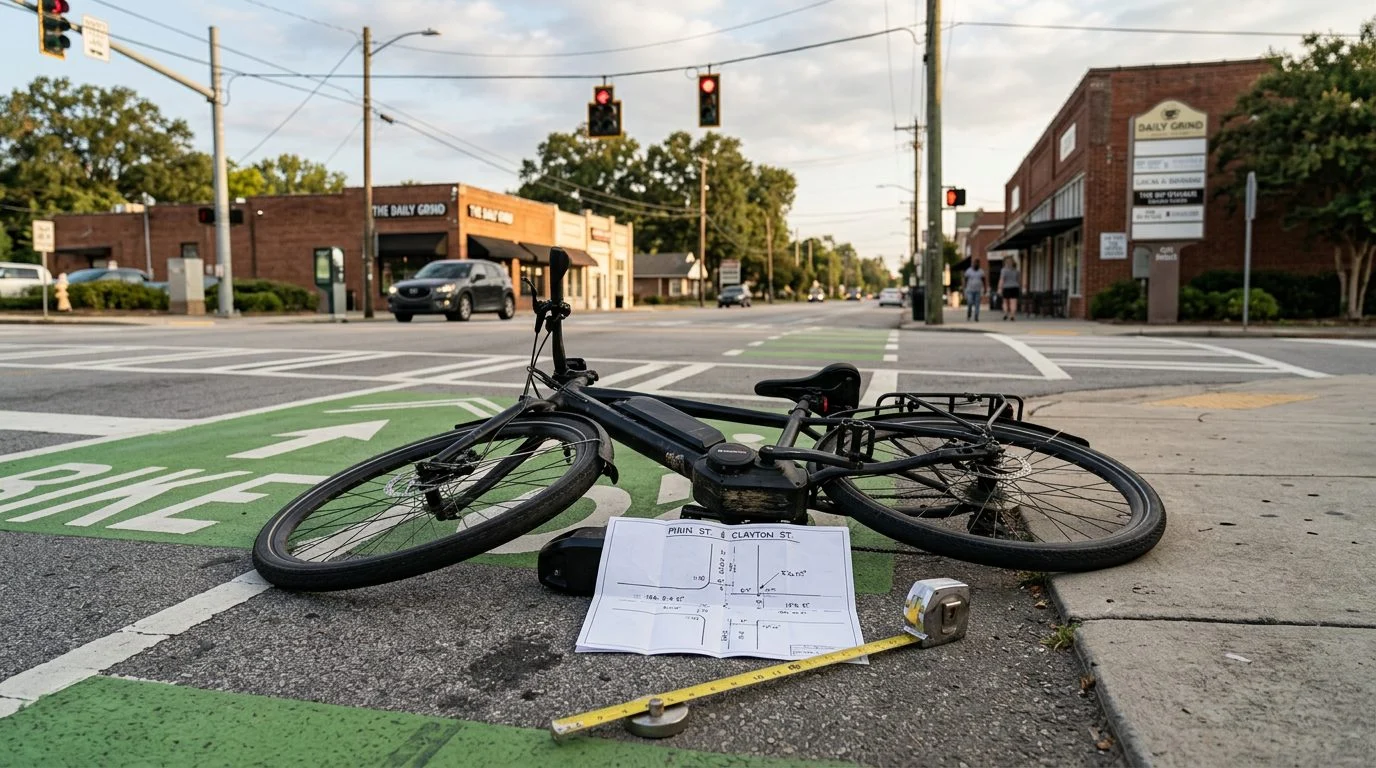
Keep the bike and its battery as they are until the firm has reviewed them. The frame, battery, controller, motor and charger can show how the bike was built, how fast it was moving and whether a defect played a part. A repair shop or a quick sale can erase that proof.
Don’t charge a damaged battery, and don’t take it apart. Other evidence fades fast too: scene photos, names of witnesses, phone video, traffic camera or business video, and anything either rider said at the scene.
Terance Madden trained as an electrical engineer before he went to law school, so he starts a case by asking what the evidence shows and how the crash happened. On a battery fire or a defective product, that means looking at the cells, the charging circuit and any certification marks, then tracing the origin and cause of the fire to find where it started. A product defect can be separated from a bad charger or rider error, and that difference can affect who is liable.
Step 3: Finding Every Party Who May Be Liable
A liable party is any person or company the law may hold responsible for the harm. The at-fault driver is one possible party. Others may include the maker, the seller, or a repair or maintenance shop.
Georgia has the jury or judge weigh the fault of everyone who contributed to the injury, even people who were never sued. O.C.G.A. § 51-12-33 What if you were partly to blame? Georgia reduces your damages by your share of fault. A rider who is 50 percent or more responsible can’t recover any damages.
A manufacturer can be liable for a product that wasn’t reasonably suited to its intended use when sold, even without a direct contract with the rider. For strict-liability claims, a product seller is not treated as a manufacturer. O.C.G.A. § 51-1-11.1 provides that, in a strict-liability product action, a product seller is not a manufacturer and is not liable as one. The ten-year limit from the first sale is found in O.C.G.A. § 51-1-11, so the bike’s age matters.
Our team also looks at whether a parts maker or a repair or maintenance shop played a part in what went wrong. If you were hurt while working, workers’ compensation may pay benefits. Georgia law still lets you sue a third party that caused the crash. O.C.G.A. § 34-9-11
Step 4: Building the Damages Picture and Caring for the Injured Person
Damages are the money the law allows for losses the crash caused. General damages are losses the law presumes come from the crash, and they need no dollar proof. Special damages, like medical bills and lost wages, must be proved. O.C.G.A. § 51-12-2 Serious injuries can carry costs for years, including future care.
If you’re the spouse, mother, daughter or caregiver handling this, you’re likely the one keeping the file. Keep a daily log of pain, appointments, missed work and help needed at home. Keep every receipt and mileage record. That log proves what the injured person lost.
Georgia limits medical expenses to the reasonable value of medically necessary care. O.C.G.A. § 51-12-1.1 makes relevant the amounts actually necessary to satisfy medical charges under any health insurance, including governmental workers’ compensation benefits, whether or not that insurance has been used. Medicare conditional payment rules Gaps in treatment give the insurer a reason to argue the injury wasn’t serious, so keep every appointment. Our team helps you track it all so nothing is left out.
Step 5: Dealing With Big Insurance
Big Insurance is not on your side. A first offer is rarely what a claim is worth. The firm knows how to pursue what is owed.
Expect a low early offer. Expect a request for a recorded statement before you know your rights. Expect slow payment, arguments that your treatment wasn’t needed, and “low impact” claims that say a bike crash couldn’t cause serious harm.
Several insurance sources may apply after a crash: the at-fault driver’s liability policy; your own uninsured and underinsured motorist coverage (UM and UIM), which applies when the driver has no insurance or too little; any umbrella or excess policy, which is extra coverage above the base limits; and corporate coverage when a maker or seller is liable.
The claim should cover the full lifetime cost of the injury, not just the first bills.
Not sure what your next step is?
Talk it through with our team — the first consultation is free, confidential, and carries no obligation.
Step 6: Settlement or Filing Suit in Georgia Court
A claim ends one of two ways: a settlement you accept, or a lawsuit filed in court when the offer falls short. Negotiations can include mediation, a session where a neutral helper works with both sides.
A lawsuit starts with a complaint, the paper that states the claim, filed in the proper Georgia court. The other side answers. Then both sides trade records and sworn testimony in discovery (the formal exchange of evidence) before any trial.
Georgia’s general deadline for injury lawsuits is two years after the claim arises. O.C.G.A. § 9-3-33 Exceptions exist, so the firm checks the timeline early. Waiting can cost rights that can’t be restored.
What to Do Next If an E-Bike Crash Has Put Your Family in This Position
If an e-bike crash has put your family in this spot, you don’t need the whole plan today. You need one good conversation. A loved one may be home with a broken hip or a head injury, and the insurance letters keep coming. You didn’t choose any of this, and you may be making every call alone.
Terance Madden is the responsible lawyer for this page. T. Madden & Associates, P.C. has been in practice since 1999, with offices in Jonesboro, Atlanta, Decatur, Macon and Augusta. Our team can walk you through the next steps. Start a free case evaluation when you’re ready.
Frequently Asked Questions
How long do I have to file an e-bike injury case in Georgia?
Georgia generally gives injured people two years from the date of the injury to file a personal injury lawsuit under O.C.G.A. § 9-3-33. Some claims involving government entities have shorter notice deadlines, so call T. Madden & Associates, P.C. early for a free, confidential consultation.
Who can be held responsible when an e-bike crash involves a defective battery?
Responsibility can reach beyond the other driver. A manufacturer, seller or distributor of a defective battery, charger or part may be liable under Georgia product liability law. Terance Madden trained as an electrical engineer, so he looks closely at the battery, charger and wiring to see what failed and why.
What happens after I contact the firm about an e-bike injury?
Your first consultation is free, confidential, and comes with no obligation to continue. From there, the firm works to preserve the bike, battery, photos, crash details and medical records while the evidence is still available.
Why do insurers make low offers after an e-bike crash, and what should I do?
Big Insurance is not on your side, and its first offer is rarely what your claim is worth. Expect tactics like recorded statements, quick low offers and “low impact” arguments. Before you talk further or sign anything, call the firm for a free, confidential first consultation, with no obligation to continue.